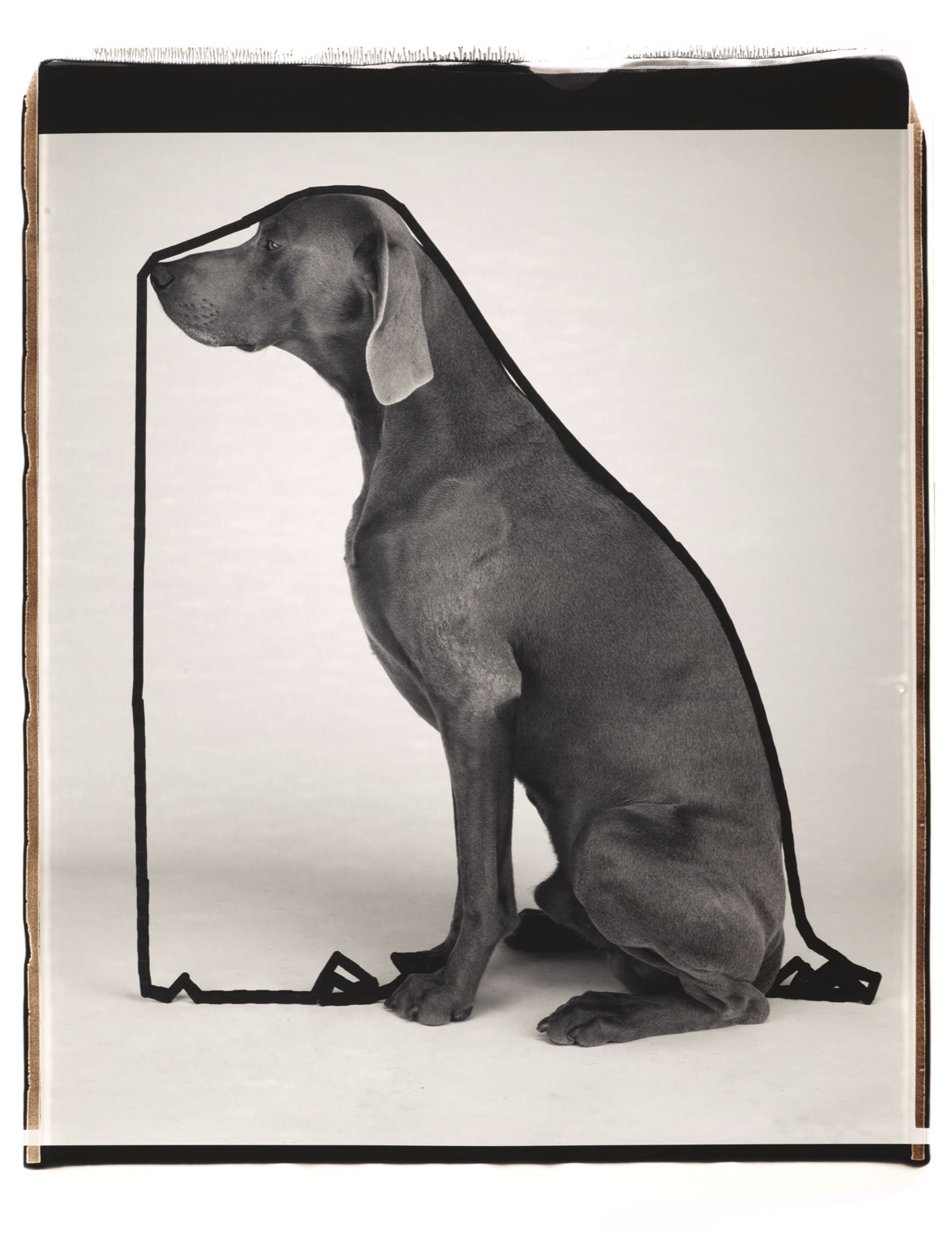
Two dogs share this picture, and only one of them is alive. A Weimaraner sits in clean profile on a pale seamless, photographed in black and white with all the tonal patience the 20 x 24 camera allows — the grain of the coat, the weight of the haunches, the wet dark of the eye. Beside and around it runs the other dog: a single thick black line, taped and drawn, that rises from the floor, arcs over the muzzle and travels down the back, sketching a second animal out of pure contour.
The joke, and the argument, is about how images work. A photograph gives us mass, tone, the light that actually fell; a drawn line gives us only edge, the mind's shorthand for a shape. Wegman sets the two systems side by side and lets them fail to coincide — the line wanders where the body does not, squares off where the dog curves, so that outline and creature drift apart like a word and the thing it names. Penny, the sitter, holds still and lets the diagram happen around her.
Unique and unrepeatable, this 2004 Polaroid turns a studio conceit into a quiet essay on description itself. It asks what a line is about — around a figure, or on the subject of one — and answers with both. The picture is at once a portrait and a demonstration, and its elegance lies in refusing to choose.
Two dogs share this picture, and only one of them is alive. A Weimaraner sits in clean profile on a pale seamless, photographed in black and white with all the tonal patience the 20 x 24 camera allows — the grain of the coat, the weight of the haunches, the wet dark of the eye. Beside and around it runs the other dog: a single thick black line, taped and drawn, that rises from the floor, arcs over the muzzle and travels down the back, sketching a second animal out of pure contour.
The joke, and the argument, is about how images work. A photograph gives us mass, tone, the light that actually fell; a drawn line gives us only edge, the mind's shorthand for a shape. Wegman sets the two systems side by side and lets them fail to coincide — the line wanders where the body does not, squares off where the dog curves, so that outline and creature drift apart like a word and the thing it names. Penny, the sitter, holds still and lets the diagram happen around her.
Unique and unrepeatable, this 2004 Polaroid turns a studio conceit into a quiet essay on description itself. It asks what a line is about — around a figure, or on the subject of one — and answers with both. The picture is at once a portrait and a demonstration, and its elegance lies in refusing to choose.