A grass verge in New York, where the road curves politely through trees: here the ambush is set. A long American sedan has been waved onto the shoulder, its chrome nose angled into the lawn like a beached liner. Beside it stand two figures in uniform — a policeman bent over his citation pad, and a nun in a pale habit and dark veil, head inclined, waiting on his verdict.
The photograph runs on the friction between two costumes of authority. Each uniform announces a jurisdiction: his over the road, hers over the soul. For a moment the hierarchy is settled in the state's favor, and the scene becomes a small inverted confession — the sister with bowed head, the officer scribbling out a secular penance, absolution priced by the mile per hour. Photography adores such reversals; it is a connoisseur of the instant when one system of order is caught trespassing inside another. The humor is real but never cruel. Winter stands back at the respectful distance of a witness and lets the geometry do the moralizing.
What lingers is how ordinary the extraordinary manages to look: the trees unbothered, the pavement empty, the great car glittering with misplaced pride. The scene is nearly a parable, except that parables end in mercy and this one ends in paperwork. An ambush, a citation, a bowed head. The law writes; grace waits its turn.
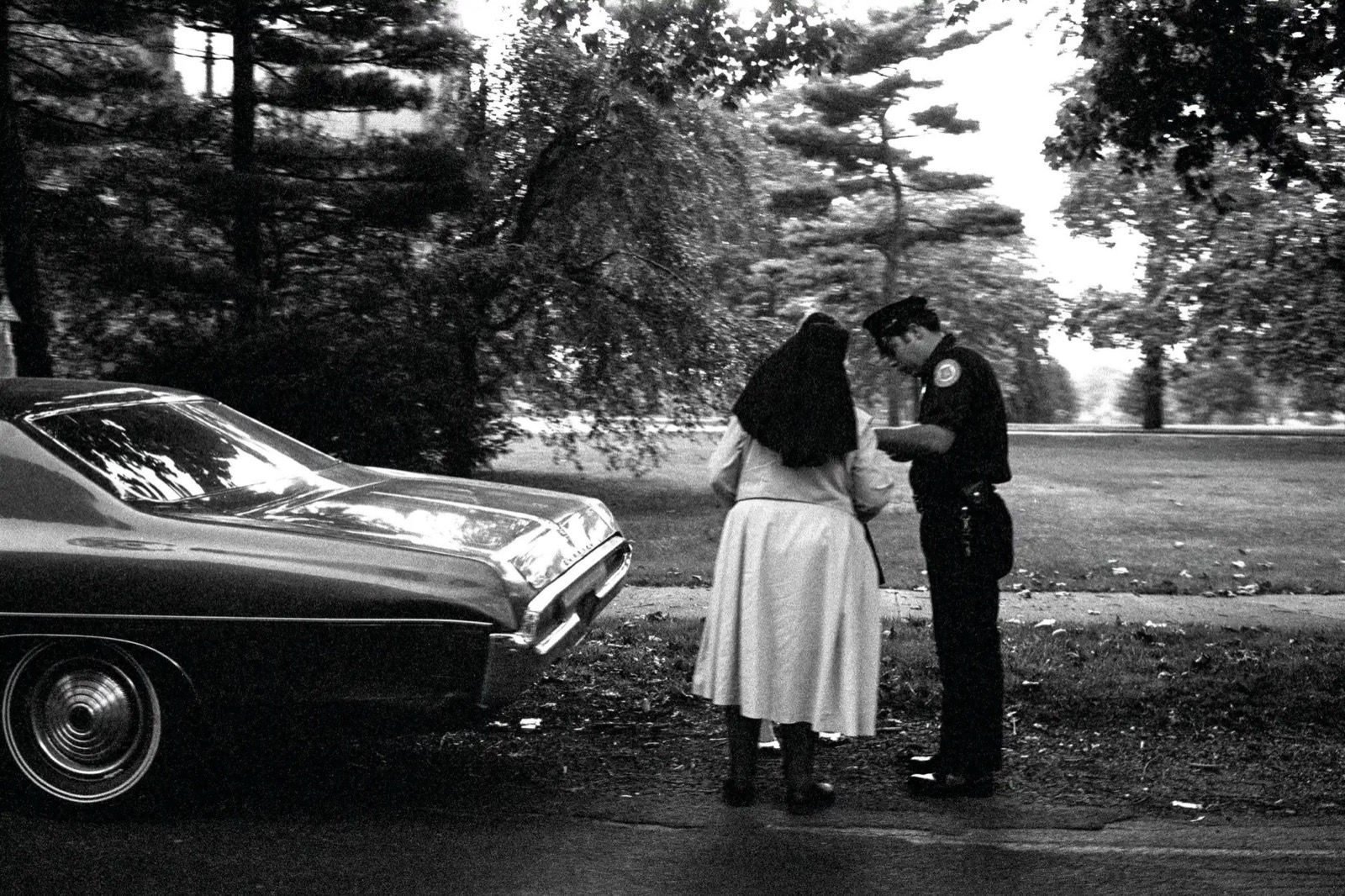

A grass verge in New York, where the road curves politely through trees: here the ambush is set. A long American sedan has been waved onto the shoulder, its chrome nose angled into the lawn like a beached liner. Beside it stand two figures in uniform — a policeman bent over his citation pad, and a nun in a pale habit and dark veil, head inclined, waiting on his verdict.
The photograph runs on the friction between two costumes of authority. Each uniform announces a jurisdiction: his over the road, hers over the soul. For a moment the hierarchy is settled in the state's favor, and the scene becomes a small inverted confession — the sister with bowed head, the officer scribbling out a secular penance, absolution priced by the mile per hour. Photography adores such reversals; it is a connoisseur of the instant when one system of order is caught trespassing inside another. The humor is real but never cruel. Winter stands back at the respectful distance of a witness and lets the geometry do the moralizing.
What lingers is how ordinary the extraordinary manages to look: the trees unbothered, the pavement empty, the great car glittering with misplaced pride. The scene is nearly a parable, except that parables end in mercy and this one ends in paperwork. An ambush, a citation, a bowed head. The law writes; grace waits its turn.