Hand-signed by the artist, with title, date, and edition number inscribed in ink on an archival label affixed to the reverse side of the mounted photograph.
The blue here is not the blue of sky but of glass: a cold, mineral wash that a windshield lends to everything it holds. On its surface, reflected conifers and bare branches knit into a scrim; behind it, a young woman turns in her seat and looks back through the weave. The photograph refuses to separate its layers. Foliage prints itself across her cheek. She is inside the car and inside the forest at once, and the glass, that supposedly neutral membrane, turns out to be the true subject.
One eye finds us and holds; the rest of the face keeps drifting in and out of the reflections, the way faces do in memory. It would be sentimental to call her trapped, and inaccurate to call her free. What the image proposes is more unsettling: that to be seen at all is to be seen through something, through weather, through family, through the thousand small mirrors a life sets up around a person. The camera does not cut through the scrim. It admires it. That admiration is the seduction, and one submits to it while distrusting it.
The photographer, British-born and long settled in Rockport, has made the coast of Maine a theater of the domestic: fog, gardens, fruit, family life given the charged clarity of fable. Her books, from The Blue Notebook to Blue Violet, have carried that sensibility into museum collections across the United States. This archival pigment print keeps the blues exact, layer over layer, without ever letting her face dissolve.
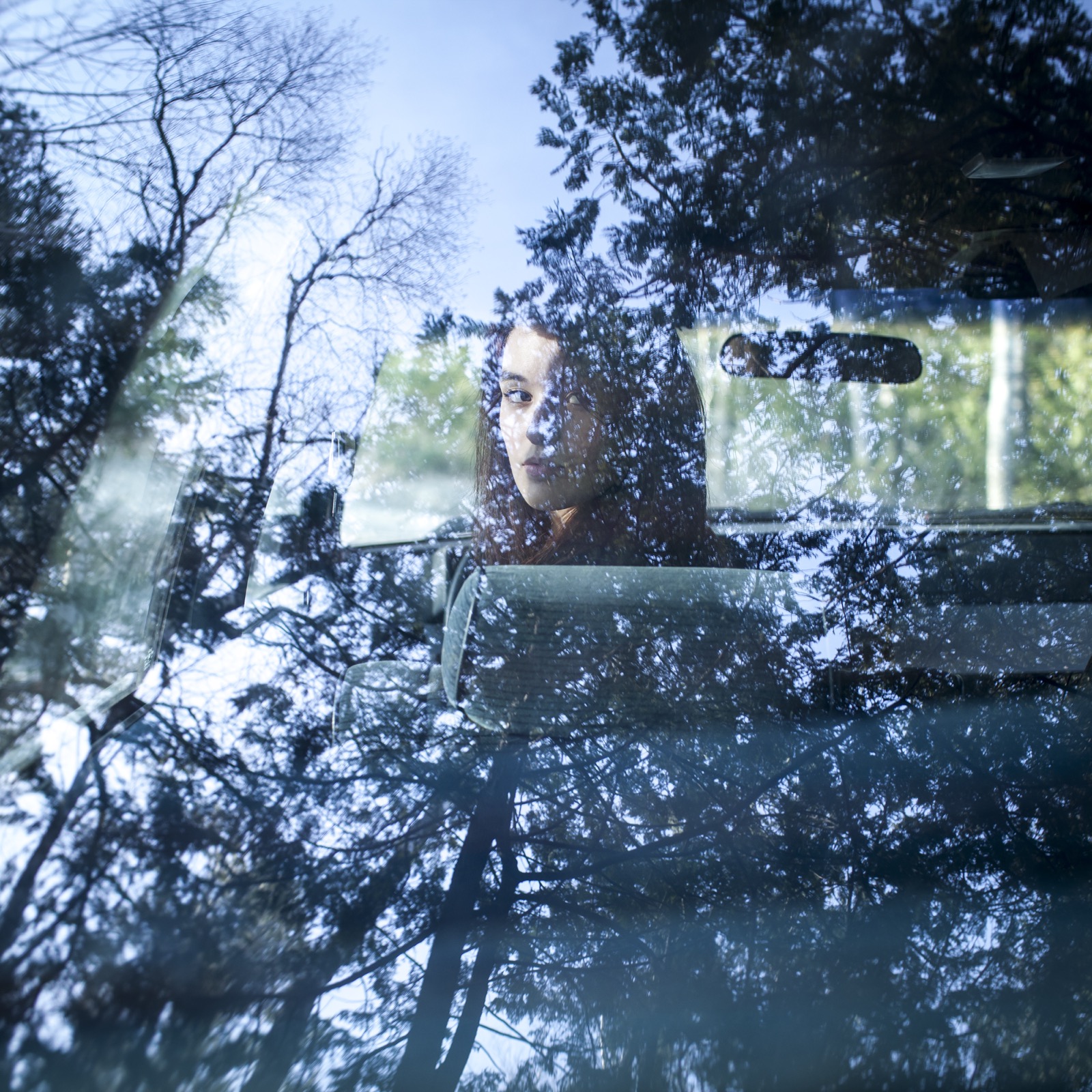

The blue here is not the blue of sky but of glass: a cold, mineral wash that a windshield lends to everything it holds. On its surface, reflected conifers and bare branches knit into a scrim; behind it, a young woman turns in her seat and looks back through the weave. The photograph refuses to separate its layers. Foliage prints itself across her cheek. She is inside the car and inside the forest at once, and the glass, that supposedly neutral membrane, turns out to be the true subject.
One eye finds us and holds; the rest of the face keeps drifting in and out of the reflections, the way faces do in memory. It would be sentimental to call her trapped, and inaccurate to call her free. What the image proposes is more unsettling: that to be seen at all is to be seen through something, through weather, through family, through the thousand small mirrors a life sets up around a person. The camera does not cut through the scrim. It admires it. That admiration is the seduction, and one submits to it while distrusting it.
The photographer, British-born and long settled in Rockport, has made the coast of Maine a theater of the domestic: fog, gardens, fruit, family life given the charged clarity of fable. Her books, from The Blue Notebook to Blue Violet, have carried that sensibility into museum collections across the United States. This archival pigment print keeps the blues exact, layer over layer, without ever letting her face dissolve.