Archival pigment print mounted on aluminium Dibond.
One Size Only / 101.6 x 127 cm / 40 x 50 in
Hand-signed by the artist, with title, date, and edition number inscribed in ink on an archival label affixed to the reverse side of the mounted photograph
There is, first, the studium — everything the eye reads with cultivated interest. A railway carriage worn to the colour of tea; orange vinyl seats; a father in a grey pinstripe suit asleep against the partition; taped to the wall, a man in sunglasses and a triumphant Ghanaian footballer in yellow, No. 10, arms raised; a chalked “92 / 93”; in the doorway a woman and a laughing man in a straw hat. A whole culture of travel and memory, legible, companionable, framed with evident tenderness.
And then there is the punctum, the detail that pierces and will not be explained away: the small striped sleeve of a sleeping child laid across the black suitcase on the father’s lap, one arm flung down in the total abandon of a sleep only the very safe can manage. That little arm is the wound of the picture. Everything else can be described; this cannot be paraphrased. It reaches out from the print and touches the viewer where description ends.
From the series “Hero, Father, Friend” (2024) — Idun-Tawiah’s fictive elegy for his own late father — the image sets its poignancy against motion. The train is between stations, between the fixed points a journey pretends to be about, and it is exactly there, in the unremarkable interval, that a father’s whole protectiveness is deposited. The photograph keeps the interval open, so that the child never has to wake and the arrival never has to come.
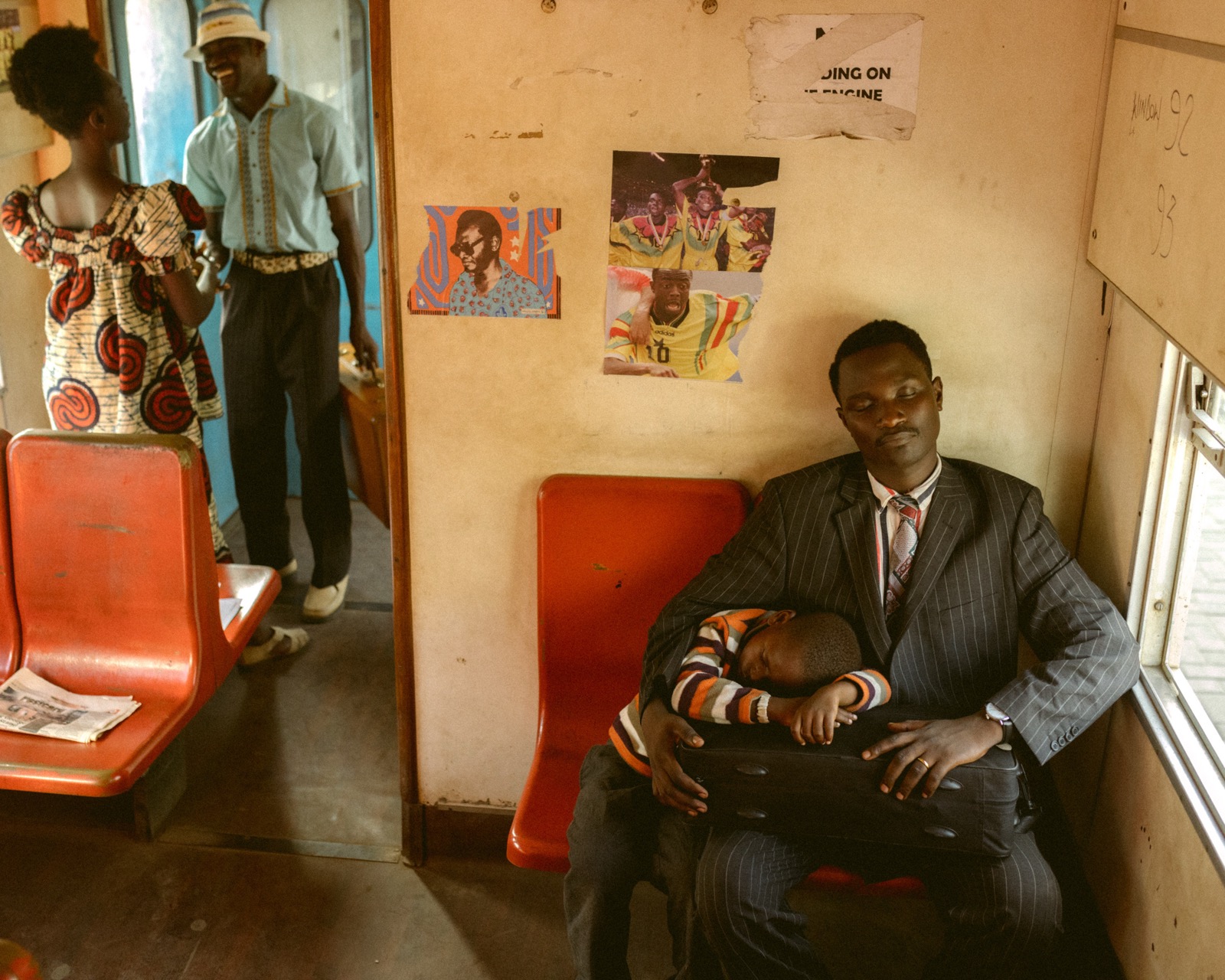
There is, first, the studium — everything the eye reads with cultivated interest. A railway carriage worn to the colour of tea; orange vinyl seats; a father in a grey pinstripe suit asleep against the partition; taped to the wall, a man in sunglasses and a triumphant Ghanaian footballer in yellow, No. 10, arms raised; a chalked “92 / 93”; in the doorway a woman and a laughing man in a straw hat. A whole culture of travel and memory, legible, companionable, framed with evident tenderness.
And then there is the punctum, the detail that pierces and will not be explained away: the small striped sleeve of a sleeping child laid across the black suitcase on the father’s lap, one arm flung down in the total abandon of a sleep only the very safe can manage. That little arm is the wound of the picture. Everything else can be described; this cannot be paraphrased. It reaches out from the print and touches the viewer where description ends.
From the series “Hero, Father, Friend” (2024) — Idun-Tawiah’s fictive elegy for his own late father — the image sets its poignancy against motion. The train is between stations, between the fixed points a journey pretends to be about, and it is exactly there, in the unremarkable interval, that a father’s whole protectiveness is deposited. The photograph keeps the interval open, so that the child never has to wake and the arrival never has to come.