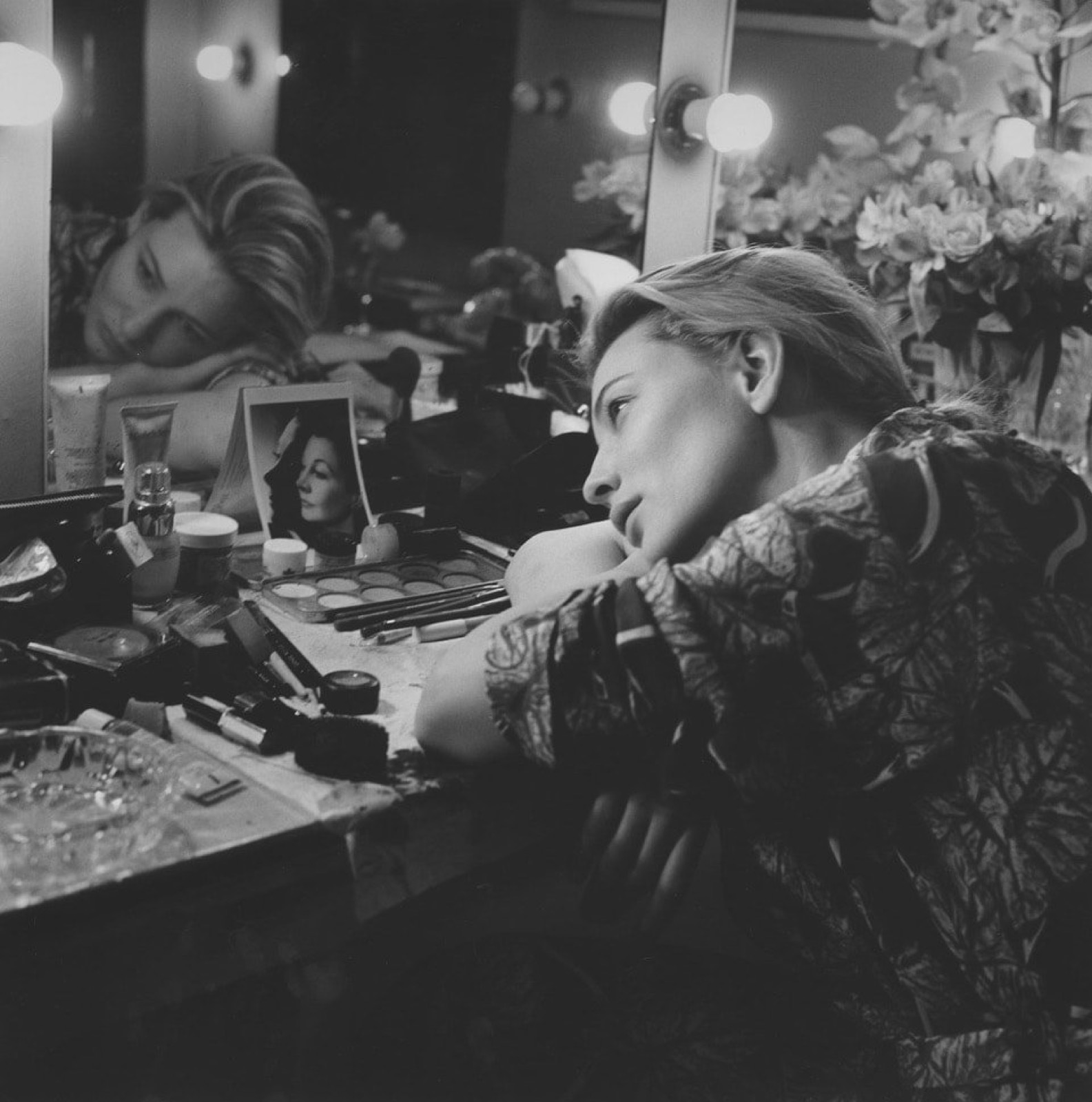
Propped against the mirror, just behind a palette of half-used eyeshadows, stands a small photograph of another woman, a profile borrowed from an earlier era of glamour. Every dressing table keeps its saints, and this one has been granted pride of place among the working tools. Blanchett, folded over her own arm in a foliage-printed robe, seems not to notice her predecessor; her gaze has gone somewhere the makeup cannot follow.
This is the hour the theatre does not sell tickets to. Bare bulbs burn around the mirrors; flowers crowd the frame’s upper corner; the table is silted with lipsticks, jars, brushes abandoned mid-gesture. And the mirror quietly doubles the actress, so that a second Blanchett lies collapsed in the glass, watching nothing. The photograph holds her in the interval between self and role, when the face is off duty but the room is still fully dressed for transformation. Backstage looks unguarded, yet it is a stage as well; the intimacy is real and constructed at once, which is precisely its fascination.
Weber, the photographer who defined the look of American fashion in the 1980s, has always been most tender with performers caught before or after the performance. In gelatin silver the scene acquires the tonal depth of the old star portraits it contains: whites flaring in the bulbs, grays pooling in the robe’s printed leaves, blacks holding the clutter together. A picture about image-making that is also, unmistakably, an image of thought, the actress alone with whatever the role has left behind.

Propped against the mirror, just behind a palette of half-used eyeshadows, stands a small photograph of another woman, a profile borrowed from an earlier era of glamour. Every dressing table keeps its saints, and this one has been granted pride of place among the working tools. Blanchett, folded over her own arm in a foliage-printed robe, seems not to notice her predecessor; her gaze has gone somewhere the makeup cannot follow.
This is the hour the theatre does not sell tickets to. Bare bulbs burn around the mirrors; flowers crowd the frame’s upper corner; the table is silted with lipsticks, jars, brushes abandoned mid-gesture. And the mirror quietly doubles the actress, so that a second Blanchett lies collapsed in the glass, watching nothing. The photograph holds her in the interval between self and role, when the face is off duty but the room is still fully dressed for transformation. Backstage looks unguarded, yet it is a stage as well; the intimacy is real and constructed at once, which is precisely its fascination.
Weber, the photographer who defined the look of American fashion in the 1980s, has always been most tender with performers caught before or after the performance. In gelatin silver the scene acquires the tonal depth of the old star portraits it contains: whites flaring in the bulbs, grays pooling in the robe’s printed leaves, blacks holding the clutter together. A picture about image-making that is also, unmistakably, an image of thought, the actress alone with whatever the role has left behind.