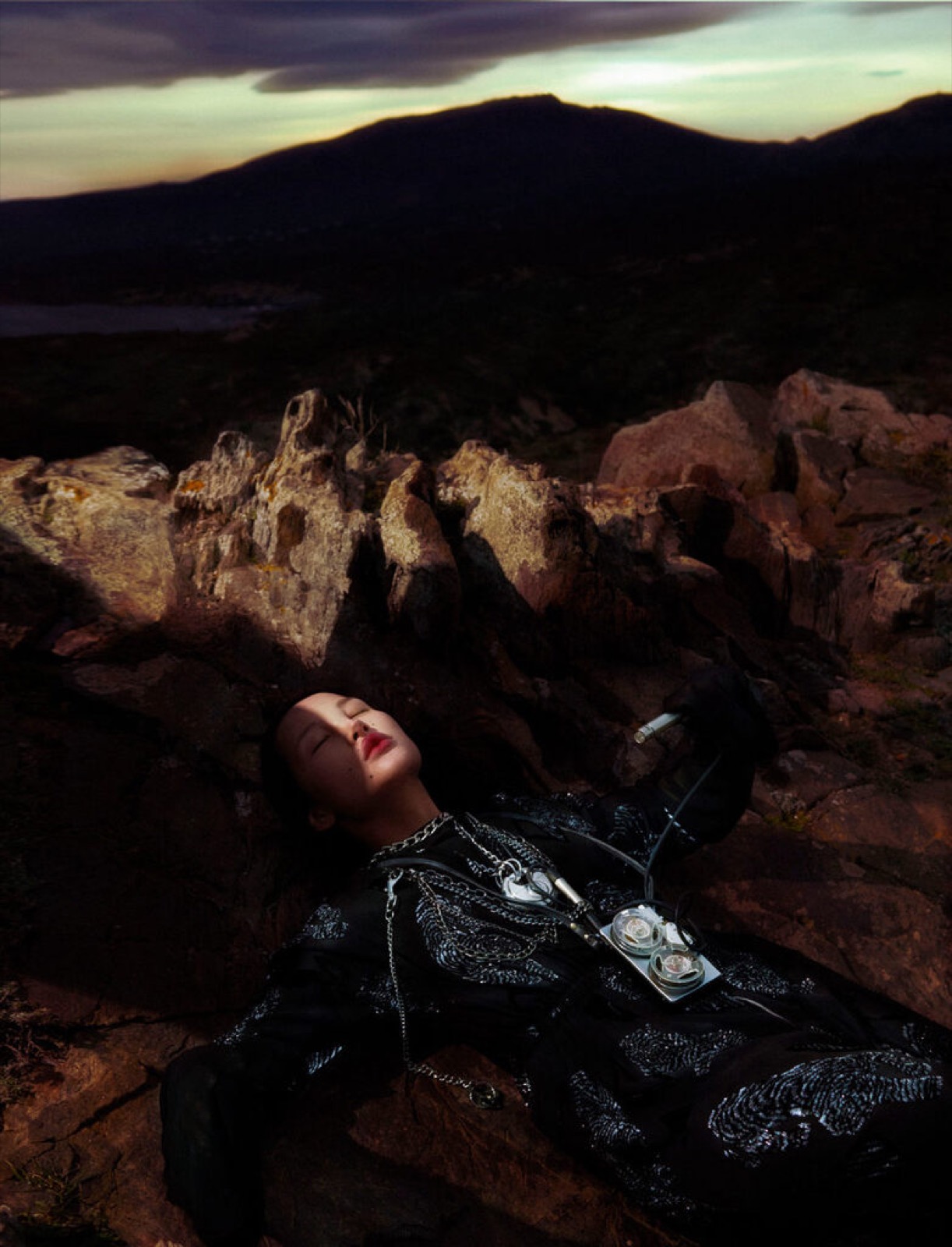
Tsunaina lies back across red rock at the end of the day, head turned toward us, eyes closed, mouth a hard red. She wears a black jacket worked in beadwork that reads as feathers or leaves, and silver chains fall across her chest; a small silver tray of white roses has been set on her body, and her raised hand holds a lit cigarette against the dark. Behind her the ground breaks into boulders and then into a headland, and the sky above the ridge is green going to violet.
The picture belongs to the strand of Yeste's work made outdoors on the Spanish coast rather than in the studio, and it turns on a compositional decision he returns to often: the body laid horizontally into a landscape so that it is read as part of the terrain. Arranged this way, flowers on the chest and eyes shut, the figure quotes the recumbent effigy — the funerary sculpture of a Mediterranean church — and Cadaqués, on the Costa Brava, supplies the rock that makes the quotation possible.
What keeps it from being merely elegiac is the cigarette. The effigy does not smoke; the living woman does, and the small flare in her raised hand is the only thing in the frame that is currently burning. Yeste came to pictures like this through editorial commissions and has spent two decades pulling that language toward sculpture and toward the ethnographic study. This 2021 print shows the pull at its most complete: the apparatus of fashion — beading, chains, styling — assembled into a monument, then undercut by the one detail insisting the sitter is awake.
Tsunaina lies back across red rock at the end of the day, head turned toward us, eyes closed, mouth a hard red. She wears a black jacket worked in beadwork that reads as feathers or leaves, and silver chains fall across her chest; a small silver tray of white roses has been set on her body, and her raised hand holds a lit cigarette against the dark. Behind her the ground breaks into boulders and then into a headland, and the sky above the ridge is green going to violet.
The picture belongs to the strand of Yeste's work made outdoors on the Spanish coast rather than in the studio, and it turns on a compositional decision he returns to often: the body laid horizontally into a landscape so that it is read as part of the terrain. Arranged this way, flowers on the chest and eyes shut, the figure quotes the recumbent effigy — the funerary sculpture of a Mediterranean church — and Cadaqués, on the Costa Brava, supplies the rock that makes the quotation possible.
What keeps it from being merely elegiac is the cigarette. The effigy does not smoke; the living woman does, and the small flare in her raised hand is the only thing in the frame that is currently burning. Yeste came to pictures like this through editorial commissions and has spent two decades pulling that language toward sculpture and toward the ethnographic study. This 2021 print shows the pull at its most complete: the apparatus of fashion — beading, chains, styling — assembled into a monument, then undercut by the one detail insisting the sitter is awake.