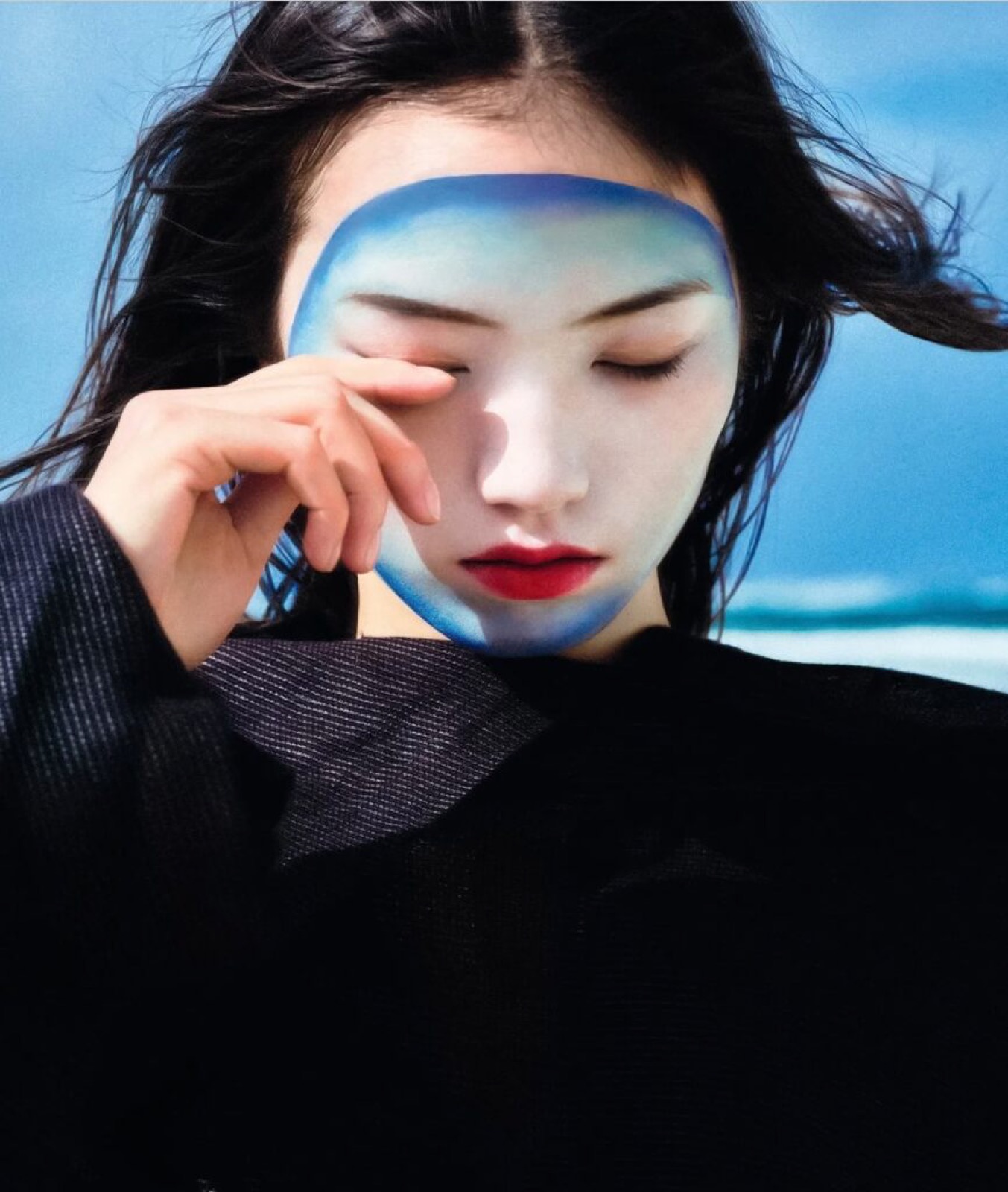
A young woman against sea and sky in a black sweater, her dark hair lifted and crossing her face in loose strands. Over the centre of her face someone has airbrushed a soft-edged panel of pale blue-white — a rectangle with rounded corners, dense at the border and fading to white at the middle — covering the brows, eyes, nose and upper lip but stopping short of the jaw and the ears, so that her own skin tone continues around it. The mouth inside the panel is painted a hard red. Her eyes are closed; one hand is raised to the temple.
The device is precise and it does the picture's thinking. A mask that follows no anatomy but its own outline splits the face into two registers at once — a painted surface and the living support beneath — and insists on the seam between them. The reference is legible enough, the white face and red mouth of the classical Japanese stage, but it has been deliberately mis-registered: too small, too soft at the edge, sprayed rather than applied, sitting on the face like a swatch rather than a mask.
This is where the image declares its allegiances. It belongs to the strand of contemporary fashion photography that treats the sitter as a site for an art-directed intervention and expects the viewer to read the intervention as such — nearer to the constructed portraiture of the gallery than to a cosmetics campaign, though it could serve as either. Yeste, moving between commission and exhibition throughout his career, does not resolve the ambiguity. He builds a picture whose subject is the visible fact that a face has been added to.
A young woman against sea and sky in a black sweater, her dark hair lifted and crossing her face in loose strands. Over the centre of her face someone has airbrushed a soft-edged panel of pale blue-white — a rectangle with rounded corners, dense at the border and fading to white at the middle — covering the brows, eyes, nose and upper lip but stopping short of the jaw and the ears, so that her own skin tone continues around it. The mouth inside the panel is painted a hard red. Her eyes are closed; one hand is raised to the temple.
The device is precise and it does the picture's thinking. A mask that follows no anatomy but its own outline splits the face into two registers at once — a painted surface and the living support beneath — and insists on the seam between them. The reference is legible enough, the white face and red mouth of the classical Japanese stage, but it has been deliberately mis-registered: too small, too soft at the edge, sprayed rather than applied, sitting on the face like a swatch rather than a mask.
This is where the image declares its allegiances. It belongs to the strand of contemporary fashion photography that treats the sitter as a site for an art-directed intervention and expects the viewer to read the intervention as such — nearer to the constructed portraiture of the gallery than to a cosmetics campaign, though it could serve as either. Yeste, moving between commission and exhibition throughout his career, does not resolve the ambiguity. He builds a picture whose subject is the visible fact that a face has been added to.