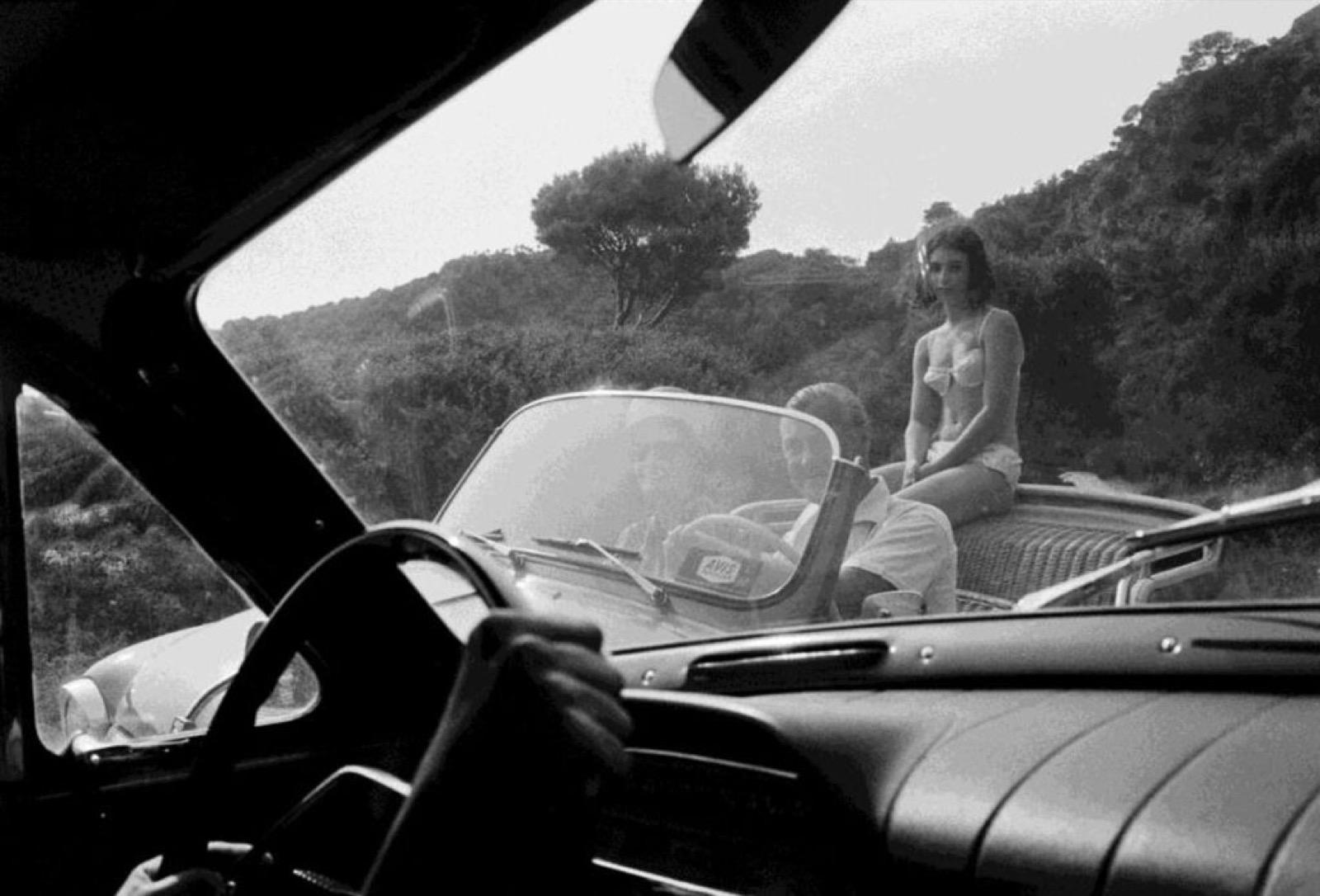
A hand curls around the steering wheel in the foreground, and everything we see is granted by that grip. Meyerowitz is shooting from inside one car, through its windshield, at another — a convertible pulled over on a Corfu hillside, its top down, three people arranged across it. A young man grins from the driver’s seat; an older man sits beside him; a woman in a white bikini top perches on the folded rear deck, turning her face outside the frame. The dashboard and wheel do the work of a proscenium.
The picture is really about the act of looking from a vehicle, that modern way of seeing the world go by in a moving frame. Meyerowitz doubles it: a driver photographing drivers, glass laid over glass, the hazy Mediterranean scrub and a single umbrella-shaped tree pressed flat behind the parked roadster. Photography and the automobile grew up together as machines for cropping the landscape, and here they are nested one inside the other. The woman’s upward perch gives the composition its lift; the men below anchor it.
This belongs to Meyerowitz’s roving European years, when he still worked in black and white, in the Robert Frank tradition, before color and the view camera brought him the luminous Cape Light. His seeing would later be gathered by MoMA, the Met and the Boston MFA; the confidence is already here, in how he trusts a roadside’s theatre. As an archival pigment print the register runs deep, from the near-black dashboard to the bleached sky. Two cars, a hillside, and the modern habit of watching the world through glass.
A hand curls around the steering wheel in the foreground, and everything we see is granted by that grip. Meyerowitz is shooting from inside one car, through its windshield, at another — a convertible pulled over on a Corfu hillside, its top down, three people arranged across it. A young man grins from the driver’s seat; an older man sits beside him; a woman in a white bikini top perches on the folded rear deck, turning her face outside the frame. The dashboard and wheel do the work of a proscenium.
The picture is really about the act of looking from a vehicle, that modern way of seeing the world go by in a moving frame. Meyerowitz doubles it: a driver photographing drivers, glass laid over glass, the hazy Mediterranean scrub and a single umbrella-shaped tree pressed flat behind the parked roadster. Photography and the automobile grew up together as machines for cropping the landscape, and here they are nested one inside the other. The woman’s upward perch gives the composition its lift; the men below anchor it.
This belongs to Meyerowitz’s roving European years, when he still worked in black and white, in the Robert Frank tradition, before color and the view camera brought him the luminous Cape Light. His seeing would later be gathered by MoMA, the Met and the Boston MFA; the confidence is already here, in how he trusts a roadside’s theatre. As an archival pigment print the register runs deep, from the near-black dashboard to the bleached sky. Two cars, a hillside, and the modern habit of watching the world through glass.