How much pink can a photograph carry before it tips into sentiment? Meyerowitz seems to be asking the question and daring the rose to answer. A whole hedge of climbing roses fills the frame, hundreds of small pink blooms banked against dark leaves, some clusters flushed nearly crimson, others faded to the palest cream. Behind them the white gable of a Cape Cod house rises, its brick chimney and a single sash window barely holding their geometry against the flood of flowers. The house is order; the roses are appetite.
We distrust prettiness, and rightly, yet the picture refuses to let us feel superior to it. Come closer and the seduction complicates: certain blossoms are sharp, others smeared soft where the wind stirred them through a long exposure, so the hedge seems to breathe and dissolve at once. This is not a greeting card but a study of how abundance verges on excess, how beauty at full volume becomes faintly unnerving. The photograph indulges the eye and then makes us aware that we are being indulged.
Meyerowitz built this on the 8×10 view camera, the same instrument behind Cape Light, whose descriptive patience lets each petal keep its weight while the mass turns atmospheric. One of the artists who, with Shore and Eggleston, argued in the 1970s that colour could bear serious thought, he treats a summer garden as a moral test as much as a pleasure. His work belongs to MoMA, the Met and the Boston MFA. This archival pigment print holds the full, dangerous sweetness of the pink.
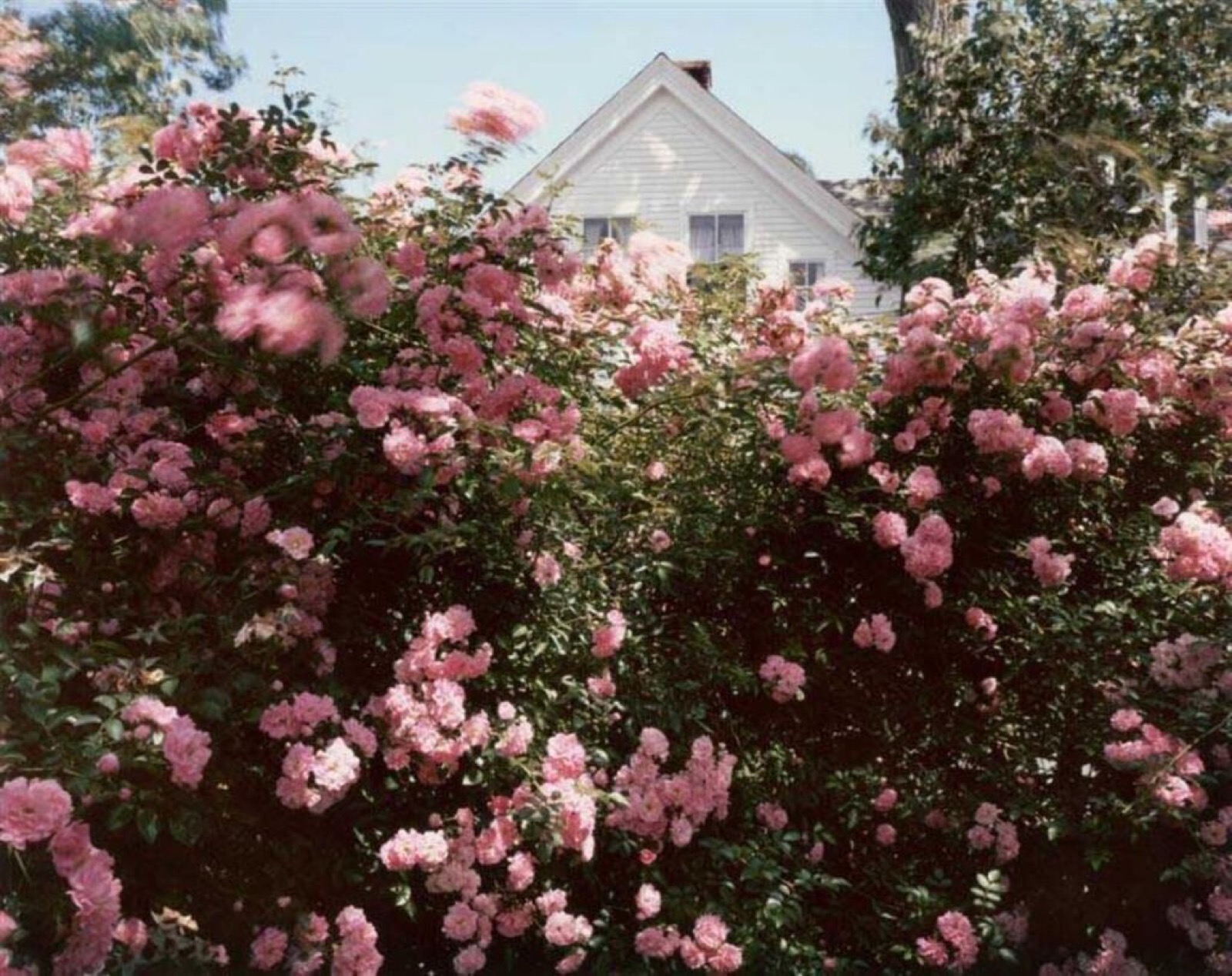

How much pink can a photograph carry before it tips into sentiment? Meyerowitz seems to be asking the question and daring the rose to answer. A whole hedge of climbing roses fills the frame, hundreds of small pink blooms banked against dark leaves, some clusters flushed nearly crimson, others faded to the palest cream. Behind them the white gable of a Cape Cod house rises, its brick chimney and a single sash window barely holding their geometry against the flood of flowers. The house is order; the roses are appetite.
We distrust prettiness, and rightly, yet the picture refuses to let us feel superior to it. Come closer and the seduction complicates: certain blossoms are sharp, others smeared soft where the wind stirred them through a long exposure, so the hedge seems to breathe and dissolve at once. This is not a greeting card but a study of how abundance verges on excess, how beauty at full volume becomes faintly unnerving. The photograph indulges the eye and then makes us aware that we are being indulged.
Meyerowitz built this on the 8×10 view camera, the same instrument behind Cape Light, whose descriptive patience lets each petal keep its weight while the mass turns atmospheric. One of the artists who, with Shore and Eggleston, argued in the 1970s that colour could bear serious thought, he treats a summer garden as a moral test as much as a pleasure. His work belongs to MoMA, the Met and the Boston MFA. This archival pigment print holds the full, dangerous sweetness of the pink.