By the early 1980s, American fashion had discovered that it could sell a feeling of nation as easily as a garment, and Weber was its chief mythographer. Here he plants two swimsuited figures on the summit of an enormous balanced boulder in the Arizona desert — a man standing spread-legged in dark briefs, a woman seated below him in a dark maillot, knees drawn up — and lets the sheer geology do the aggrandising. The rock is vast; the bodies are small and perfect; the sky is a bright, near-empty screen behind them.
Everything about the picture is directed, and it does not pretend otherwise. The couple have been placed like a sculpture on a plinth, the granite boulder promoted from landscape to pedestal, the surrounding jumble of stones and a dry shrub arranged into a wilderness that flatters them. This is fashion imagery aspiring to the condition of monument — the healthy American body raised, literally, above the earth, athletic and untroubled, an advertisement for a way of life, not a product. Weber understood that desire, staged at this scale, reads as destiny.
The gesture is pure Weber: the Adirondack-and-desert Americana, the worship of physical grace, the fashion campaign expanded into national landscape until it feels like scripture. Made as a gelatin silver print, the image trades colour for a cooler, more classical register, the grey of the rock and the grey of the sky pressing the two tanned bodies into crisp silhouette. Take away the swimwear and the couple could be figures on an antique frieze. That is the ambition here, and the picture very nearly earns it.
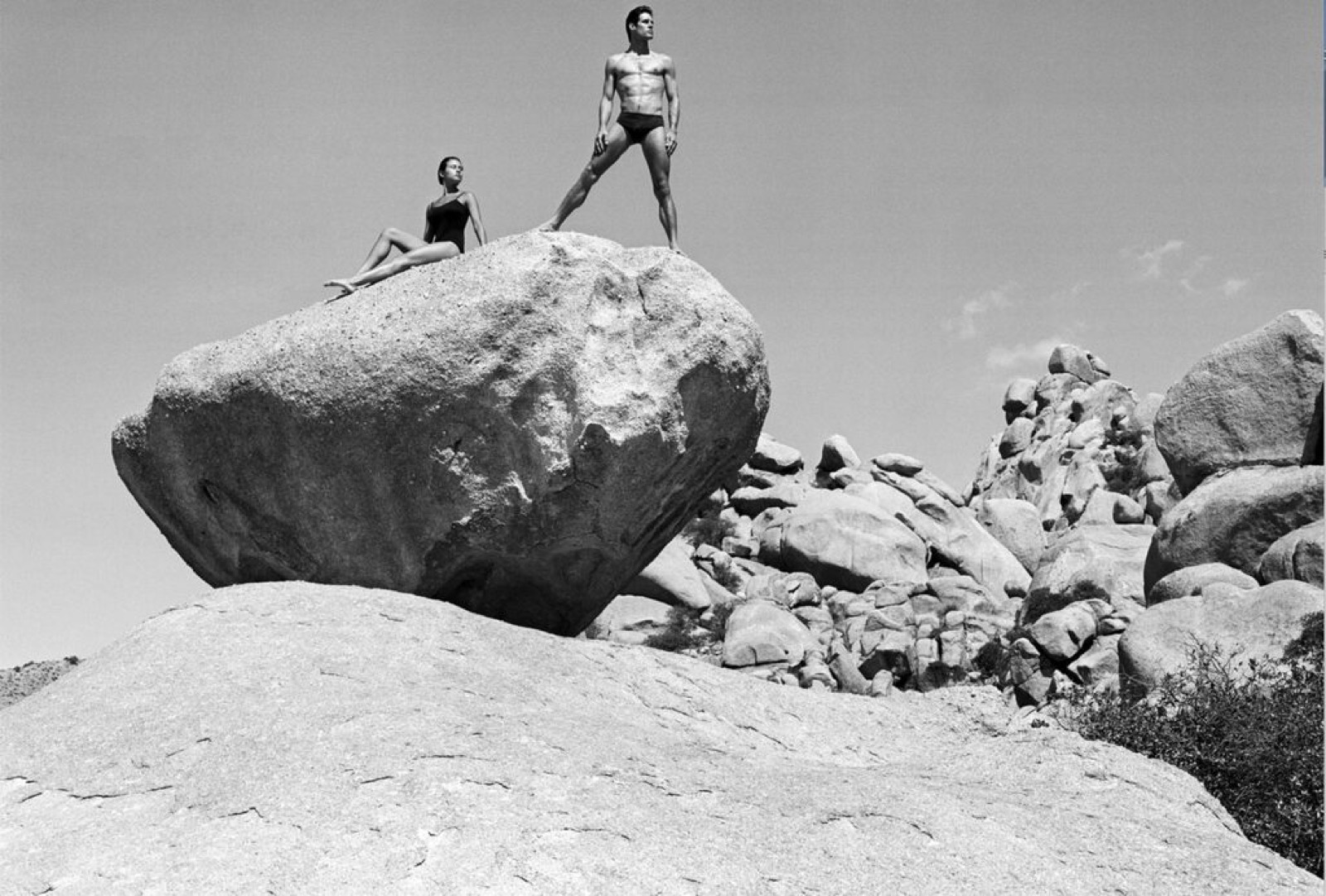

By the early 1980s, American fashion had discovered that it could sell a feeling of nation as easily as a garment, and Weber was its chief mythographer. Here he plants two swimsuited figures on the summit of an enormous balanced boulder in the Arizona desert — a man standing spread-legged in dark briefs, a woman seated below him in a dark maillot, knees drawn up — and lets the sheer geology do the aggrandising. The rock is vast; the bodies are small and perfect; the sky is a bright, near-empty screen behind them.
Everything about the picture is directed, and it does not pretend otherwise. The couple have been placed like a sculpture on a plinth, the granite boulder promoted from landscape to pedestal, the surrounding jumble of stones and a dry shrub arranged into a wilderness that flatters them. This is fashion imagery aspiring to the condition of monument — the healthy American body raised, literally, above the earth, athletic and untroubled, an advertisement for a way of life, not a product. Weber understood that desire, staged at this scale, reads as destiny.
The gesture is pure Weber: the Adirondack-and-desert Americana, the worship of physical grace, the fashion campaign expanded into national landscape until it feels like scripture. Made as a gelatin silver print, the image trades colour for a cooler, more classical register, the grey of the rock and the grey of the sky pressing the two tanned bodies into crisp silhouette. Take away the swimwear and the couple could be figures on an antique frieze. That is the ambition here, and the picture very nearly earns it.