We are set down at the water’s edge and given almost nothing to hold: a soft grey sky, a darker sea, and between them a horizon so dissolved in haze that it barely qualifies as a line. The sun hangs as a blurred white disc, its glare unrolling a silver path straight down the rippled surface toward our feet. This is where the picture puts us, at the near end of that path, as if invited to walk out on it.
Photography has always been at home in exactly this kind of emptiness, where there is little to describe and everything to register. The image is barely a scene; it is closer to a graph of light on water, the ripples reading as a fine texture that keeps the eye moving even when nothing happens. Marine pictures like this trade on a paradox the medium knows well: the more a photograph strips away, the more it seems to be about looking itself, about patience and attention rather than incident.
The plainness is a discipline, not a lack. A gelatin silver print toned with selenium, made the year after the negative, gives that long grey scale its cool backbone and lets the highlight on the water gleam without burning out. Saula, who made the picture and founded the gallery that carries it, works this reduced, elemental register on purpose, ocean, mist and a single sun, trusting the hand-printed sheet to turn near-nothing into something you go on looking at long after the incident-hungry eye has given up.
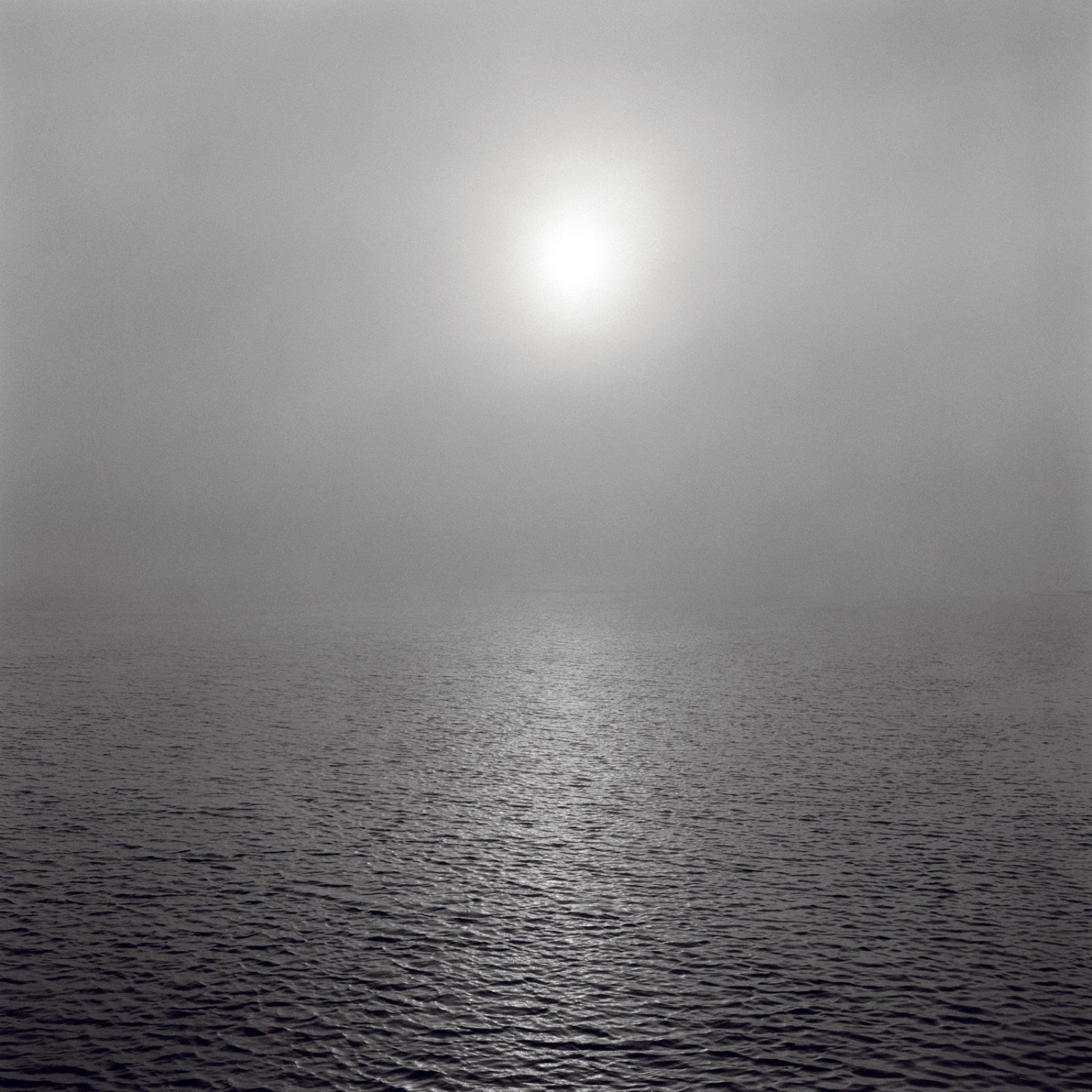

We are set down at the water’s edge and given almost nothing to hold: a soft grey sky, a darker sea, and between them a horizon so dissolved in haze that it barely qualifies as a line. The sun hangs as a blurred white disc, its glare unrolling a silver path straight down the rippled surface toward our feet. This is where the picture puts us, at the near end of that path, as if invited to walk out on it.
Photography has always been at home in exactly this kind of emptiness, where there is little to describe and everything to register. The image is barely a scene; it is closer to a graph of light on water, the ripples reading as a fine texture that keeps the eye moving even when nothing happens. Marine pictures like this trade on a paradox the medium knows well: the more a photograph strips away, the more it seems to be about looking itself, about patience and attention rather than incident.
The plainness is a discipline, not a lack. A gelatin silver print toned with selenium, made the year after the negative, gives that long grey scale its cool backbone and lets the highlight on the water gleam without burning out. Saula, who made the picture and founded the gallery that carries it, works this reduced, elemental register on purpose, ocean, mist and a single sun, trusting the hand-printed sheet to turn near-nothing into something you go on looking at long after the incident-hungry eye has given up.