The tonal range of the print is announced by the dog, a Newfoundland whose coat runs from a soot-black head to a white bib, the darkest and lightest notes sitting side by side at the centre. Everything else is calibrated against it. The young man’s skin holds a warm mid-grey lit from above, his blond hair pale against the deep green-black leaves. Weber has built the image the way a printer builds a scale, anchoring the extremes and letting the flesh find its place between them.
Dappled light falls across a torso modeled like a cast, the ridged abdomen, the arm folded up to grip the far shoulder, the hand lowered to rest on the dog’s head. Texture is everywhere and everywhere various: the shag of wet fur, the matte of leaves gone almost to velvet, the sheen of skin drawn tight over muscle. The Newfoundland does double duty, screening the figure and grounding him, so that classical nudity turns companionable, a boy and his dog in an Adirondack wood.
Weber, who spent decades photographing the Adirondacks as a private academy of American beauty, works here in the long line that runs from Eakins’s students to the classical figure study, but warmed by real weather and real fur. This gelatin silver print is where his tonal intelligence shows plainest, the blacks holding detail in the dog’s coat, the highlights never chalking on the skin. It is a picture about surfaces, and how tenderly a photograph can render them. The dignity is the dog’s as much as the man’s.
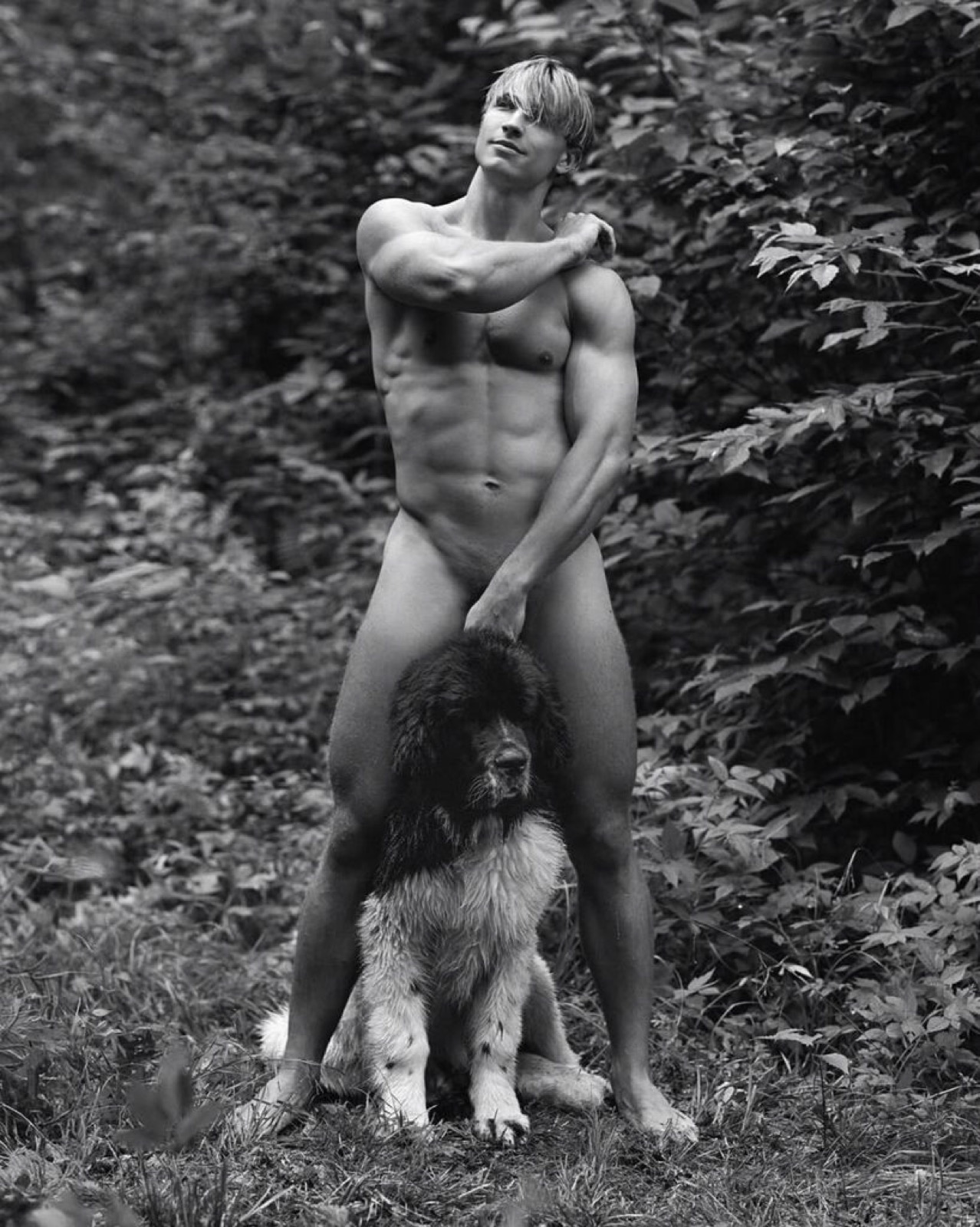

The tonal range of the print is announced by the dog, a Newfoundland whose coat runs from a soot-black head to a white bib, the darkest and lightest notes sitting side by side at the centre. Everything else is calibrated against it. The young man’s skin holds a warm mid-grey lit from above, his blond hair pale against the deep green-black leaves. Weber has built the image the way a printer builds a scale, anchoring the extremes and letting the flesh find its place between them.
Dappled light falls across a torso modeled like a cast, the ridged abdomen, the arm folded up to grip the far shoulder, the hand lowered to rest on the dog’s head. Texture is everywhere and everywhere various: the shag of wet fur, the matte of leaves gone almost to velvet, the sheen of skin drawn tight over muscle. The Newfoundland does double duty, screening the figure and grounding him, so that classical nudity turns companionable, a boy and his dog in an Adirondack wood.
Weber, who spent decades photographing the Adirondacks as a private academy of American beauty, works here in the long line that runs from Eakins’s students to the classical figure study, but warmed by real weather and real fur. This gelatin silver print is where his tonal intelligence shows plainest, the blacks holding detail in the dog’s coat, the highlights never chalking on the skin. It is a picture about surfaces, and how tenderly a photograph can render them. The dignity is the dog’s as much as the man’s.