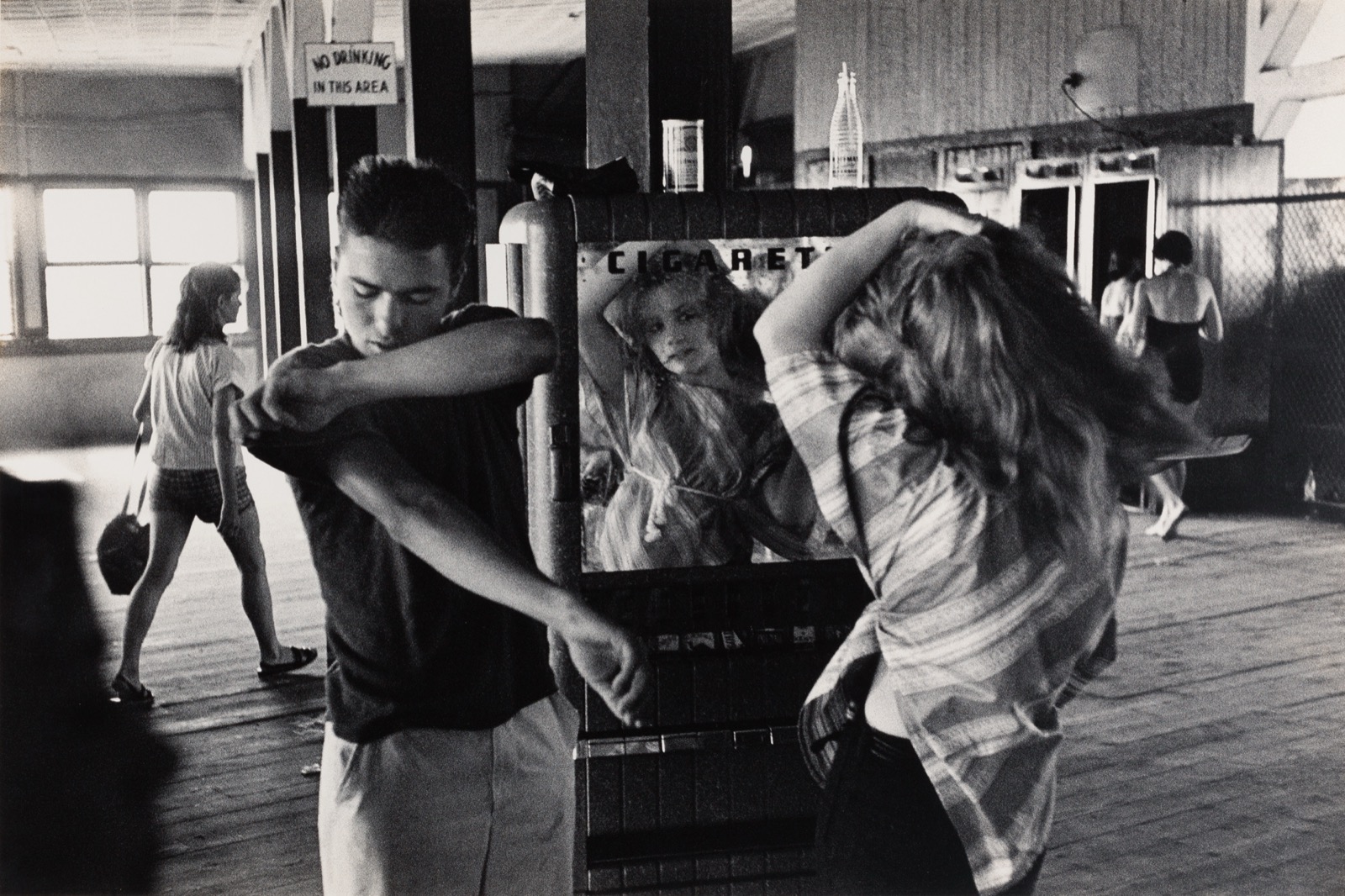
A boy lifts his bent arm to comb or shield his face; across the cigarette machine a girl rakes both hands up through her hair. Between them, mirrored on the chrome vending front beneath the word CIGARETTES, a second girl appears, calmly fixing herself in the same glass. The sign overhead—NO DRINKING IN THIS AREA—presides over a boardwalk arcade where other young figures drift toward the sea. To photograph adolescence is to collect evidence of a condition that erases itself: these gestures of grooming are rehearsals for a self not yet arrived.
What the picture knows, and the children do not, is that vanity and tenderness are the same reflex here. The mirrored machine turns a slot for cigarettes into an instrument of self-regard; the camera, no less, is a machine for looking, and the photographer has stood close enough to be implicated rather than spying. Davidson spent months with this Brooklyn gang in 1959, and the intimacy shows—he is inside the heat of the day, not above it. The image refuses both nostalgia and accusation. It simply holds them in their summer, half tough, half unguarded, at the exact frontier between play and consequence.
Grain and glare belong to the moment as much as the actors do: the blown light of the arcade, the soft tonal weather of mid-century New York. Such a photograph is now a document of a vanished sensibility, and the vintage print—its silver settled into the paper—carries that nearness as no later reproduction can. Held by MoMA and the Met, Davidson made of these strangers an unkillable afternoon. We keep looking because looking, here, is a form of care.

A boy lifts his bent arm to comb or shield his face; across the cigarette machine a girl rakes both hands up through her hair. Between them, mirrored on the chrome vending front beneath the word CIGARETTES, a second girl appears, calmly fixing herself in the same glass. The sign overhead—NO DRINKING IN THIS AREA—presides over a boardwalk arcade where other young figures drift toward the sea. To photograph adolescence is to collect evidence of a condition that erases itself: these gestures of grooming are rehearsals for a self not yet arrived.
What the picture knows, and the children do not, is that vanity and tenderness are the same reflex here. The mirrored machine turns a slot for cigarettes into an instrument of self-regard; the camera, no less, is a machine for looking, and the photographer has stood close enough to be implicated rather than spying. Davidson spent months with this Brooklyn gang in 1959, and the intimacy shows—he is inside the heat of the day, not above it. The image refuses both nostalgia and accusation. It simply holds them in their summer, half tough, half unguarded, at the exact frontier between play and consequence.
Grain and glare belong to the moment as much as the actors do: the blown light of the arcade, the soft tonal weather of mid-century New York. Such a photograph is now a document of a vanished sensibility, and the vintage print—its silver settled into the paper—carries that nearness as no later reproduction can. Held by MoMA and the Met, Davidson made of these strangers an unkillable afternoon. We keep looking because looking, here, is a form of care.