A face at very close range, made of two overlapping images. On the left the features are sharp: an eye with a heavily glittered lid in blue and green, a yellow line beneath the brow, skin dusted with something metallic, a lower lip painted dense red. Across the right half a second version of the same face has been dragged in red and magenta — a second eye, a second nostril, a smear of colour where the cheek should be — so that the woman appears to be turning and standing still at once.
The doubling was made in the camera rather than afterwards: the streaks trail in a single direction and carry the light with them, which is what a slow shutter does and what a digital composite rarely troubles to imitate. Held on the left of the face and released across the right, the exposure records the beginning and the end of a movement within one frame, and the beauty picture becomes a study of duration.
These 2015 pictures of Cathrine mark a particular moment in Yeste's work, when the extreme beauty close-up — a genre he had been producing for the European magazines for a decade — began absorbing the devices of the studio experiment: prisms, gels, dragged shutters, second exposures. What had been a means of describing a cosmetic became a means of describing motion, and the make-up, elaborate as it is, ends up serving as pigment for a picture about something else.
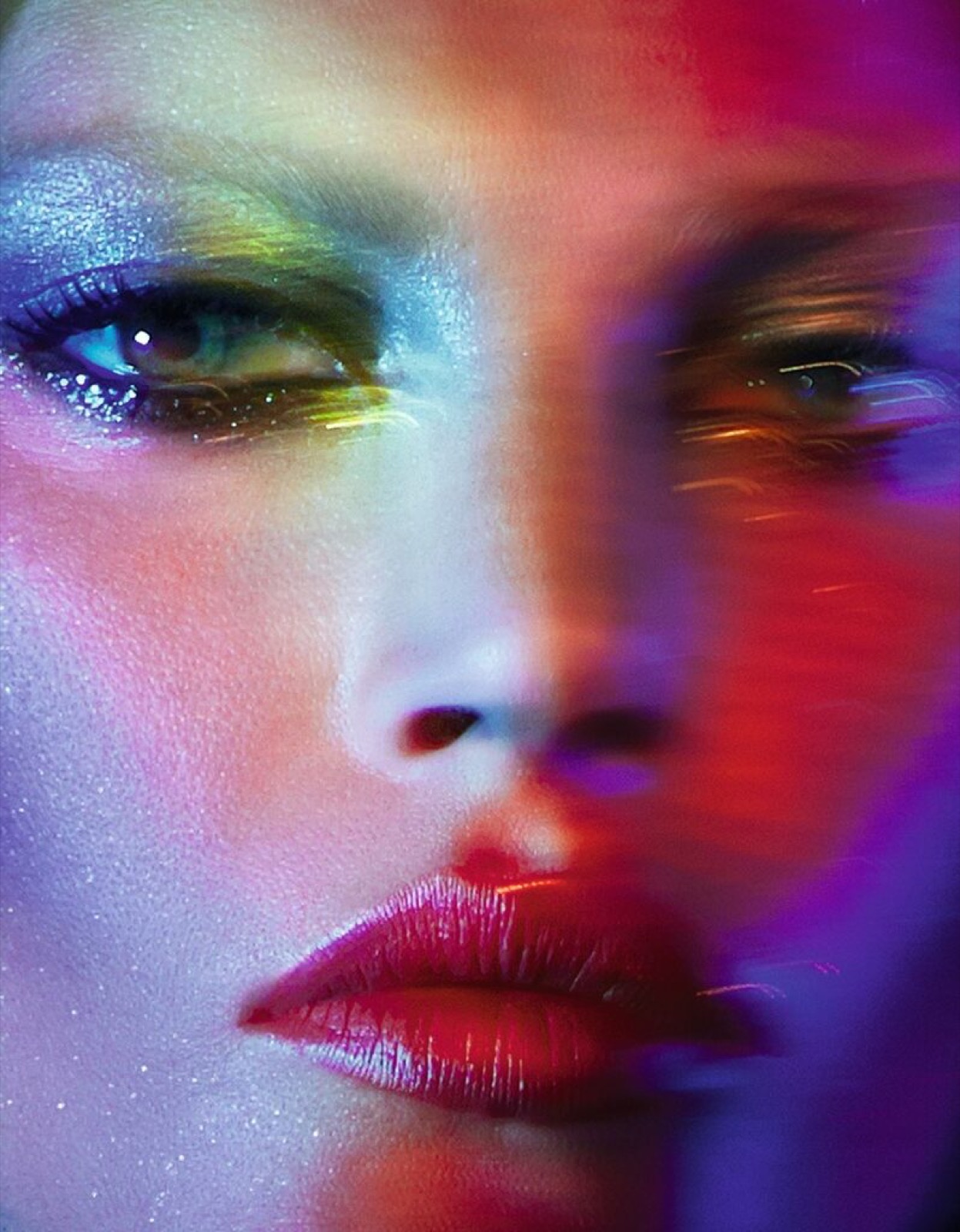

A face at very close range, made of two overlapping images. On the left the features are sharp: an eye with a heavily glittered lid in blue and green, a yellow line beneath the brow, skin dusted with something metallic, a lower lip painted dense red. Across the right half a second version of the same face has been dragged in red and magenta — a second eye, a second nostril, a smear of colour where the cheek should be — so that the woman appears to be turning and standing still at once.
The doubling was made in the camera rather than afterwards: the streaks trail in a single direction and carry the light with them, which is what a slow shutter does and what a digital composite rarely troubles to imitate. Held on the left of the face and released across the right, the exposure records the beginning and the end of a movement within one frame, and the beauty picture becomes a study of duration.
These 2015 pictures of Cathrine mark a particular moment in Yeste's work, when the extreme beauty close-up — a genre he had been producing for the European magazines for a decade — began absorbing the devices of the studio experiment: prisms, gels, dragged shutters, second exposures. What had been a means of describing a cosmetic became a means of describing motion, and the make-up, elaborate as it is, ends up serving as pigment for a picture about something else.