Wetness is the whole subject: hair darkened and plastered into filaments that fan from the crown, each strand separated and glistening as if drawn with a fine dark pen. The water has reorganised the head into pattern, streaks radiating over the nape, a few loose ends flaring against the pale mottled ground. Below, the bare back rises in broad planes of grey, the skin still beaded, a scatter of small moles the only interruption. We see him from behind alone, and the picture asks us to read a person through the texture of soaked hair.
This is a photograph acutely aware of what silver can do. The gelatin emulsion is a substance built to register exactly this, the graded passage from the wet black of the hairline to the luminous shoulder, the way light sits in a film of water. Chemistry answers chemistry: the wetness on the swimmer’s body finds its match in the developed grain of the print, both records of a moment’s contact between surfaces. To hold the sheet is to hold a trace of that touch, the emulsion keeping what a towel would have wiped away.
Weber, who through the 1980s made the swimmer and the athlete central to American photography, strips the genre to its barest terms: no pool, no medals, no face, only a nape and a pair of shoulders. It is a portrait that withholds identity while insisting on presence, an image that circulates as icon precisely because it could be anyone and is unmistakably someone. Printed in silver gelatin, it keeps the swimmer at the instant of surfacing, the water not yet dry.
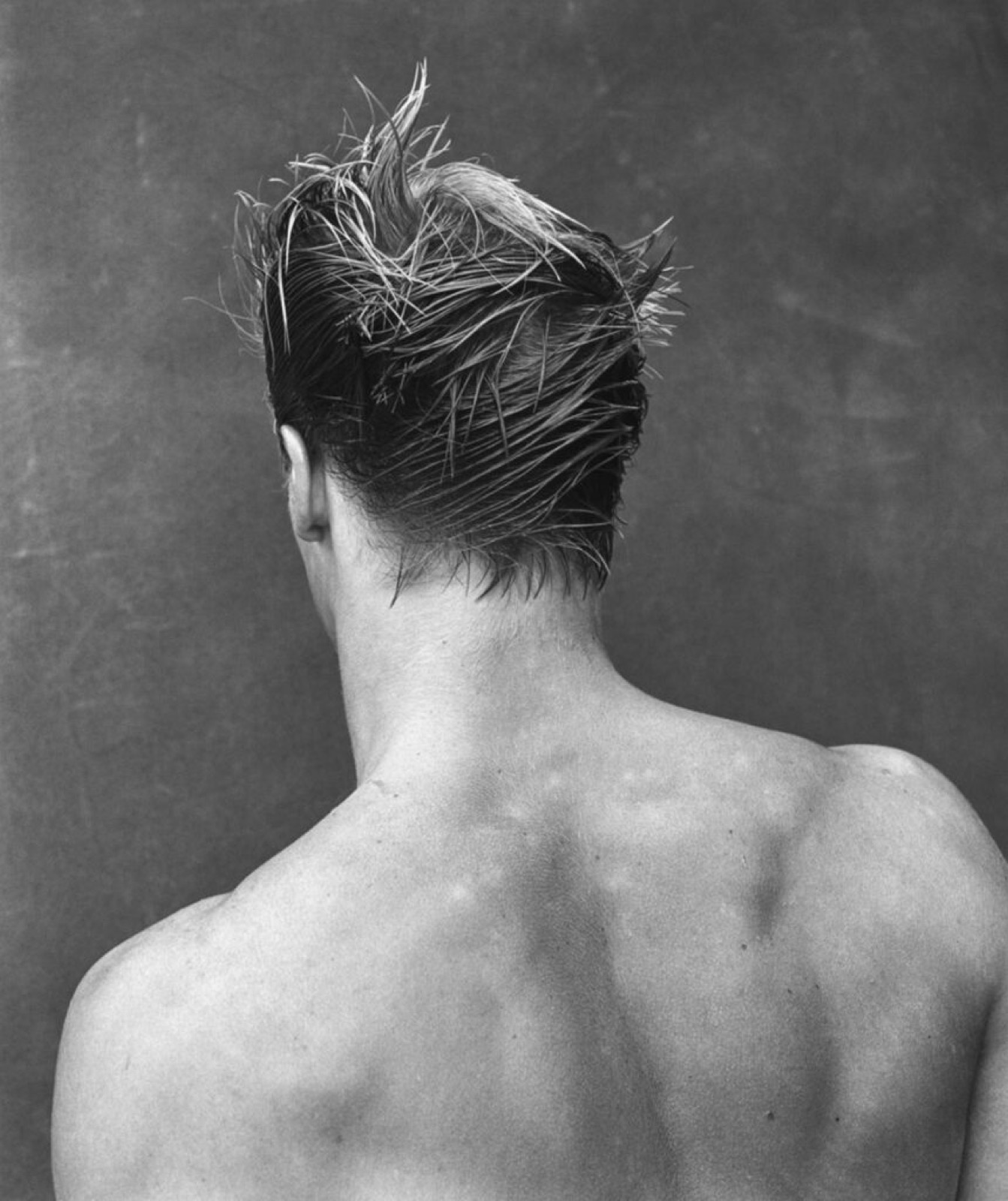

Wetness is the whole subject: hair darkened and plastered into filaments that fan from the crown, each strand separated and glistening as if drawn with a fine dark pen. The water has reorganised the head into pattern, streaks radiating over the nape, a few loose ends flaring against the pale mottled ground. Below, the bare back rises in broad planes of grey, the skin still beaded, a scatter of small moles the only interruption. We see him from behind alone, and the picture asks us to read a person through the texture of soaked hair.
This is a photograph acutely aware of what silver can do. The gelatin emulsion is a substance built to register exactly this, the graded passage from the wet black of the hairline to the luminous shoulder, the way light sits in a film of water. Chemistry answers chemistry: the wetness on the swimmer’s body finds its match in the developed grain of the print, both records of a moment’s contact between surfaces. To hold the sheet is to hold a trace of that touch, the emulsion keeping what a towel would have wiped away.
Weber, who through the 1980s made the swimmer and the athlete central to American photography, strips the genre to its barest terms: no pool, no medals, no face, only a nape and a pair of shoulders. It is a portrait that withholds identity while insisting on presence, an image that circulates as icon precisely because it could be anyone and is unmistakably someone. Printed in silver gelatin, it keeps the swimmer at the instant of surfacing, the water not yet dry.