The sky is turning over on itself, coiling like water above a drain, and it has pressed the land down to a dark hem at the bottom of the frame. All the drama is overhead. A seam of pale yellow opens along the horizon the way light under a door says the next room is still lit. I keep returning to that seam; it is the picture’s one promise of elsewhere.
Nine-tenths of the frame is cloud, smeared and folded like wet charcoal, with a small pale opening left of center where the mass thins for a moment. The earth is reduced to a brown strip, moorland flat as a ruled line, a glint of standing water at its far right edge. There is no person here to give the storm a scale, and that absence feels honest. We say our fields, our roads, our borders; nobody says our sky. To photograph weather like this is to accept a minor part in it, to stand still while something enormous rehearses above you.
Todd Hido is known for the American night: suburban houses lit from within, roads dissolving through a wet windshield. Pictures like this one simply raise that gaze from the road to the weather that governs it, and museums have followed him there; his prints are held by SFMOMA, the Getty and the Whitney. The archival pigment print keeps these grays soft and deep at once, an ink wash with a single warm sentence of light written along its lower edge.
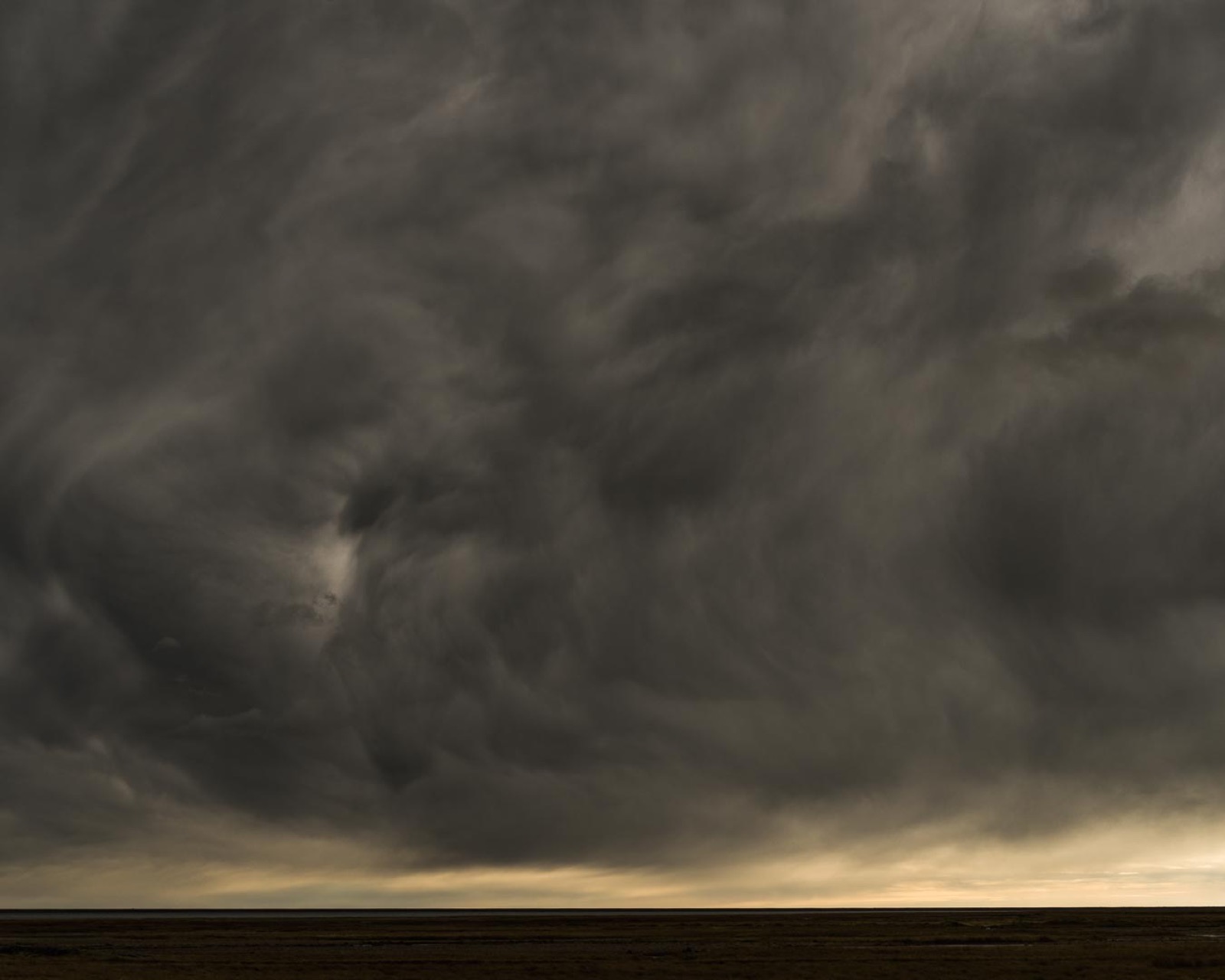

The sky is turning over on itself, coiling like water above a drain, and it has pressed the land down to a dark hem at the bottom of the frame. All the drama is overhead. A seam of pale yellow opens along the horizon the way light under a door says the next room is still lit. I keep returning to that seam; it is the picture’s one promise of elsewhere.
Nine-tenths of the frame is cloud, smeared and folded like wet charcoal, with a small pale opening left of center where the mass thins for a moment. The earth is reduced to a brown strip, moorland flat as a ruled line, a glint of standing water at its far right edge. There is no person here to give the storm a scale, and that absence feels honest. We say our fields, our roads, our borders; nobody says our sky. To photograph weather like this is to accept a minor part in it, to stand still while something enormous rehearses above you.
Todd Hido is known for the American night: suburban houses lit from within, roads dissolving through a wet windshield. Pictures like this one simply raise that gaze from the road to the weather that governs it, and museums have followed him there; his prints are held by SFMOMA, the Getty and the Whitney. The archival pigment print keeps these grays soft and deep at once, an ink wash with a single warm sentence of light written along its lower edge.