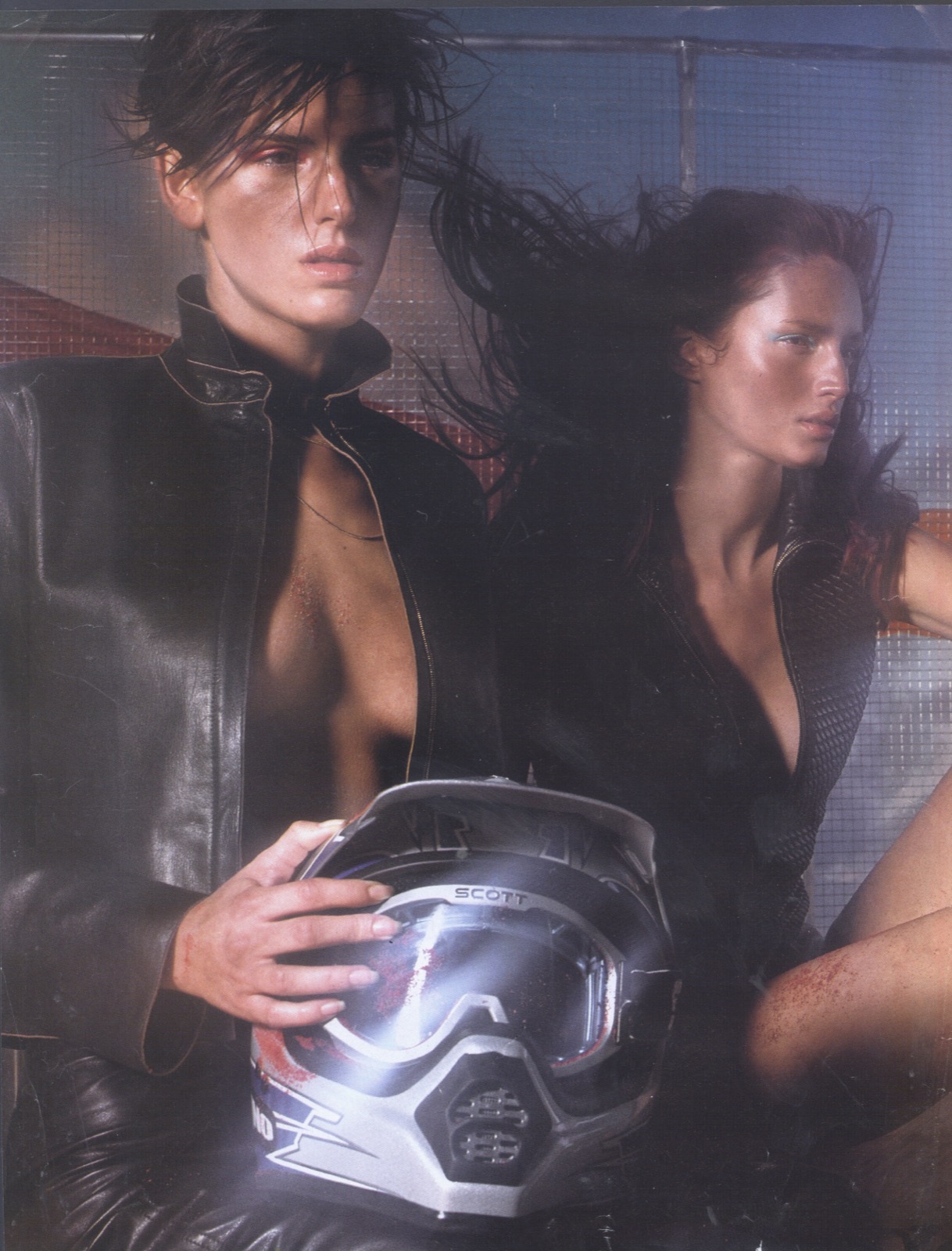
Two bodies share the frame, and the clothes do the talking. He wears a black leather biker jacket unzipped to the navel, the lapels falling open over a bare chest still slicked with the day; she answers in a second skin of dark leather, one shoulder cut to a slope of collarbone, the textured panel at her bust catching a wet shine. Between them they cradle a silver Scott motocross helmet, its goggle visor lit from within like a face turned to glass. Hair is the real styling here—his dark fringe pushed forward and damp, hers streaming sideways on a wind that exists only for the camera. Nothing is buttoned, nothing is settled; the wardrobe is all surface and slither, made to be looked at hard.
The light is frontal, almost punishing, the way a flash flattens skin into something sculptural before it flatters it. It rakes across leather to find every scuff and seam, then pools cold in the helmet's lenses. Behind them a chain-link fence and a wall of frosted glass block, banded with a smear of red, give the picture its garage-and-nightclub grammar—machine glamour, the body as engine. Their gazes go past us, lips parted, that practiced fashion blankness that reads as both boredom and heat.
This is the cinematic, high-contrast register that made Peters a fixture of the international magazine page, editorial desire shot like a film still. A vintage print holds the grain and the gloss of that moment intact, the actual object behind the reproduction—and in the hands of a sought-after image-maker, that first print is where the seduction was set.

Two bodies share the frame, and the clothes do the talking. He wears a black leather biker jacket unzipped to the navel, the lapels falling open over a bare chest still slicked with the day; she answers in a second skin of dark leather, one shoulder cut to a slope of collarbone, the textured panel at her bust catching a wet shine. Between them they cradle a silver Scott motocross helmet, its goggle visor lit from within like a face turned to glass. Hair is the real styling here—his dark fringe pushed forward and damp, hers streaming sideways on a wind that exists only for the camera. Nothing is buttoned, nothing is settled; the wardrobe is all surface and slither, made to be looked at hard.
The light is frontal, almost punishing, the way a flash flattens skin into something sculptural before it flatters it. It rakes across leather to find every scuff and seam, then pools cold in the helmet's lenses. Behind them a chain-link fence and a wall of frosted glass block, banded with a smear of red, give the picture its garage-and-nightclub grammar—machine glamour, the body as engine. Their gazes go past us, lips parted, that practiced fashion blankness that reads as both boredom and heat.
This is the cinematic, high-contrast register that made Peters a fixture of the international magazine page, editorial desire shot like a film still. A vintage print holds the grain and the gloss of that moment intact, the actual object behind the reproduction—and in the hands of a sought-after image-maker, that first print is where the seduction was set.