
Ramón Masats
Spanish, 1931–2024Sanfermines, Pamplona, 1956-60
Gelatin Silver Print. Printed Later.
Image: 37.5 x 24.5 cm / 14 3/4 x 9 5/8 in / Paper: 40 x 30 cm / 15 3/4 x 11 3/4 in
Image: 56.5 x 37.5 cm / 22 1/4 x 14 3/4 in / Paper: 60 x 50 cm / 23 5/8 x 19 3/4 in
Ramón Masats Estate dry stamp, signed and authenticated by Sonia Masats with title and edition number in pencil on label affixed to print verso
Edition of 15 — Image: 37.5 x 24.5 cm / 14 3/4 x 9 5/8 in / Paper: 40 x 30 cm / 15 3/4 x 11 3/4 in
Edition of 5 — Image: 56.5 x 37.5 cm / 22 1/4 x 14 3/4 in / Paper: 60 x 50 cm / 23 5/8 x 19 3/4 in
© The Artist
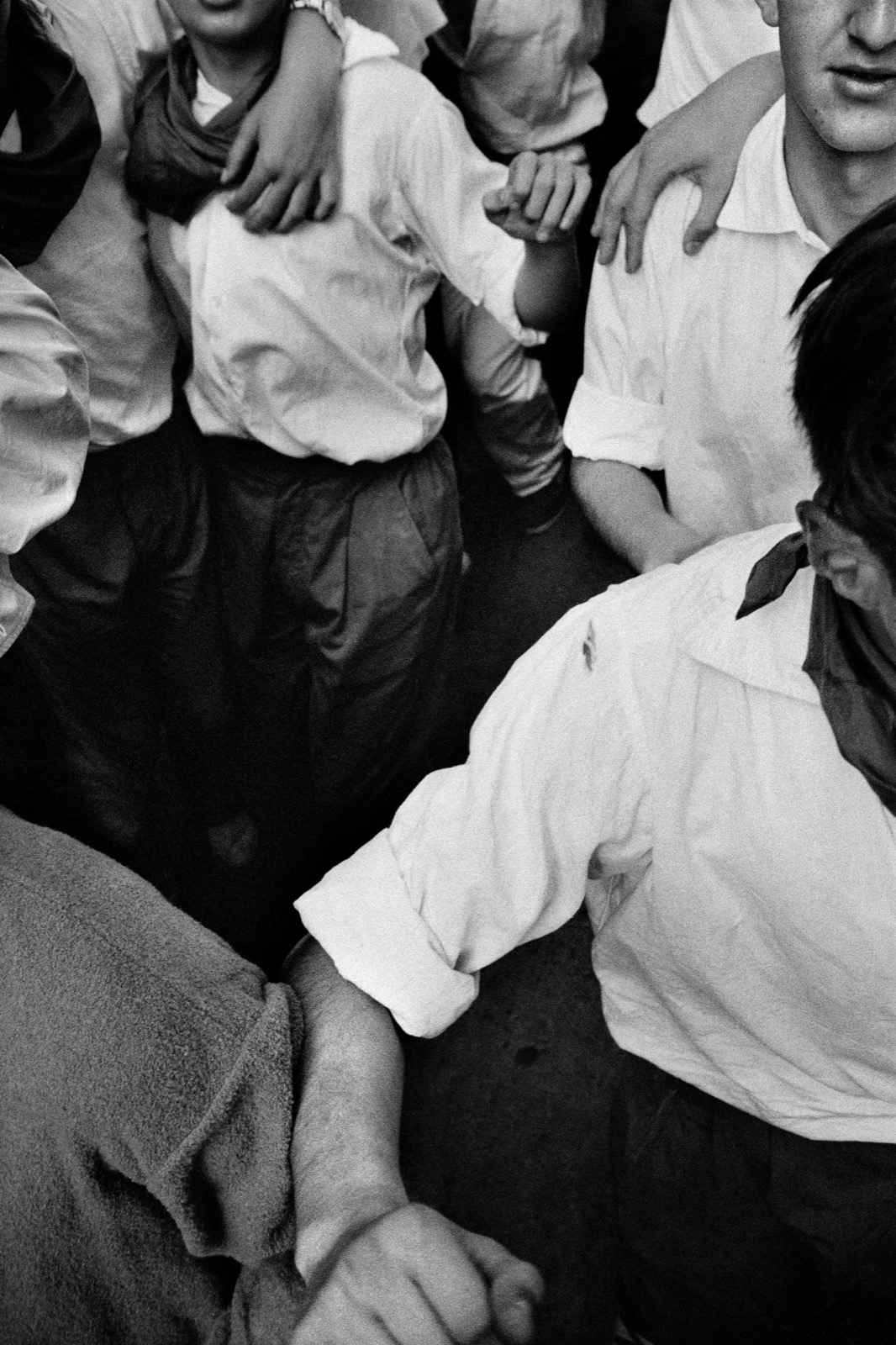
In the tight-managed Spain of the Franco decades, the fiesta was one of the licensed places where a young body could disappear into a crowd, and Masats went straight for the disappearance. He cropped so close that no full face survives: only white shirts, dark trousers, forearms with the sleeves shoved up past the elbow, and a single hand clamped on a neighbour’s shoulder. The dark neckerchief knotted at one throat is the sanctioned uniform of Sanfermines, worn by thousands at once. It marks a body as part of the throng.
What the framing does is turn a specific afternoon into a study of contact itself. Photography loves a crowd for the way it can be sliced into abstraction, and here the slice yields a lattice of grips and leaning weights, each man braced against the next. We read belonging not from expressions, which are withheld, but from the grammar of hands. It is documentary that behaves almost like sculpture, alert to how bodies transmit pressure and trust through cotton and skin.
Masats came out of the AFAL group, the loose federation that in those years pushed Spanish photography past salon prettiness toward the street’s actual texture; the Premio Nacional confirmed his standing in 2004. This gelatin silver print, made later from the negative, gives the whites a laundered brightness and sinks the shadows between bodies into velvet. Long after the specific fiesta is forgotten, the picture keeps its argument: that a crowd is a structure, and photography can show us its joints.