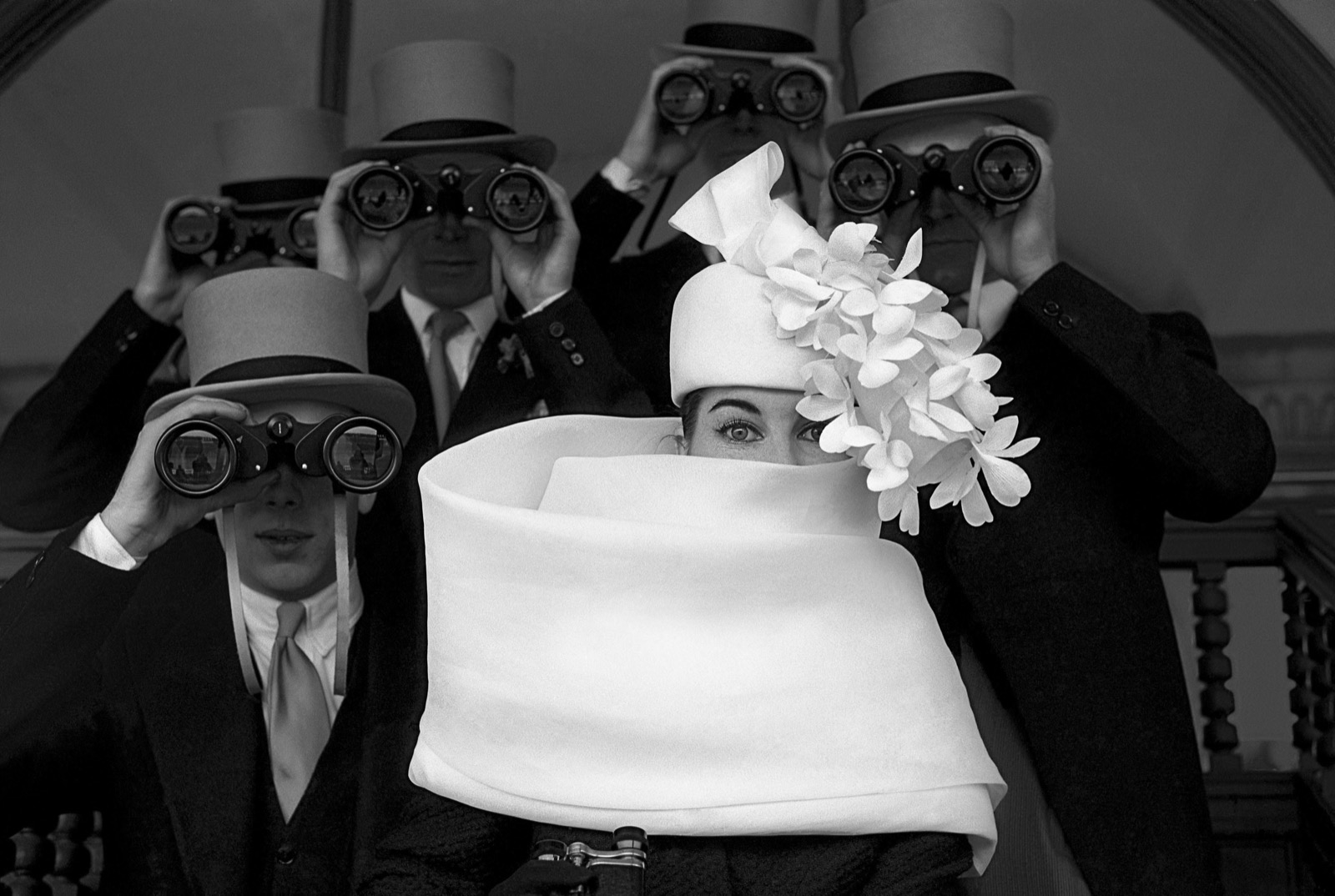
At the Paris races in 1958, Frank Horvat resolved a problem that had occupied fashion photography since the war: how to release couture from the studio without surrendering the precision the genre demanded. His answer was to let the racecourse supply both the elegance and the irony. Four men in pale grey top hats lift binoculars in a tight rank, their faces eclipsed by the instruments, while at the center a woman in a soft Givenchy pillbox returns the only living gaze in the frame. A dense cascade of white blossom spills down the right side of her crown; below it, a tall sculptural swathe of pale fabric rises across her face like a furled collar, leaving a single dark eye exposed above it.
The intelligence of the picture lies in that asymmetry of seeing. The men, equipped to look, are rendered blind to the very subject beside them; she, half-veiled, sees everything. Horvat keeps the description candid and unforced — the tonalities soft, the afternoon light flat and even, the reflections caught faintly in the nearest pair of lenses — so that the geometry of stacked silk and repeated glass never hardens into mere design. A baluster rail at the lower right anchors the scene in a real grandstand rather than a set.
Horvat (1928–2020) belonged to the generation, with his work for Jardin des Modes, Vogue and Harper's Bazaar, that carried the photojournalist's eye into fashion. The Givenchy hat sequence of 1958 remains his most enduring achievement and is held in major museum collections internationally. This is a distinct exposure from the familiar Hat C — a rare alternate frame, gelatin silver, printed later — from the series that fixed his place in the history of the genre.
At the Paris races in 1958, Frank Horvat resolved a problem that had occupied fashion photography since the war: how to release couture from the studio without surrendering the precision the genre demanded. His answer was to let the racecourse supply both the elegance and the irony. Four men in pale grey top hats lift binoculars in a tight rank, their faces eclipsed by the instruments, while at the center a woman in a soft Givenchy pillbox returns the only living gaze in the frame. A dense cascade of white blossom spills down the right side of her crown; below it, a tall sculptural swathe of pale fabric rises across her face like a furled collar, leaving a single dark eye exposed above it.
The intelligence of the picture lies in that asymmetry of seeing. The men, equipped to look, are rendered blind to the very subject beside them; she, half-veiled, sees everything. Horvat keeps the description candid and unforced — the tonalities soft, the afternoon light flat and even, the reflections caught faintly in the nearest pair of lenses — so that the geometry of stacked silk and repeated glass never hardens into mere design. A baluster rail at the lower right anchors the scene in a real grandstand rather than a set.
Horvat (1928–2020) belonged to the generation, with his work for Jardin des Modes, Vogue and Harper's Bazaar, that carried the photojournalist's eye into fashion. The Givenchy hat sequence of 1958 remains his most enduring achievement and is held in major museum collections internationally. This is a distinct exposure from the familiar Hat C — a rare alternate frame, gelatin silver, printed later — from the series that fixed his place in the history of the genre.