The lone figure turned toward a distant fire belongs to an old European lineage, the Romantic wanderer set small against nature; here the fire is real grass smoking at the field’s right edge, and the wanderer wears an ordinary coat. Cig Harvey knows the ancestry and declines its grandeur. The composition is severe and legible: a dark horizon of trees, a low band of lawn, and one vertical black silhouette left of center, holding its ground against the orange glow from the opposite margin.
What organizes the frame is not the flame but the smoke it makes. A wall of pink-lit vapor rolls across the middle distance, catching the fire’s color and softening the tree line, so the brightest event, the burning reeds at far right, is nearly pushed from view. The sky stays almost black, pricked by a few embers rising like faint stars. The figure faces the light but is not lit by it, standing at the seam where the cold field ends and the warm cloud begins.
The restraint is the point. Where a lesser night picture would center the blaze, this one hands the drama to atmosphere and keeps a person only for scale. Harvey, British-born and settled on the Maine coast, is known for a color lyric of gardens, fruit and fog, and for books that read like private weather; her work is widely collected and shown in American museums. As an archival pigment print the deep tonal range survives intact, the smoke’s blush and the sky’s near-void alike, a night held steady where the eye alone would blink.
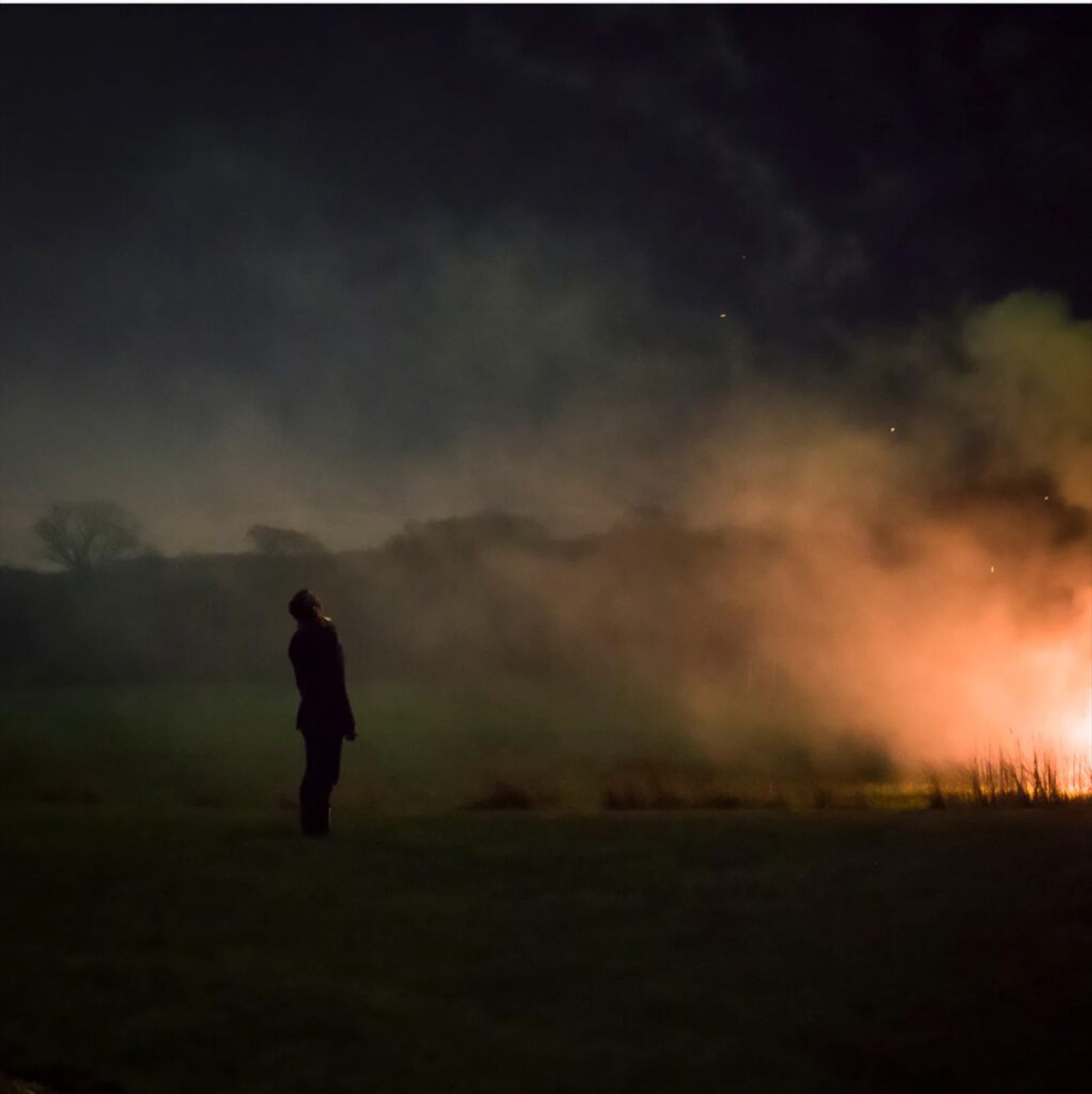

The lone figure turned toward a distant fire belongs to an old European lineage, the Romantic wanderer set small against nature; here the fire is real grass smoking at the field’s right edge, and the wanderer wears an ordinary coat. Cig Harvey knows the ancestry and declines its grandeur. The composition is severe and legible: a dark horizon of trees, a low band of lawn, and one vertical black silhouette left of center, holding its ground against the orange glow from the opposite margin.
What organizes the frame is not the flame but the smoke it makes. A wall of pink-lit vapor rolls across the middle distance, catching the fire’s color and softening the tree line, so the brightest event, the burning reeds at far right, is nearly pushed from view. The sky stays almost black, pricked by a few embers rising like faint stars. The figure faces the light but is not lit by it, standing at the seam where the cold field ends and the warm cloud begins.
The restraint is the point. Where a lesser night picture would center the blaze, this one hands the drama to atmosphere and keeps a person only for scale. Harvey, British-born and settled on the Maine coast, is known for a color lyric of gardens, fruit and fog, and for books that read like private weather; her work is widely collected and shown in American museums. As an archival pigment print the deep tonal range survives intact, the smoke’s blush and the sky’s near-void alike, a night held steady where the eye alone would blink.