Every snowflake here is a dash rather than a dot, a tiny hyphen of speed, and once you notice this the picture changes from a snow scene into a wind scene. The flakes are being flung past on the diagonal like punctuation escaping a novel. Below them, a congregation of reeds leans hard in the same direction, seed heads still rusty, the only members of the landscape with the sense to bow. The trees, being trees, stand there and take it.
Hido drives into weather that makes other people cancel their plans, and photographs it, often through the windshield, from that state of mobile shelter every commuter knows: the storm as something happening to the world in general and to you not quite yet. There is a long tradition of driven snow on the diagonal, Hiroshige managed it with woodblocks, but here the machine admits its own struggle, focus surrendering, flakes blooming near the glass. The blizzard is doing the composing; the photographer’s genius is agreeing to it.
Hido, who grew up with Ohio winters and now lives with California’s gentler ones, has spent his career proving that American landscape photography did not end with the sublime; sometimes it just pulled over. His prints are held by SFMOMA, the Getty and the Whitney, climate-controlled places where weather like this is strictly forbidden, which may be why it looks so alive there. The archival pigment print earns its keep in the grays, dozens of them, from reed-rust to whiteout. It is the rare picture that makes you feel lucky to be indoors, looking.
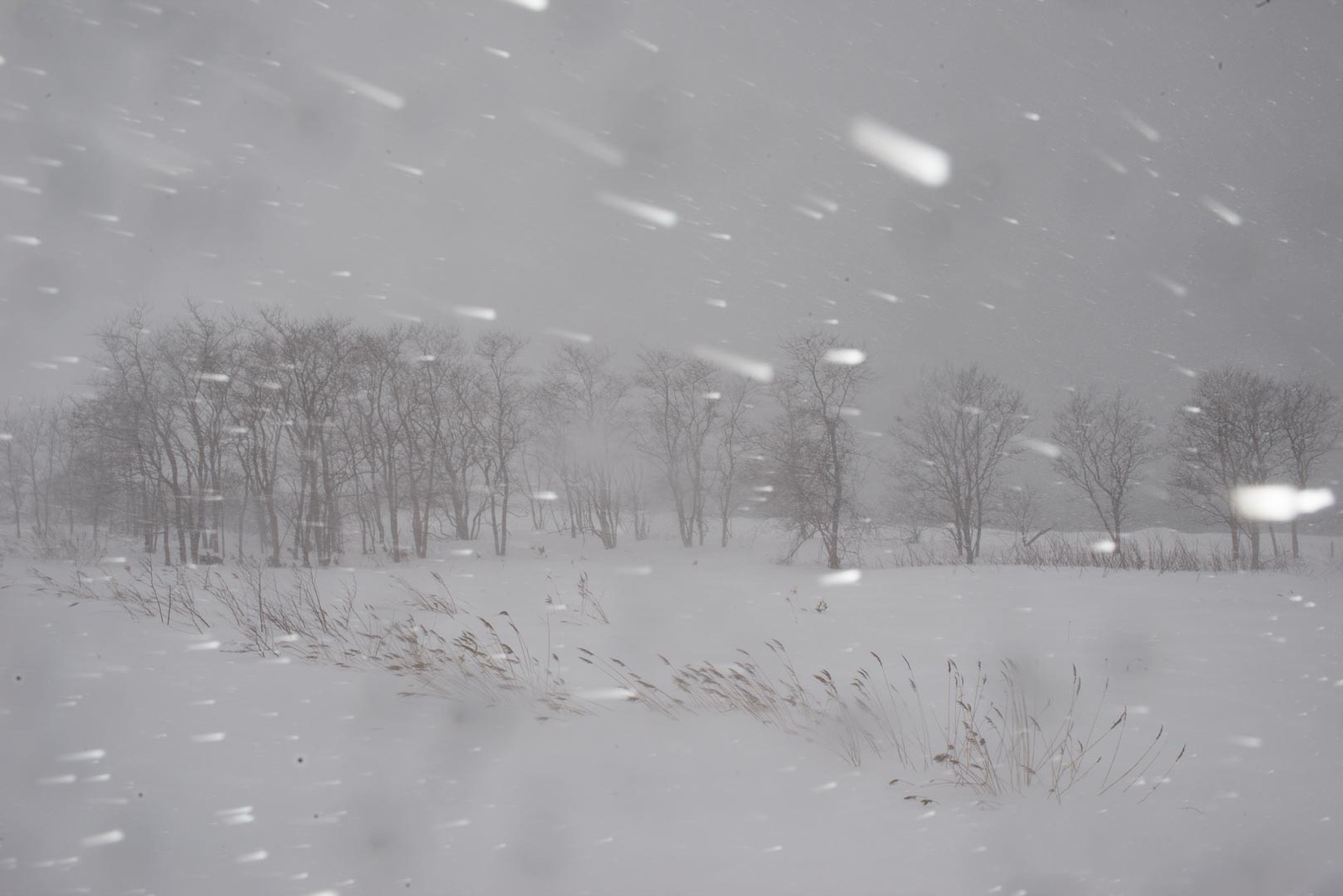

Every snowflake here is a dash rather than a dot, a tiny hyphen of speed, and once you notice this the picture changes from a snow scene into a wind scene. The flakes are being flung past on the diagonal like punctuation escaping a novel. Below them, a congregation of reeds leans hard in the same direction, seed heads still rusty, the only members of the landscape with the sense to bow. The trees, being trees, stand there and take it.
Hido drives into weather that makes other people cancel their plans, and photographs it, often through the windshield, from that state of mobile shelter every commuter knows: the storm as something happening to the world in general and to you not quite yet. There is a long tradition of driven snow on the diagonal, Hiroshige managed it with woodblocks, but here the machine admits its own struggle, focus surrendering, flakes blooming near the glass. The blizzard is doing the composing; the photographer’s genius is agreeing to it.
Hido, who grew up with Ohio winters and now lives with California’s gentler ones, has spent his career proving that American landscape photography did not end with the sublime; sometimes it just pulled over. His prints are held by SFMOMA, the Getty and the Whitney, climate-controlled places where weather like this is strictly forbidden, which may be why it looks so alive there. The archival pigment print earns its keep in the grays, dozens of them, from reed-rust to whiteout. It is the rare picture that makes you feel lucky to be indoors, looking.