Hand-signed by the artist, with title, date, and edition number inscribed in ink on an archival label affixed to the reverse side of the mounted photograph.
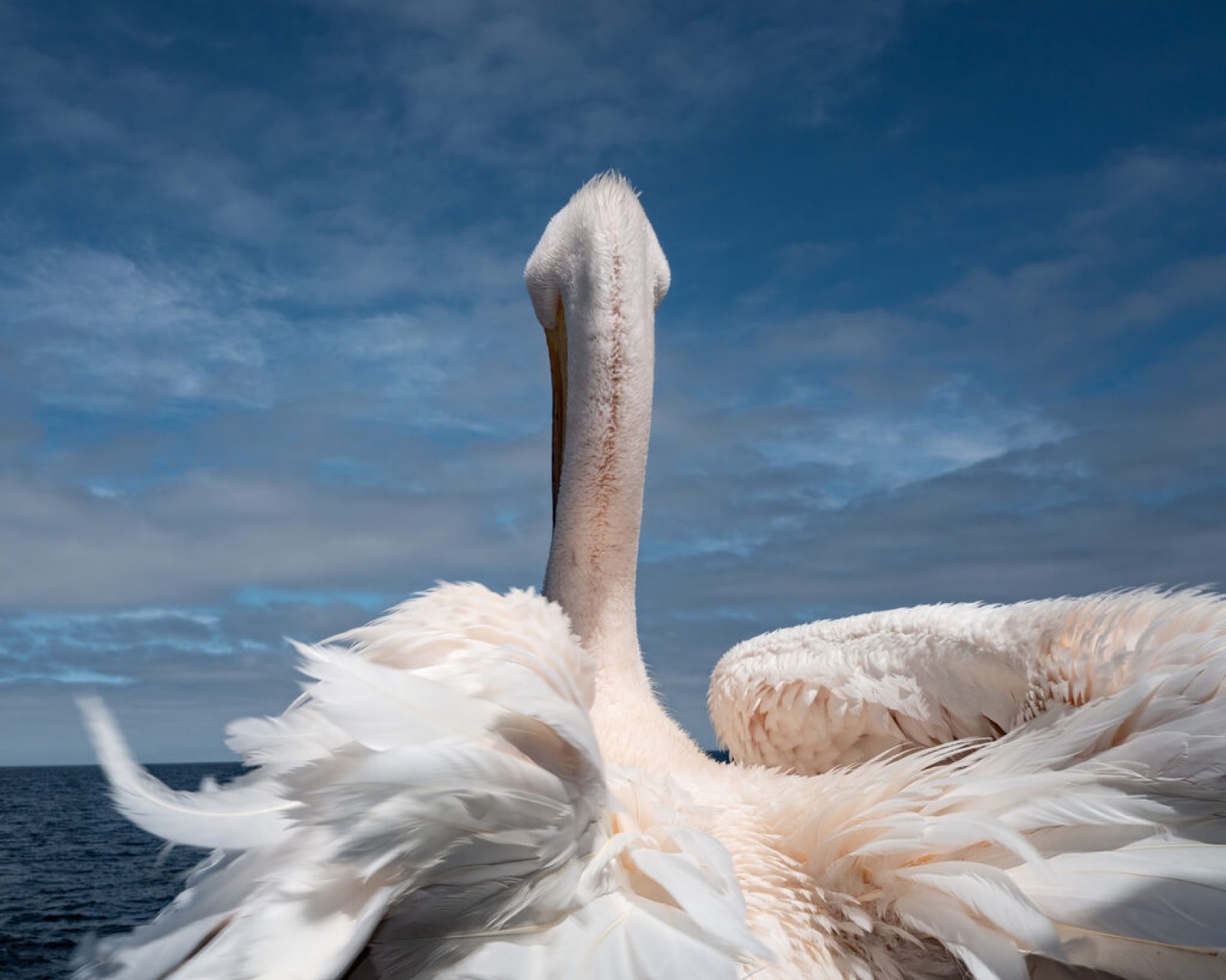
Audubon wired his specimens into attitudes of life; the camera, more honest and more timid, has mostly kept wild birds at the far end of long lenses, small proofs of an encounter. Cig Harvey does neither. She stands close enough to count pinfeathers and photographs her subject from behind, so that the bird becomes a white column rising out of a commotion of wind-ruffled plumage into a hard blue sky.
The picture is organized with an almost architectural economy. The neck is a plumb line dropped through the center of the frame; the long bill lies folded against it like a furled instrument; the head, turned away, withholds the eye that would have made this ornithology. The horizon enters low at the left, just enough sea to state the premise. Everything else is a division of labor: sky smooth, feathers turbulent, light naming each barb along the crest.
It is a portrait made from the wrong side, which is to say the interesting one. Denied a face, we are given posture — upright, alert, faintly comic in its dignity — and a lesson in how many tints hide inside white: cream, rose, grey, the yellow ghost of the bill. Harvey's gamble is that description, pressed this close, turns strange on its own. The bird never looks back. It doesn't need to.
Audubon wired his specimens into attitudes of life; the camera, more honest and more timid, has mostly kept wild birds at the far end of long lenses, small proofs of an encounter. Cig Harvey does neither. She stands close enough to count pinfeathers and photographs her subject from behind, so that the bird becomes a white column rising out of a commotion of wind-ruffled plumage into a hard blue sky.
The picture is organized with an almost architectural economy. The neck is a plumb line dropped through the center of the frame; the long bill lies folded against it like a furled instrument; the head, turned away, withholds the eye that would have made this ornithology. The horizon enters low at the left, just enough sea to state the premise. Everything else is a division of labor: sky smooth, feathers turbulent, light naming each barb along the crest.
It is a portrait made from the wrong side, which is to say the interesting one. Denied a face, we are given posture — upright, alert, faintly comic in its dignity — and a lesson in how many tints hide inside white: cream, rose, grey, the yellow ghost of the bill. Harvey's gamble is that description, pressed this close, turns strange on its own. The bird never looks back. It doesn't need to.