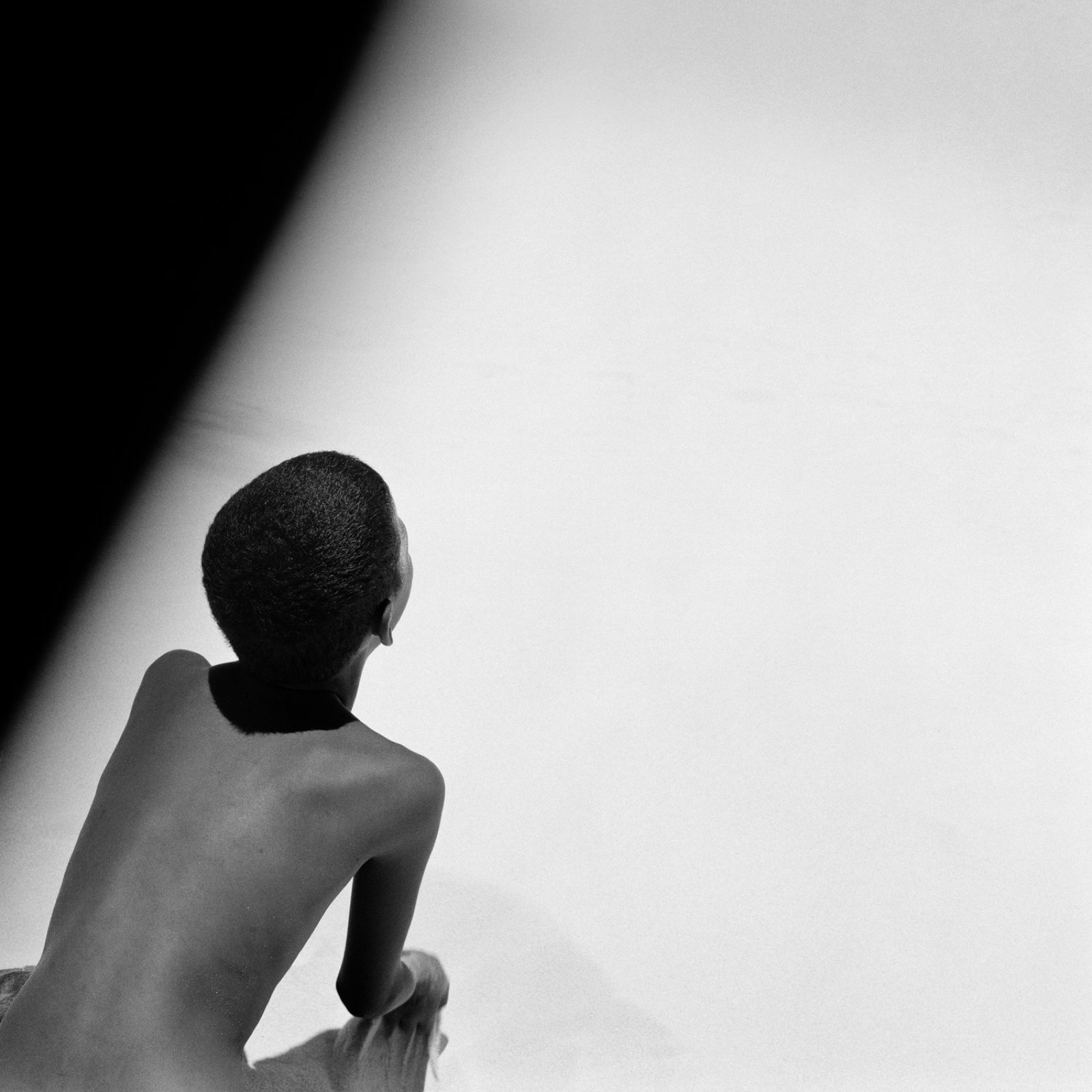
Roy DeCarava argued, in prints of great tenderness, that dark skin deserved to be printed dark — that shadow was not a problem to be corrected but a dwelling place. This photograph descends from that conviction. A boy is seen from above and behind, his cropped hair and thin shoulders rendered in the deepest tones the paper will hold, while the ground around him burns to an almost unexposed white. In the upper left, a great black curve enters the frame like the limb of an eclipse.
What the picture withholds is exactly what portraits usually promise: the face. We are given instead the geography of a back, the twin ridges of the shoulder blades, a collar of shadow pooled at the nape, one hand at the bottom edge closing around something pale — cloth, or a fistful of sand. The vantage is high, the way an adult stands over a child, and yet nothing here surveils. The gaze protects. The boy looks into all that whiteness as into weather, or a future, and we look with him, slightly above, close enough to hear him breathe.
Boy was made in 2017 by a Catalan photographer at the beginning of his path, and it carries the unguarded intensity of early work — pictures made before an audience is imagined. It has become one of the quiet anchors of Galería Alta's contemporary program, the kind of image a gallery builds a sensibility around rather than merely shows. Its authority is not institutional but intimate: a child, a shadow, a page of light, and the old, durable dignity of being seen without being exposed.
Roy DeCarava argued, in prints of great tenderness, that dark skin deserved to be printed dark — that shadow was not a problem to be corrected but a dwelling place. This photograph descends from that conviction. A boy is seen from above and behind, his cropped hair and thin shoulders rendered in the deepest tones the paper will hold, while the ground around him burns to an almost unexposed white. In the upper left, a great black curve enters the frame like the limb of an eclipse.
What the picture withholds is exactly what portraits usually promise: the face. We are given instead the geography of a back, the twin ridges of the shoulder blades, a collar of shadow pooled at the nape, one hand at the bottom edge closing around something pale — cloth, or a fistful of sand. The vantage is high, the way an adult stands over a child, and yet nothing here surveils. The gaze protects. The boy looks into all that whiteness as into weather, or a future, and we look with him, slightly above, close enough to hear him breathe.
Boy was made in 2017 by a Catalan photographer at the beginning of his path, and it carries the unguarded intensity of early work — pictures made before an audience is imagined. It has become one of the quiet anchors of Galería Alta's contemporary program, the kind of image a gallery builds a sensibility around rather than merely shows. Its authority is not institutional but intimate: a child, a shadow, a page of light, and the old, durable dignity of being seen without being exposed.