Can we Take the Long Way Home? II, Accra, Ghana, 2023
Archival pigment print mounted on aluminium Dibond.
One Size Only / 83.8 x 127 cm / 33 x 50 in
Hand-signed by the artist, with title, date, and edition number inscribed in ink on an archival label affixed to the reverse side of the mounted photograph
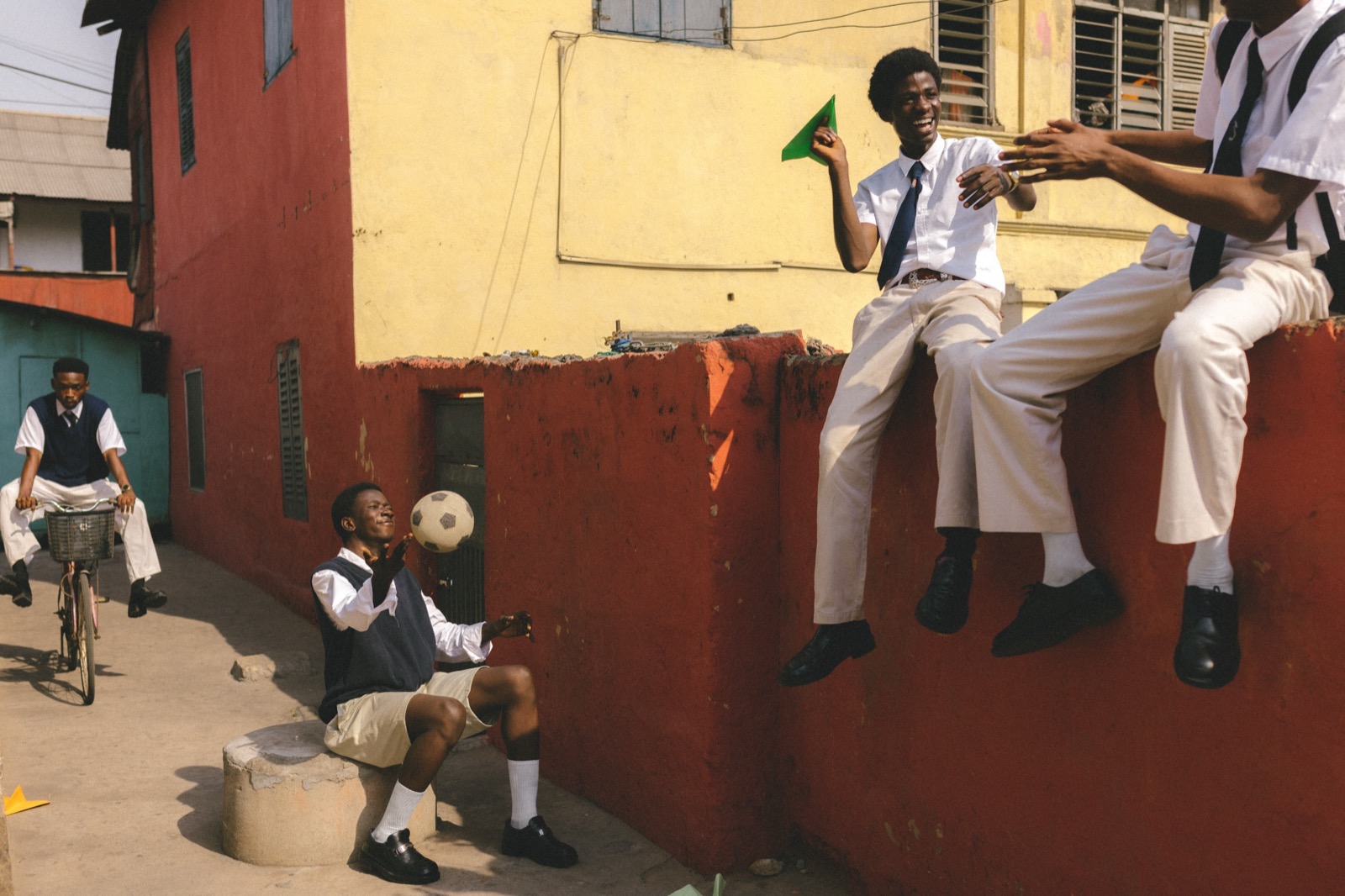
A low red wall crosses the picture like a stave, and the boys are placed against it like notes. Four of them, each at his own pitch of play: one arriving by bicycle, one on a concrete stump juggling a football inches from his nose, two on the wall, one lifting a green paper airplane an instant before the throw. The paint is chalky and scabbed, the house behind yellow over red and strung with wires, the socks pulled white and high. Nothing outranks anything else: plane, ball, basket and grin get equal weight.
The photographer’s problem was time, and it is solved twice over. The football must stay at the boy’s face; the airplane must still be in the hand, its flight kept in the future tense. Idun-Tawiah stands where the wall’s diagonal opens the corner — ground, stump, parapet, three stages at once — while the cyclist enters where the frame would close. In identical white and navy, each gesture is a signature: the juggler’s tilted chin, the thrower’s raised arm, his neighbour’s two hands already open to applaud.
The title asks permission — can we take the long way home? — and the photograph is the argument for yes. School is out, the light is hard, and home can wait until the airplane has flown. Idun-Tawiah, photographing an Accra boyhood he knows from inside, keeps the sentiment in the facts: a wall here is a stage, a goalpost, a launch pad. The long way home is where boys rehearse who they will be, and the picture holds that rehearsal open — ball in the air, plane in the hand, wheel still turning.
A low red wall crosses the picture like a stave, and the boys are placed against it like notes. Four of them, each at his own pitch of play: one arriving by bicycle, one on a concrete stump juggling a football inches from his nose, two on the wall, one lifting a green paper airplane an instant before the throw. The paint is chalky and scabbed, the house behind yellow over red and strung with wires, the socks pulled white and high. Nothing outranks anything else: plane, ball, basket and grin get equal weight.
The photographer’s problem was time, and it is solved twice over. The football must stay at the boy’s face; the airplane must still be in the hand, its flight kept in the future tense. Idun-Tawiah stands where the wall’s diagonal opens the corner — ground, stump, parapet, three stages at once — while the cyclist enters where the frame would close. In identical white and navy, each gesture is a signature: the juggler’s tilted chin, the thrower’s raised arm, his neighbour’s two hands already open to applaud.
The title asks permission — can we take the long way home? — and the photograph is the argument for yes. School is out, the light is hard, and home can wait until the airplane has flown. Idun-Tawiah, photographing an Accra boyhood he knows from inside, keeps the sentiment in the facts: a wall here is a stage, a goalpost, a launch pad. The long way home is where boys rehearse who they will be, and the picture holds that rehearsal open — ball in the air, plane in the hand, wheel still turning.