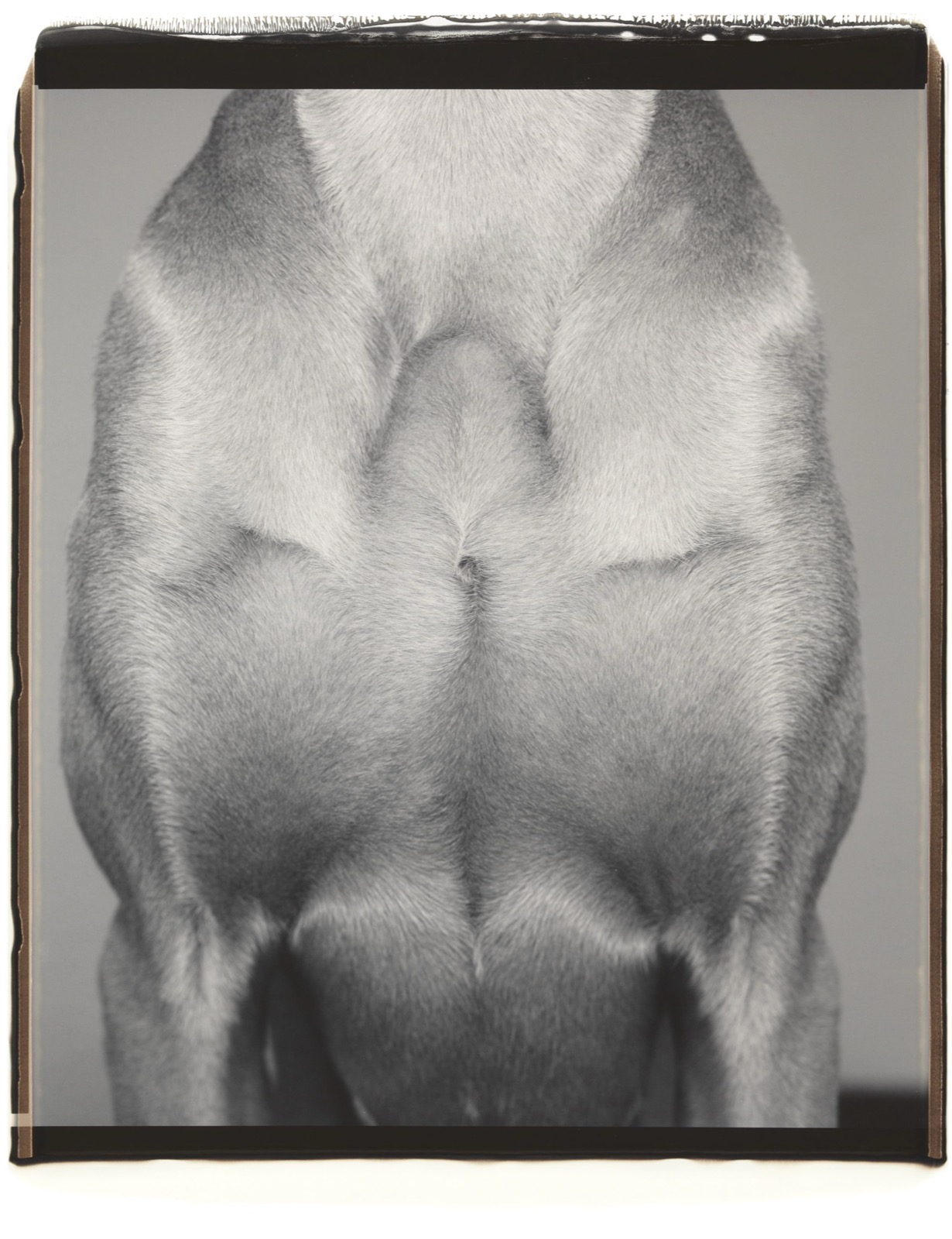
No face, no eyes, no famous mournful gaze: what the picture refuses is precisely the thing we came for, and in its place stands the broad grey back, the twin haunches meeting along a central seam, the hindquarters offered with the frontal gravity of a marble bust. This is the dog seen from the side it never shows in the paintings, the anti-portrait, the sitter caught turning away and somehow more dignified for it.
Stare a while and the animal dissolves into other things. The muscled swell of the flanks becomes a pair of hills under snow; the soft groove down the spine turns architectural, a fluted column seen from behind, the body reduced to a grand front with nothing behind it but more dog. There is a joke here, obviously, of the schoolboy variety, but Wegman plays it so straight that the humour curdles into something almost sculptural. The fur, lit from above, holds the grey scale like brushed pewter, every hair separately accounted for.
Wegman has spent half a century proving that his Weimaraners will hold any pose the mind projects onto them, and the wit has always depended on this deadpan compliance. Made on the outsized black-and-white Polaroid, the image is a single unrepeatable sheet, mounted as one physical object rather than issued as prints; the tonal range you see is the material itself, not a scan of it. It is, in the end, a portrait of the least portraitlike view available, and it works. The dog wins by turning its back.
No face, no eyes, no famous mournful gaze: what the picture refuses is precisely the thing we came for, and in its place stands the broad grey back, the twin haunches meeting along a central seam, the hindquarters offered with the frontal gravity of a marble bust. This is the dog seen from the side it never shows in the paintings, the anti-portrait, the sitter caught turning away and somehow more dignified for it.
Stare a while and the animal dissolves into other things. The muscled swell of the flanks becomes a pair of hills under snow; the soft groove down the spine turns architectural, a fluted column seen from behind, the body reduced to a grand front with nothing behind it but more dog. There is a joke here, obviously, of the schoolboy variety, but Wegman plays it so straight that the humour curdles into something almost sculptural. The fur, lit from above, holds the grey scale like brushed pewter, every hair separately accounted for.
Wegman has spent half a century proving that his Weimaraners will hold any pose the mind projects onto them, and the wit has always depended on this deadpan compliance. Made on the outsized black-and-white Polaroid, the image is a single unrepeatable sheet, mounted as one physical object rather than issued as prints; the tonal range you see is the material itself, not a scan of it. It is, in the end, a portrait of the least portraitlike view available, and it works. The dog wins by turning its back.