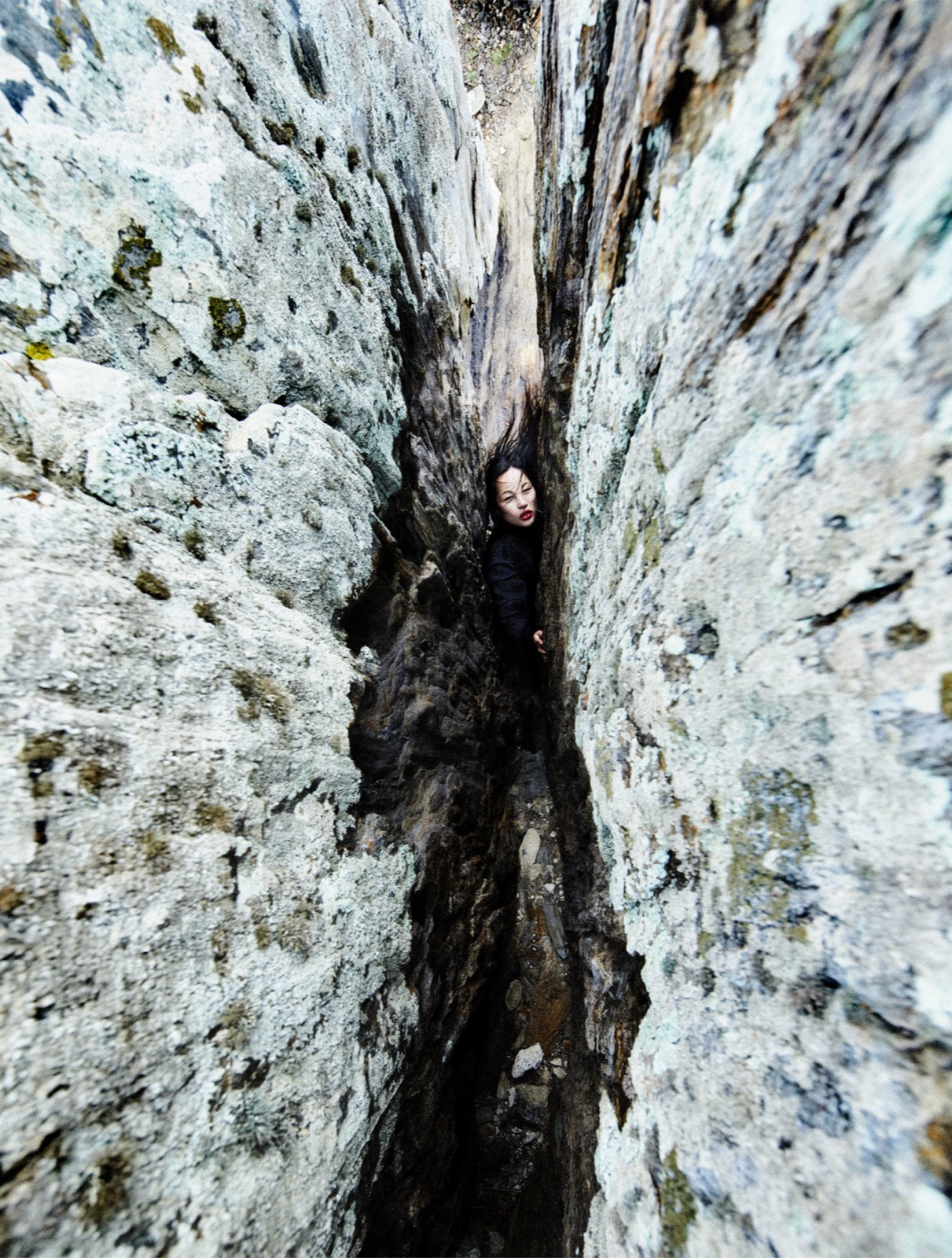
The red of her lipstick is the smallest fact in the frame and the one that runs the whole picture. Everything else belongs to geology: two lichen-mapped rock faces in mineral greys and off-whites, a crevice of wet brown shadow, scree far below. Then that precise mouth, worn by a woman wedged deep in the fissure with her black clothes dissolving into it, and the image snaps from landscape into fashion, or rather into an argument about how little fashion needs in order to declare itself.
This is a directorial picture in the fullest sense, staged with the logic of cinema rather than the logic of the catalogue. The camera looks down the chimney of rock; her hair lifts on an updraft; one hand grips the stone as though the earth were mid-swallow. Nothing about the garment is described, no seam, no silhouette, and that refusal is the point: the shoot behaves like a myth, Persephone restaged for a wide-angle lens, and the clothes are subsumed into narrative the way costume is absorbed in serious film.
Yeste has built his standing, Numéro, Harper’s Bazaar, Vogue, on exactly this willingness to hand fashion over to the elements, fire, water, sand, wind, and let them style it. In Cadaqués the element is stone. As an archival pigment print the picture keeps its double scale intact: from a distance a cold abstract V of rock, up close a fine-grained inventory of lichen, and in between, small and unmissable, that red signal of a mouth refusing to fade.
The red of her lipstick is the smallest fact in the frame and the one that runs the whole picture. Everything else belongs to geology: two lichen-mapped rock faces in mineral greys and off-whites, a crevice of wet brown shadow, scree far below. Then that precise mouth, worn by a woman wedged deep in the fissure with her black clothes dissolving into it, and the image snaps from landscape into fashion, or rather into an argument about how little fashion needs in order to declare itself.
This is a directorial picture in the fullest sense, staged with the logic of cinema rather than the logic of the catalogue. The camera looks down the chimney of rock; her hair lifts on an updraft; one hand grips the stone as though the earth were mid-swallow. Nothing about the garment is described, no seam, no silhouette, and that refusal is the point: the shoot behaves like a myth, Persephone restaged for a wide-angle lens, and the clothes are subsumed into narrative the way costume is absorbed in serious film.
Yeste has built his standing, Numéro, Harper’s Bazaar, Vogue, on exactly this willingness to hand fashion over to the elements, fire, water, sand, wind, and let them style it. In Cadaqués the element is stone. As an archival pigment print the picture keeps its double scale intact: from a distance a cold abstract V of rock, up close a fine-grained inventory of lichen, and in between, small and unmissable, that red signal of a mouth refusing to fade.