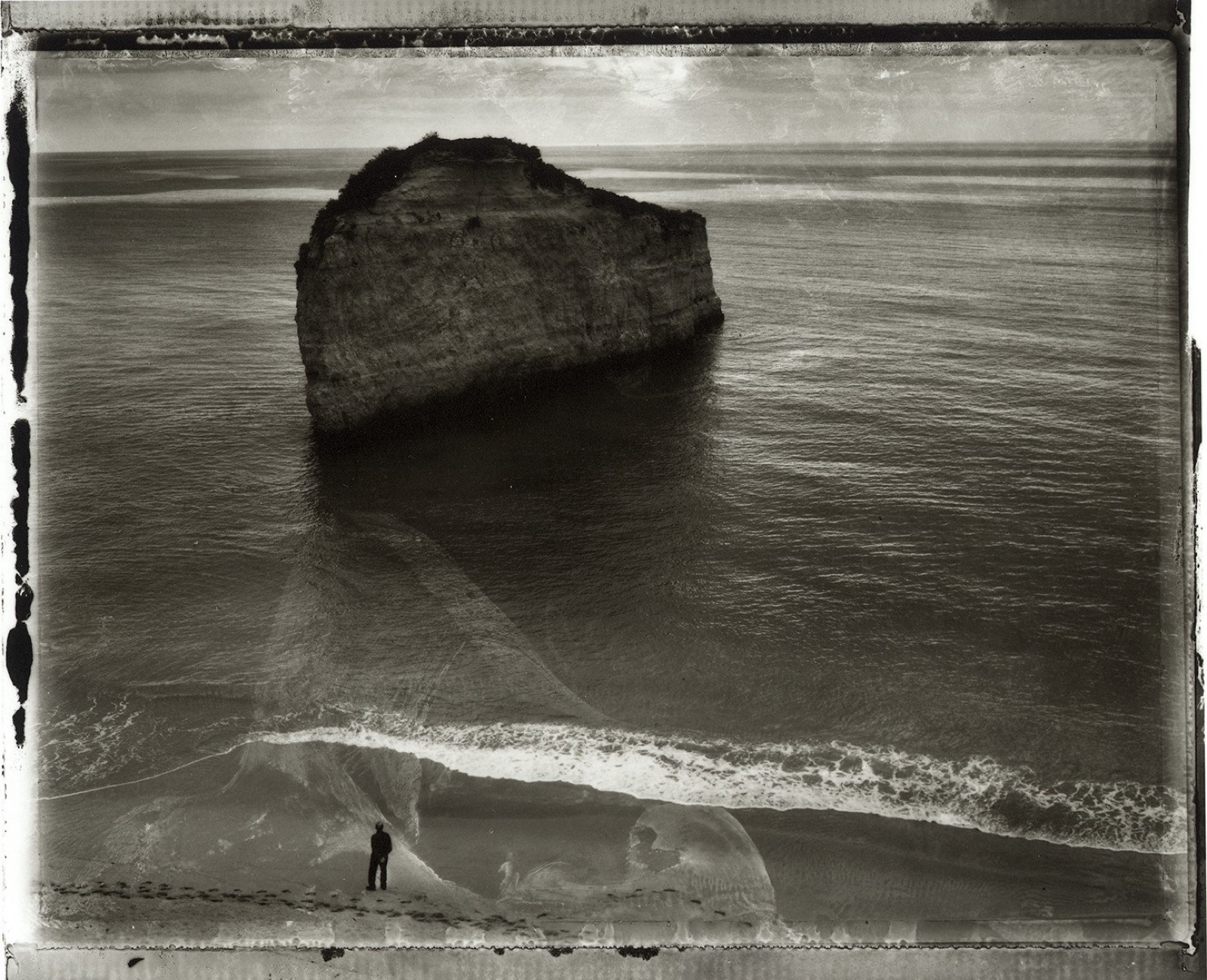
Begin with the man, because the picture makes you hunt for him: a single dark upright on the lower beach, scarcely taller than the grain around him, fixed in place while the sea-stack offshore towers like a dropped curtain weight. Sarah Moon stages scale as a deliberate strategy here. The figure is not a subject so much as a unit of measure, placed so that the eye must travel from his stillness up across the doubled, exposed-twice arc of surf to the flat-topped rock that anchors the horizon. Everything in the frame is arranged to be read as distance.
What separates this from straight landscape is Moon's refusal of the clean negative. The print carries its own making at the edges — the raw black Polaroid borders, the bleeds and chemical flares she leaves untrimmed — so the image declares itself as object and emulsion rather than window. That decision belongs squarely to her position in contemporary photography: a fashion image-maker who turned the constructed, atmospheric tableau into fine-art practice, treating the print's accidents as authorship. The ghosted surf, where one wave seems to pass through another, is the tell. This is not documentation of a shore; it is a picture built to look remembered.
Coming late in a long career — Moon's work sits in the collections of the Maison Européenne de la Photographie and the Victoria and Albert, and her monochrome seascapes are among the most sought of her non-fashion output — "Noël au Portugal" reads as a study in how little a photograph needs to hold a viewer. A man, a rock, a torn black border, and the sea doing the work of memory. The gelatin silver surface keeps it grave and intimate at once, an image that positions stillness itself as the contemporary gesture.
Begin with the man, because the picture makes you hunt for him: a single dark upright on the lower beach, scarcely taller than the grain around him, fixed in place while the sea-stack offshore towers like a dropped curtain weight. Sarah Moon stages scale as a deliberate strategy here. The figure is not a subject so much as a unit of measure, placed so that the eye must travel from his stillness up across the doubled, exposed-twice arc of surf to the flat-topped rock that anchors the horizon. Everything in the frame is arranged to be read as distance.
What separates this from straight landscape is Moon's refusal of the clean negative. The print carries its own making at the edges — the raw black Polaroid borders, the bleeds and chemical flares she leaves untrimmed — so the image declares itself as object and emulsion rather than window. That decision belongs squarely to her position in contemporary photography: a fashion image-maker who turned the constructed, atmospheric tableau into fine-art practice, treating the print's accidents as authorship. The ghosted surf, where one wave seems to pass through another, is the tell. This is not documentation of a shore; it is a picture built to look remembered.
Coming late in a long career — Moon's work sits in the collections of the Maison Européenne de la Photographie and the Victoria and Albert, and her monochrome seascapes are among the most sought of her non-fashion output — "Noël au Portugal" reads as a study in how little a photograph needs to hold a viewer. A man, a rock, a torn black border, and the sea doing the work of memory. The gelatin silver surface keeps it grave and intimate at once, an image that positions stillness itself as the contemporary gesture.