A house is burning at night, and the fire has reached the roof: flame stands above the ridgeline and pours from the upper windows, throwing red across the bare trees that frame the scene on both sides and across the dry grass in front. Below and much closer to us, Michelle lies on her side on the ground in an enormous hooded garment of woven metallic mesh that spreads behind her in heavy coils. Her face is the one cool thing in the picture. One bare arm reaches forward into the dirt.
Everything here is scaled by the fire. It supplies the only light, and therefore also the modelling of the mesh, the rim on the branches, the red in the grass — the entire palette of the photograph issues from a single event. The figure is placed low and to the left, beneath the horizon of the burning building, in the position nineteenth-century painting reserved for the survivor or the mourner at the foot of a catastrophe. She is not fleeing. She is lying down, propped on an elbow, facing us.
Yeste has worked this territory before — the outdoor night production, the single overwhelming light source, the body arranged as sculpture within it — but rarely at this scale of incident. The image belongs to a lineage in fashion photography of borrowing the disaster picture, running from the staged catastrophes of the 1970s magazines onward, and it accepts the borrowing openly: mesh at night reflects only what is given to it, so the garment requires an inferno in order to be seen at all. Whether the house was built to burn is a question this print neither answers nor appears to consider important.
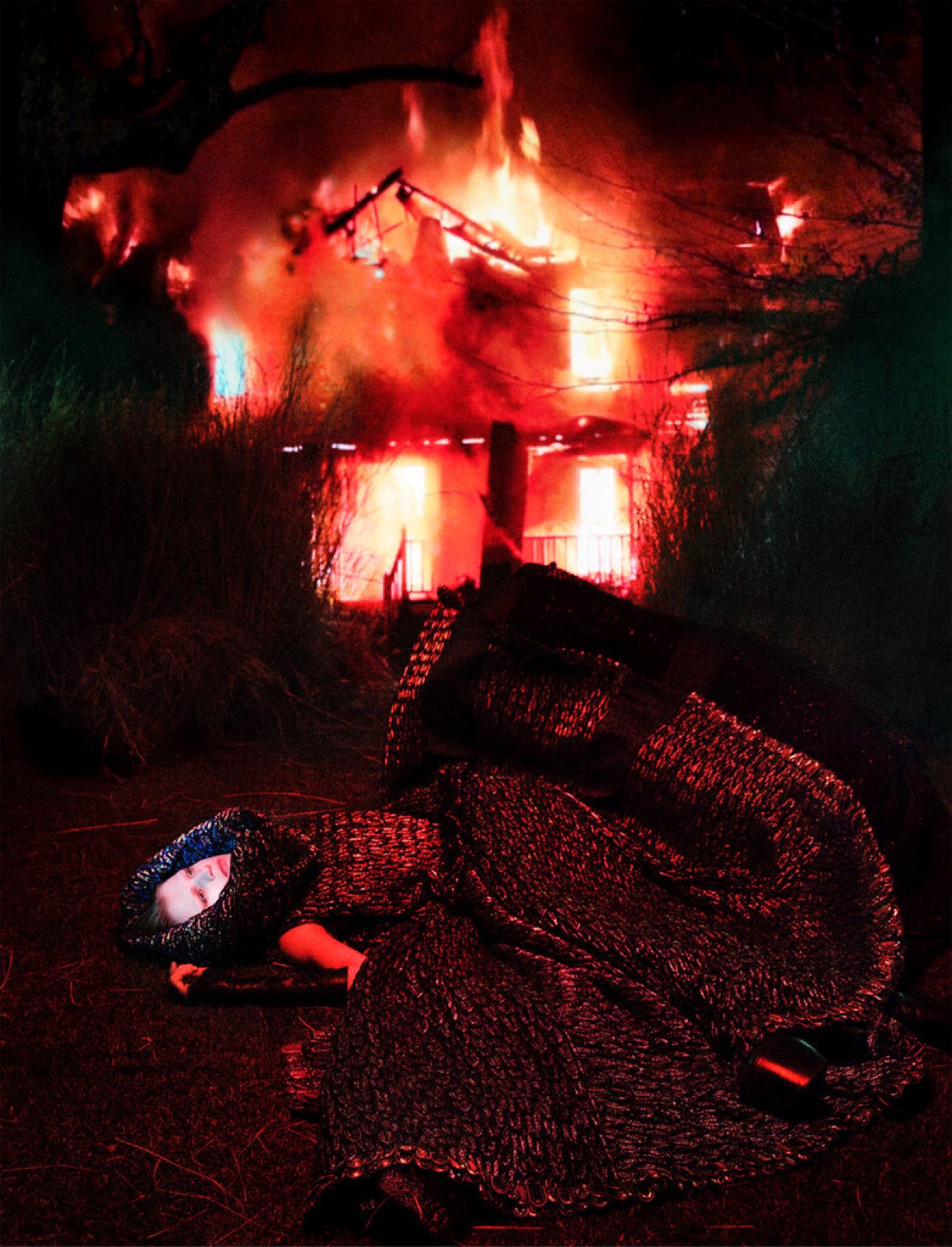

A house is burning at night, and the fire has reached the roof: flame stands above the ridgeline and pours from the upper windows, throwing red across the bare trees that frame the scene on both sides and across the dry grass in front. Below and much closer to us, Michelle lies on her side on the ground in an enormous hooded garment of woven metallic mesh that spreads behind her in heavy coils. Her face is the one cool thing in the picture. One bare arm reaches forward into the dirt.
Everything here is scaled by the fire. It supplies the only light, and therefore also the modelling of the mesh, the rim on the branches, the red in the grass — the entire palette of the photograph issues from a single event. The figure is placed low and to the left, beneath the horizon of the burning building, in the position nineteenth-century painting reserved for the survivor or the mourner at the foot of a catastrophe. She is not fleeing. She is lying down, propped on an elbow, facing us.
Yeste has worked this territory before — the outdoor night production, the single overwhelming light source, the body arranged as sculpture within it — but rarely at this scale of incident. The image belongs to a lineage in fashion photography of borrowing the disaster picture, running from the staged catastrophes of the 1970s magazines onward, and it accepts the borrowing openly: mesh at night reflects only what is given to it, so the garment requires an inferno in order to be seen at all. Whether the house was built to burn is a question this print neither answers nor appears to consider important.