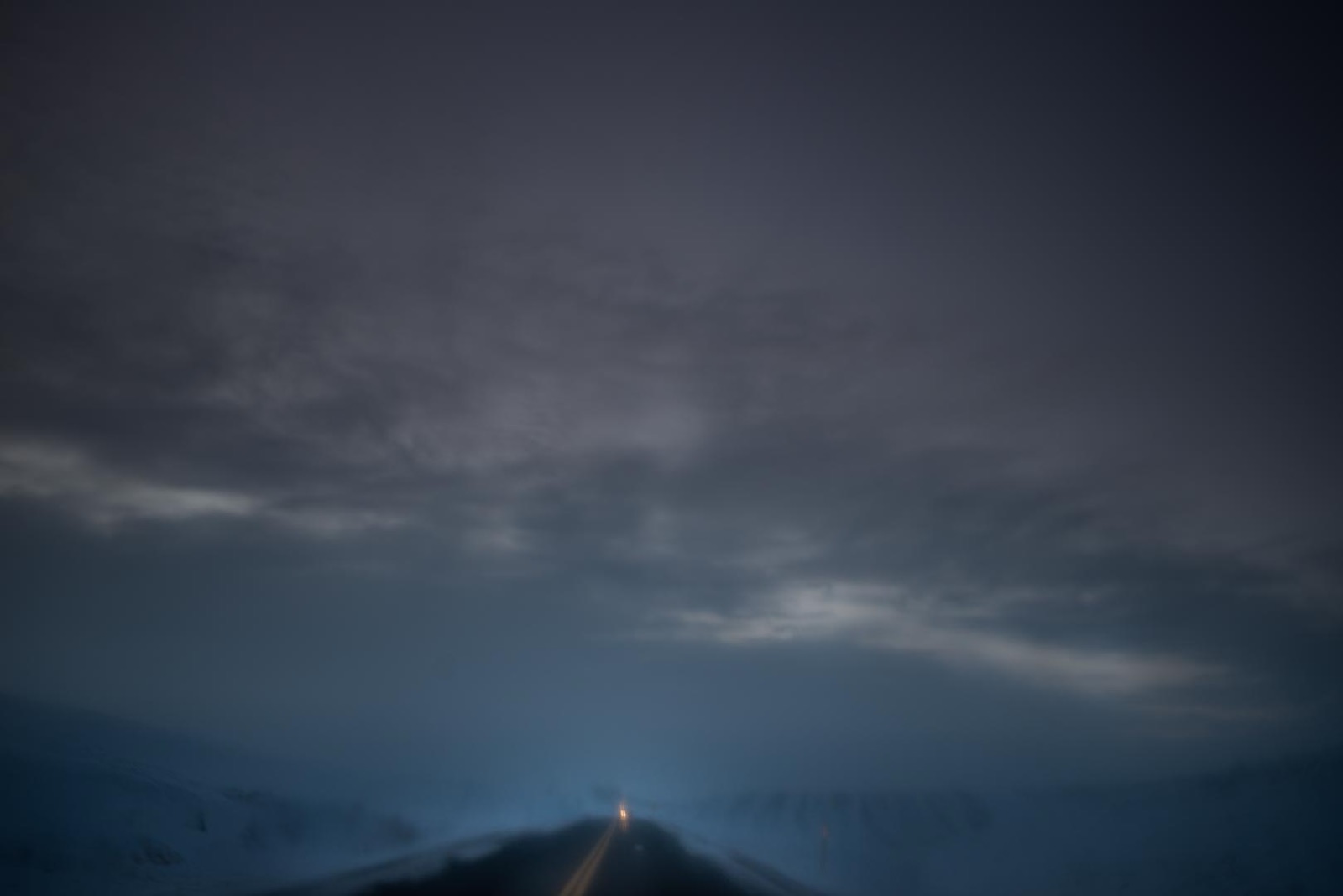
The American road picture was declared finished long before this blue dusk existed; Robert Frank had already driven it, and the ad agencies had strip-mined what was left. Then a pair of headlights appears at the end of a snow-banked two-lane, small as a struck match, and the genre sits up again. Almost everything here is sky, a heavy lid of cloud going indigo; the road takes what light remains, its yellow line running straight at us out of the dark.
Hido shoots these landscapes from the road, often through the windshield, and the blur here is the blur of being somewhere without stopping. The picture runs on torch-song pacing: one low flame of amber in acres of blue, the hills keeping their snow like a held breath. It could be the establishing shot of a film noir that never arrives, or the cover of the saddest record of the winter. What sells the drama is restraint; nothing moves but the light.
His pictures go by numbers, 11176-7577, the way great singles once carried catalogue codes, and the reticence suits him; a name would pin down what the picture keeps loose. This is the Hido that museums committed to early, with prints at SFMOMA, the Getty and the Whitney, the poet of American driving weather. As an archival pigment print it holds the hardest register in photography, dusk, without clogging: indigo staying open in the shadows, that double star of headlights still warm. You keep waiting for the car to reach you. It never will, and that is the pleasure.
The American road picture was declared finished long before this blue dusk existed; Robert Frank had already driven it, and the ad agencies had strip-mined what was left. Then a pair of headlights appears at the end of a snow-banked two-lane, small as a struck match, and the genre sits up again. Almost everything here is sky, a heavy lid of cloud going indigo; the road takes what light remains, its yellow line running straight at us out of the dark.
Hido shoots these landscapes from the road, often through the windshield, and the blur here is the blur of being somewhere without stopping. The picture runs on torch-song pacing: one low flame of amber in acres of blue, the hills keeping their snow like a held breath. It could be the establishing shot of a film noir that never arrives, or the cover of the saddest record of the winter. What sells the drama is restraint; nothing moves but the light.
His pictures go by numbers, 11176-7577, the way great singles once carried catalogue codes, and the reticence suits him; a name would pin down what the picture keeps loose. This is the Hido that museums committed to early, with prints at SFMOMA, the Getty and the Whitney, the poet of American driving weather. As an archival pigment print it holds the hardest register in photography, dusk, without clogging: indigo staying open in the shadows, that double star of headlights still warm. You keep waiting for the car to reach you. It never will, and that is the pleasure.