Nowhere in the frame is the source: no tap, no hose, no waterfall, only the arc of droplets flung across Bridget Hall’s shoulder and hanging in the air like a broken necklace. Weber withholds the mechanics and keeps the effect. Behind her, a large pale body dissolves into blur, an animal’s flank, perhaps, refusing to resolve into place or narrative. What we are shown is precise and partial: a wet white vest clinging to her ribs, one arm folded up behind a head of slicked-dark hair, her face tipped toward a light we cannot see.
The picture is built like a fashion image and lit like a myth. Hall is styled down to almost nothing, a plain ribbed tank soaked translucent, so that the drama is carried entirely by water, gesture and skin. Her parted lips and lifted chin read less as seduction than as effort, a body caught mid-exertion in a made scene. Weber, the great director of American desire, stages the natural and lets the constructed show through: the spray is choreographed, the blur deliberate, the ease hard-won.
This is the register in which Weber remade fashion photography in the 1980s and kept working into the new century, sun, sport, wet cloth, the athletic body treated as classical statuary and shot with a reporter’s nerve. The gelatin silver print is essential to the effect: continuous grays carry the water from bright highlight to shadowed droplet, and the soft background stays luminous rather than muddy. It is an object made to hold light the way the picture holds its spray, everything given except the thing that caused it.
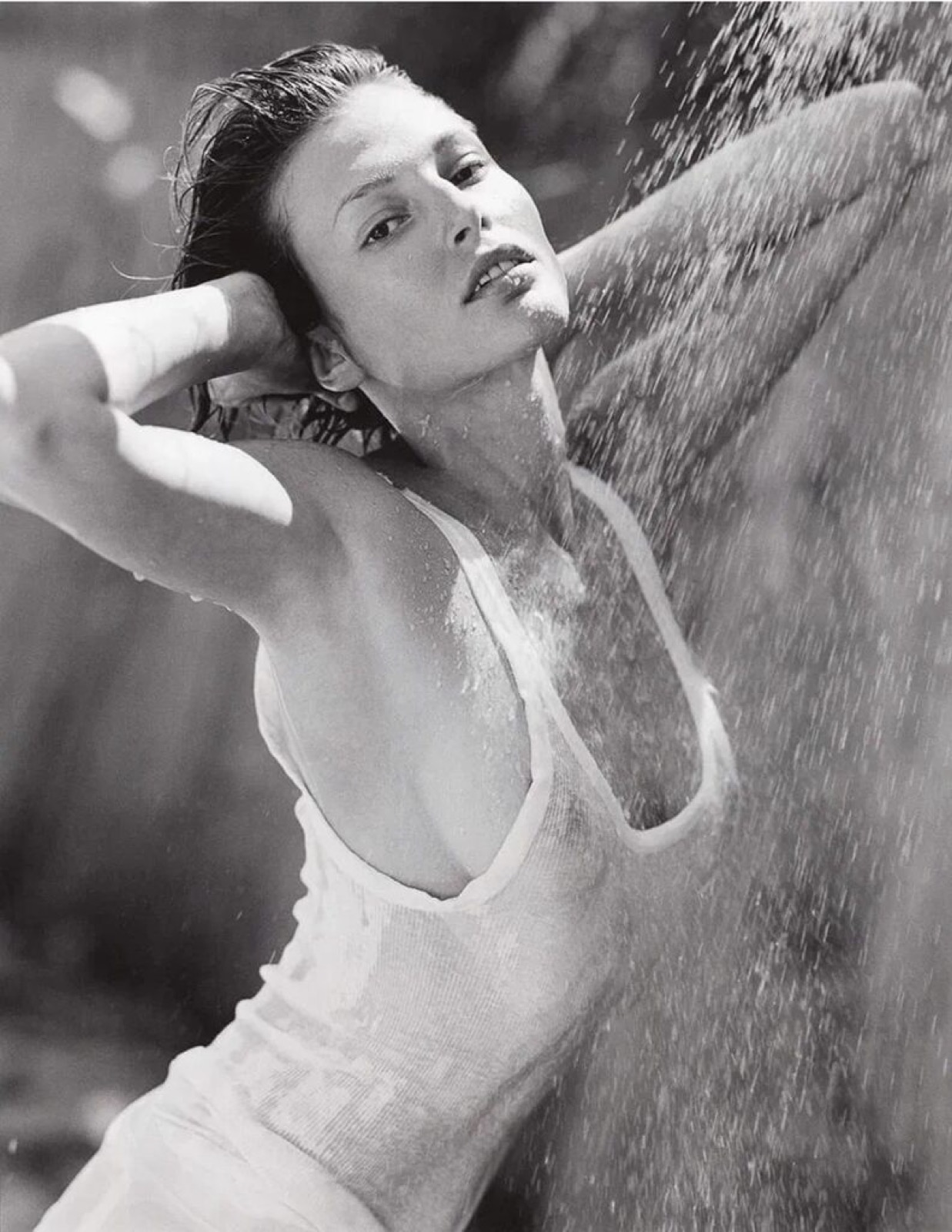

Nowhere in the frame is the source: no tap, no hose, no waterfall, only the arc of droplets flung across Bridget Hall’s shoulder and hanging in the air like a broken necklace. Weber withholds the mechanics and keeps the effect. Behind her, a large pale body dissolves into blur, an animal’s flank, perhaps, refusing to resolve into place or narrative. What we are shown is precise and partial: a wet white vest clinging to her ribs, one arm folded up behind a head of slicked-dark hair, her face tipped toward a light we cannot see.
The picture is built like a fashion image and lit like a myth. Hall is styled down to almost nothing, a plain ribbed tank soaked translucent, so that the drama is carried entirely by water, gesture and skin. Her parted lips and lifted chin read less as seduction than as effort, a body caught mid-exertion in a made scene. Weber, the great director of American desire, stages the natural and lets the constructed show through: the spray is choreographed, the blur deliberate, the ease hard-won.
This is the register in which Weber remade fashion photography in the 1980s and kept working into the new century, sun, sport, wet cloth, the athletic body treated as classical statuary and shot with a reporter’s nerve. The gelatin silver print is essential to the effect: continuous grays carry the water from bright highlight to shadowed droplet, and the soft background stays luminous rather than muddy. It is an object made to hold light the way the picture holds its spray, everything given except the thing that caused it.