GLOBE, stitched in pale thread across the band of his cap, names both the theatre and the lineage this usher enters: Faurer's gallery of solitary young people, framed close, looking back at the lens with a gravity beyond their years. He stands in the lobby of the Globe, the theatre's name stitched across his cap, his dark coat finished in pale piping, a button at the collar. To his right, in bold lobby lettering, the titles crowd in—Public Enemy, Scarface, The Killers—the violent mythologies he ushers strangers toward every night.
The boy belongs to the great descent that runs from Sander's tradesmen through Walker Evans's clerks: the worker photographed in the costume of his function, dignified and slightly trapped by it. Yet Faurer adds something the older portraitists withheld—the blurred, glittering lobby behind, the smear of glass and brass, the cinematic light that makes the usher half a figure in the very dream he polices. He is at once attendant and protagonist.
His expression is the picture's argument. It is not the smile the job requires but a level, faintly wounded looking-out, the face of someone who knows the screen sells crime as glamour while he stands all evening in its glow for wages. Photography of this kind does not flatter labor or condemn the dream; it holds the two in one frame and lets the young man's gaze carry the contradiction. Beside the killers in their lettering, he is the only real person in the room.
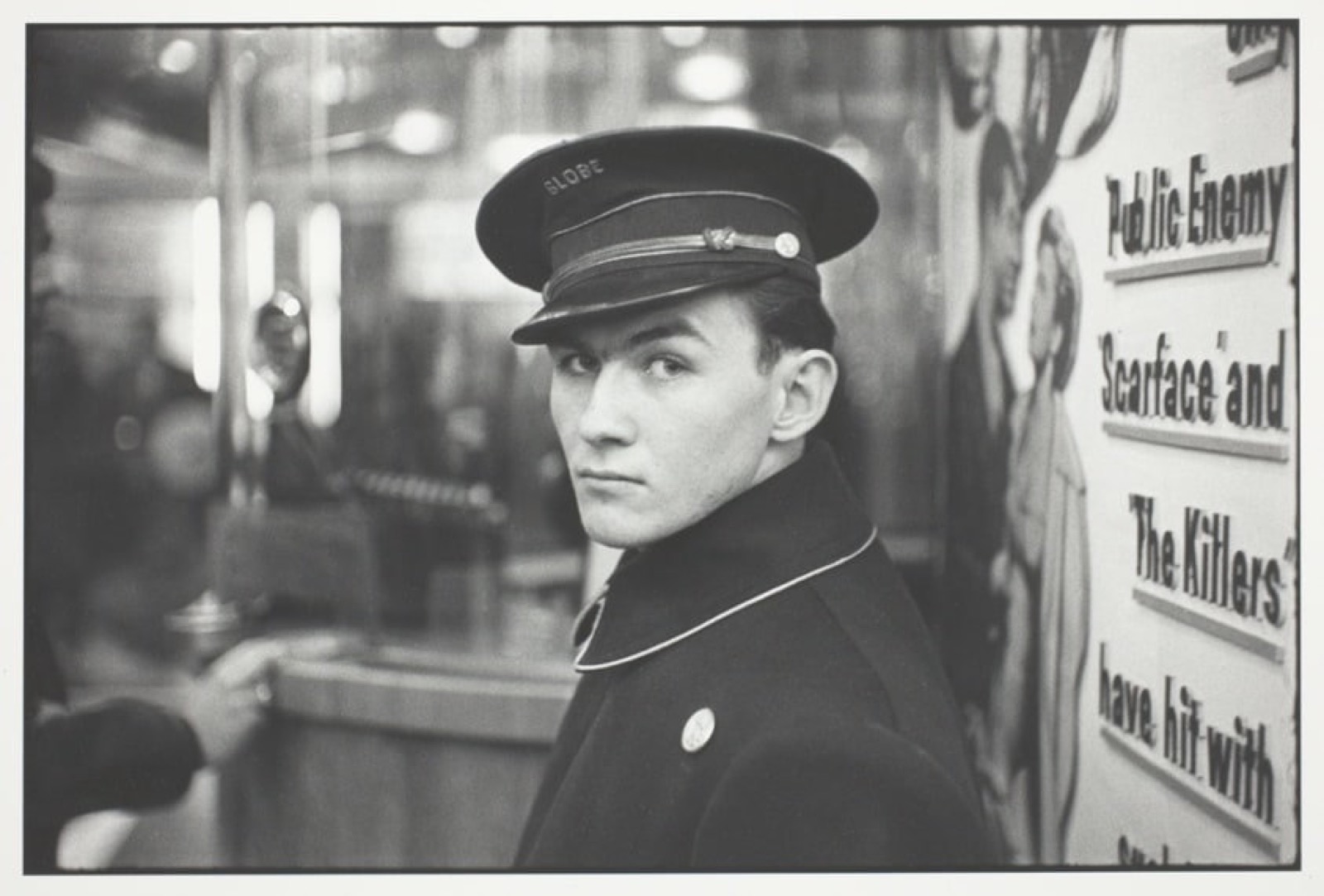

GLOBE, stitched in pale thread across the band of his cap, names both the theatre and the lineage this usher enters: Faurer's gallery of solitary young people, framed close, looking back at the lens with a gravity beyond their years. He stands in the lobby of the Globe, the theatre's name stitched across his cap, his dark coat finished in pale piping, a button at the collar. To his right, in bold lobby lettering, the titles crowd in—Public Enemy, Scarface, The Killers—the violent mythologies he ushers strangers toward every night.
The boy belongs to the great descent that runs from Sander's tradesmen through Walker Evans's clerks: the worker photographed in the costume of his function, dignified and slightly trapped by it. Yet Faurer adds something the older portraitists withheld—the blurred, glittering lobby behind, the smear of glass and brass, the cinematic light that makes the usher half a figure in the very dream he polices. He is at once attendant and protagonist.
His expression is the picture's argument. It is not the smile the job requires but a level, faintly wounded looking-out, the face of someone who knows the screen sells crime as glamour while he stands all evening in its glow for wages. Photography of this kind does not flatter labor or condemn the dream; it holds the two in one frame and lets the young man's gaze carry the contradiction. Beside the killers in their lettering, he is the only real person in the room.