It rises. The sun lifts off the line of the road and hangs there, low, already tired, ringed by a pale circle of frozen air that the cold has drawn around it like a second, fainter sun. To see this is to watch a verb suspended: the light does not arrive, it lingers; it does not fall on the snow so much as soak into it, until the white of the field and the white of the sky are nearly the same substance, and only the dark wedge of a single pine insists that there is a difference between earth and what hangs above it.
I keep returning to that tree. It stands a little apart from the low huddle of others at the left, alone in the middle distance, neither tall nor majestic, simply present — and it is this ordinariness that holds me. The plowed track runs out of the bottom of the frame and up toward the horizon, its tire-marks pressed into the snow, and at the road's vanishing point the pine waits as if it had been set there to be counted. A halo for the sun, a small dark sentinel for the field: the photograph offers two solitudes and lets them look at each other across the cold.
What Jessica Lange has noticed, along Highway 61 in the deep of a Minnesota winter, is the moment before anything happens — the white morning that has not decided whether to brighten or to close. There is no figure, no incident, only a road that someone has cleared and then abandoned to the light. The image does not console me; it does something colder and more lasting. It makes the silence visible, and leaves me standing in it, breath held, on a road I have never walked.
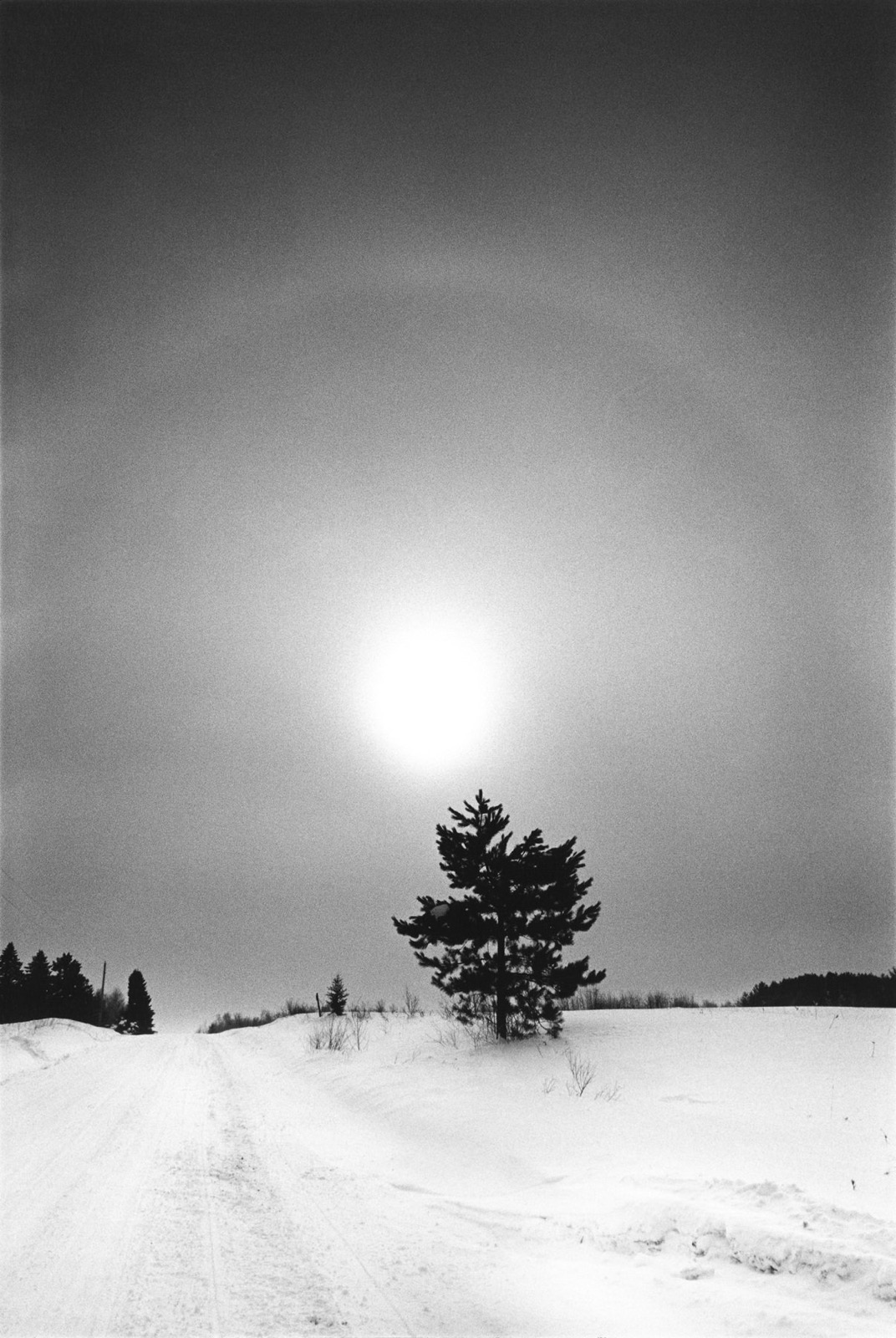

It rises. The sun lifts off the line of the road and hangs there, low, already tired, ringed by a pale circle of frozen air that the cold has drawn around it like a second, fainter sun. To see this is to watch a verb suspended: the light does not arrive, it lingers; it does not fall on the snow so much as soak into it, until the white of the field and the white of the sky are nearly the same substance, and only the dark wedge of a single pine insists that there is a difference between earth and what hangs above it.
I keep returning to that tree. It stands a little apart from the low huddle of others at the left, alone in the middle distance, neither tall nor majestic, simply present — and it is this ordinariness that holds me. The plowed track runs out of the bottom of the frame and up toward the horizon, its tire-marks pressed into the snow, and at the road's vanishing point the pine waits as if it had been set there to be counted. A halo for the sun, a small dark sentinel for the field: the photograph offers two solitudes and lets them look at each other across the cold.
What Jessica Lange has noticed, along Highway 61 in the deep of a Minnesota winter, is the moment before anything happens — the white morning that has not decided whether to brighten or to close. There is no figure, no incident, only a road that someone has cleared and then abandoned to the light. The image does not console me; it does something colder and more lasting. It makes the silence visible, and leaves me standing in it, breath held, on a road I have never walked.