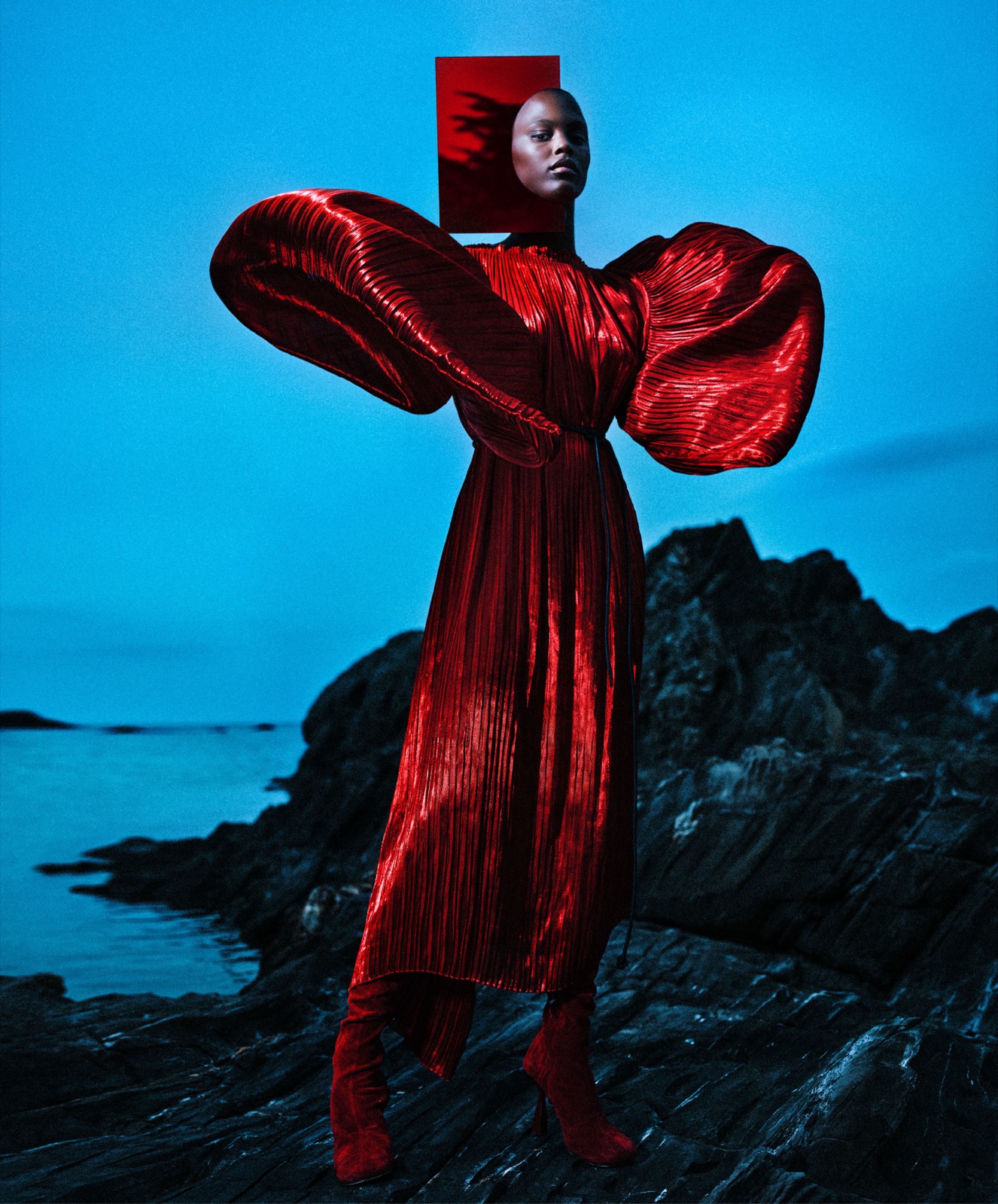
The great puffed sleeves swing inward and cross, caught at the instant they meet, a metallic-red lamé folding over itself in ridges that catch and throw the last blue light. Behind the collar, where a head should sit, a red panel has been raised into the frame, printed with a black flame-shaped smear; the model’s actual face slides out from its right edge, calm, shaven-headed, refusing to be where we expect it. The sea lies flat and cold beyond the rocks.
A photograph that stages another image inside itself is always half about its own machinery, and this one flaunts the trick: the crimson rectangle is a picture held before a face, so that we read the head twice, once as printed abstraction and once as flesh. Fashion has long borrowed Surrealism’s dislocations, but here the sleight is deadpan, almost administrative. The whole scene runs on a single collision — incandescent red against a drained coastal blue — and lets the two colours argue while the figure stays impassive on the wet black stone.
Yeste made his name in the top rank of Spanish fashion image-making — Numéro, Harper’s Bazaar, Vogue — and his best pictures smuggle the elements into the commission: here the sea and the twilight do half the styling. As an archival pigment print the reds keep their metallic burn and the blues their glacial depth, the tonal duel the title names held in perfect suspension. It is less a fashion plate than a small essay on how far a single garment, and a single borrowed head, can carry a picture.
The great puffed sleeves swing inward and cross, caught at the instant they meet, a metallic-red lamé folding over itself in ridges that catch and throw the last blue light. Behind the collar, where a head should sit, a red panel has been raised into the frame, printed with a black flame-shaped smear; the model’s actual face slides out from its right edge, calm, shaven-headed, refusing to be where we expect it. The sea lies flat and cold beyond the rocks.
A photograph that stages another image inside itself is always half about its own machinery, and this one flaunts the trick: the crimson rectangle is a picture held before a face, so that we read the head twice, once as printed abstraction and once as flesh. Fashion has long borrowed Surrealism’s dislocations, but here the sleight is deadpan, almost administrative. The whole scene runs on a single collision — incandescent red against a drained coastal blue — and lets the two colours argue while the figure stays impassive on the wet black stone.
Yeste made his name in the top rank of Spanish fashion image-making — Numéro, Harper’s Bazaar, Vogue — and his best pictures smuggle the elements into the commission: here the sea and the twilight do half the styling. As an archival pigment print the reds keep their metallic burn and the blues their glacial depth, the tonal duel the title names held in perfect suspension. It is less a fashion plate than a small essay on how far a single garment, and a single borrowed head, can carry a picture.