A clapboard house stands side-on in winter light, its roof carrying snow, its windows blank. Behind and below it the ground gives way to something bleaker: a low line of freight cars and two pale industrial mounds, salt or sand, heaped at the edge of frozen water. Domestic architecture and the machinery of a working landscape share a single frame, and neither seems aware of the other.
The image has the soft vignetting and slight unreliability of a plastic camera, and Hido uses that limitation deliberately. A blur clouds the lower left, the sort of accident a careful photographer would once have discarded and now keeps, because it belongs to the emotional register of the series, these are pictures posed as recovered memory, scenes from Silver Meadows that behave like things half-remembered rather than clearly seen.
The sepia is the argument. This warm brown tonality quotes the family snapshot, the fading colour print in a shoebox, and grafts that private nostalgia onto a plain American scene. As archival pigment on aluminium the surface is smooth and modern, yet everything it carries points backward. The photograph is less a record of a house than a study of how photographs make the past feel like a place we could still drive back to.
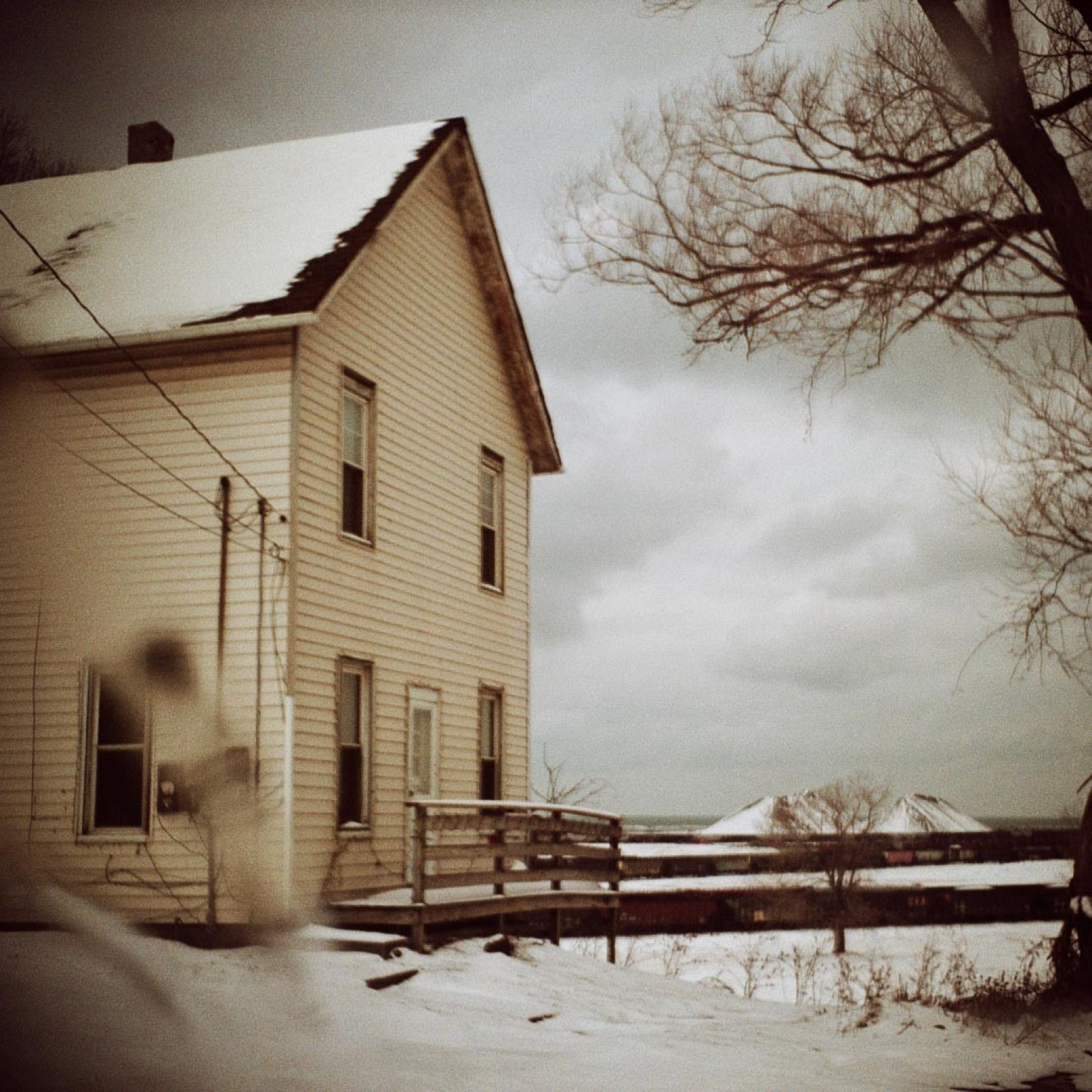

A clapboard house stands side-on in winter light, its roof carrying snow, its windows blank. Behind and below it the ground gives way to something bleaker: a low line of freight cars and two pale industrial mounds, salt or sand, heaped at the edge of frozen water. Domestic architecture and the machinery of a working landscape share a single frame, and neither seems aware of the other.
The image has the soft vignetting and slight unreliability of a plastic camera, and Hido uses that limitation deliberately. A blur clouds the lower left, the sort of accident a careful photographer would once have discarded and now keeps, because it belongs to the emotional register of the series, these are pictures posed as recovered memory, scenes from Silver Meadows that behave like things half-remembered rather than clearly seen.
The sepia is the argument. This warm brown tonality quotes the family snapshot, the fading colour print in a shoebox, and grafts that private nostalgia onto a plain American scene. As archival pigment on aluminium the surface is smooth and modern, yet everything it carries points backward. The photograph is less a record of a house than a study of how photographs make the past feel like a place we could still drive back to.