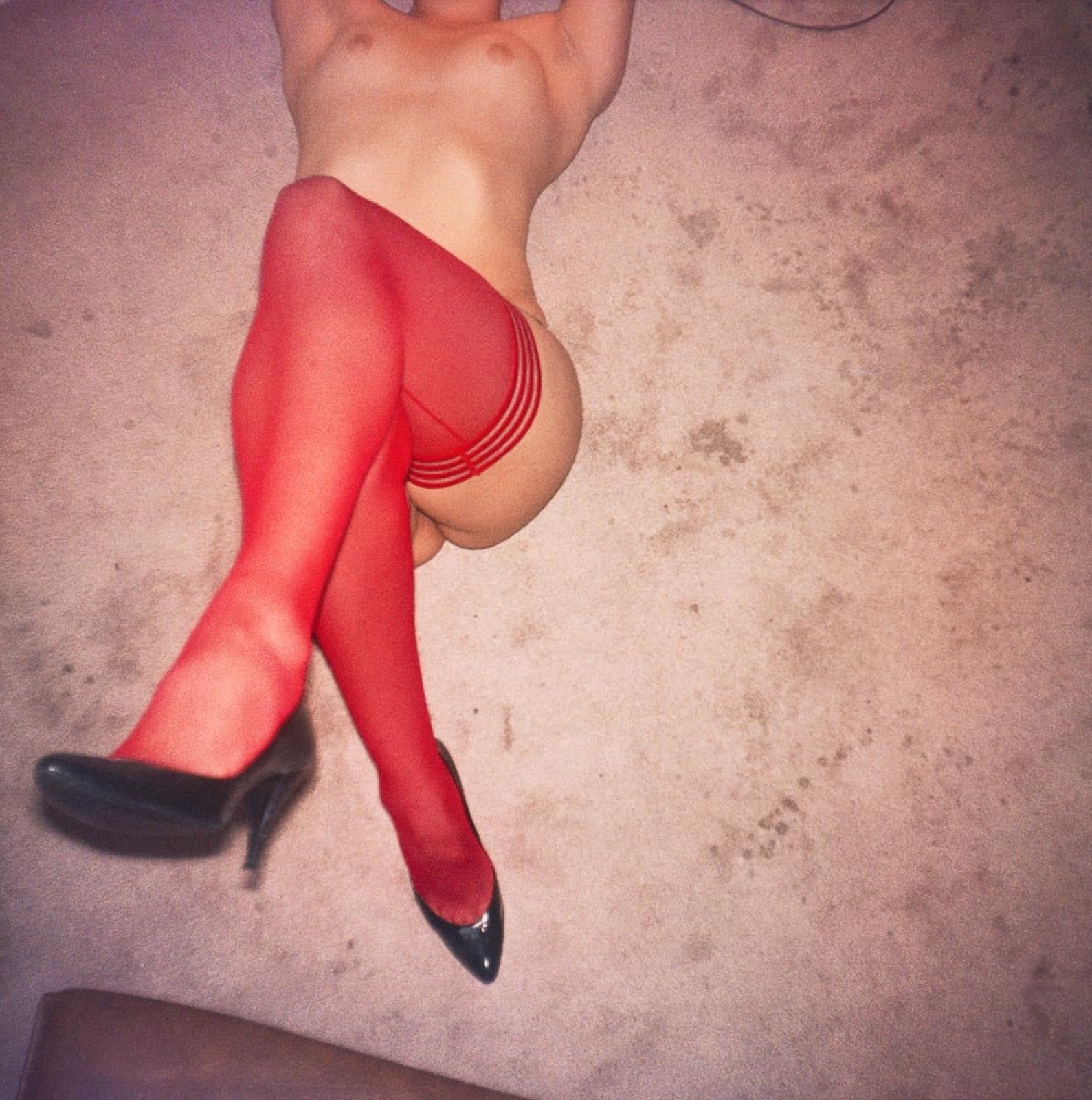
What kind of document does a number make? Todd Hido titles his pictures the way an archivist labels negatives — 7987-a — and the habit shapes how this one asks to be read: less a composed nude than an entry in a long private inventory. A woman lies on pale carpet, seen from almost directly overhead, wearing only red thigh-high stockings and black patent heels, her head dropped back until it nearly leaves the frame. The flash examines her body and the stained floor beneath it with the same level attention.
The photograph descends from the anonymous erotica of postwar America — snapshots posed on beds and shag carpets, lit by a single hard flash — and Hido preserves that vernacular's awkward candor while composing with complete deliberation. The crossed legs cut a sharp zigzag through the square frame; the banded stocking tops supply its only saturated color; a stray cord and the corner of a sofa quietly hold the edges. Having spent years photographing the suburban house from outside, its curtained windows glowing at night, he here turns the same scrutiny inward, onto carpet that records its history as faithfully as film does.
The face withheld, the name unrecorded, the pose at once flaunted and guarded: what the picture finally documents is the transaction between camera and model, its heat and its distance. The serial title keeps its counsel, though the appended letter concedes one thing — where there is an a, a b was made. The archive continues past the edge of the print.
What kind of document does a number make? Todd Hido titles his pictures the way an archivist labels negatives — 7987-a — and the habit shapes how this one asks to be read: less a composed nude than an entry in a long private inventory. A woman lies on pale carpet, seen from almost directly overhead, wearing only red thigh-high stockings and black patent heels, her head dropped back until it nearly leaves the frame. The flash examines her body and the stained floor beneath it with the same level attention.
The photograph descends from the anonymous erotica of postwar America — snapshots posed on beds and shag carpets, lit by a single hard flash — and Hido preserves that vernacular's awkward candor while composing with complete deliberation. The crossed legs cut a sharp zigzag through the square frame; the banded stocking tops supply its only saturated color; a stray cord and the corner of a sofa quietly hold the edges. Having spent years photographing the suburban house from outside, its curtained windows glowing at night, he here turns the same scrutiny inward, onto carpet that records its history as faithfully as film does.
The face withheld, the name unrecorded, the pose at once flaunted and guarded: what the picture finally documents is the transaction between camera and model, its heat and its distance. The serial title keeps its counsel, though the appended letter concedes one thing — where there is an a, a b was made. The archive continues past the edge of the print.