Set this beside the bathers of Eakins or the lakeside boys of the old physique annuals and you feel the same heat coming off it, the same frank pleasure in young flesh stacked against summer light. A concrete pier wades out into the lake, and a crowd of swimmers has colonized its top edge — boys mostly, lean and sun-darkened, perched along the lip with legs dangling, shoulders touching, some standing to dive, one caught mid-leap with arms thrown wide. They make a frieze of bodies, casual as breathing, the way the young arrange themselves before they know they're being watched.
What pulls against all that easy company is the girl in the foreground. She stands waist-deep at the far bottom of the frame, her back to us, a small figure in a two-piece, hair cropped, arms loose at her sides. She isn't swimming toward the pier or away from it. She simply watches the older kids the way you watch a party you haven't been invited to, the gap of dark water between her and them measured in every kind of distance — age, nerve, desire. Lange gives her the whole lower third of the picture and lets the loneliness of it sit there, unhurried.
The grain holds everything in the same silvered hush: the chalky stone of a second, ruined piling to the left, the small white boats stitched along the horizon, the wide flat glare of the water. It's an unmistakably American summer, the kind that smells of warm cement and lake weed, but the longing in it is older than any place. The eye keeps sliding from the heap of bodies back down to that solitary girl, and the picture refuses to close the distance for you.
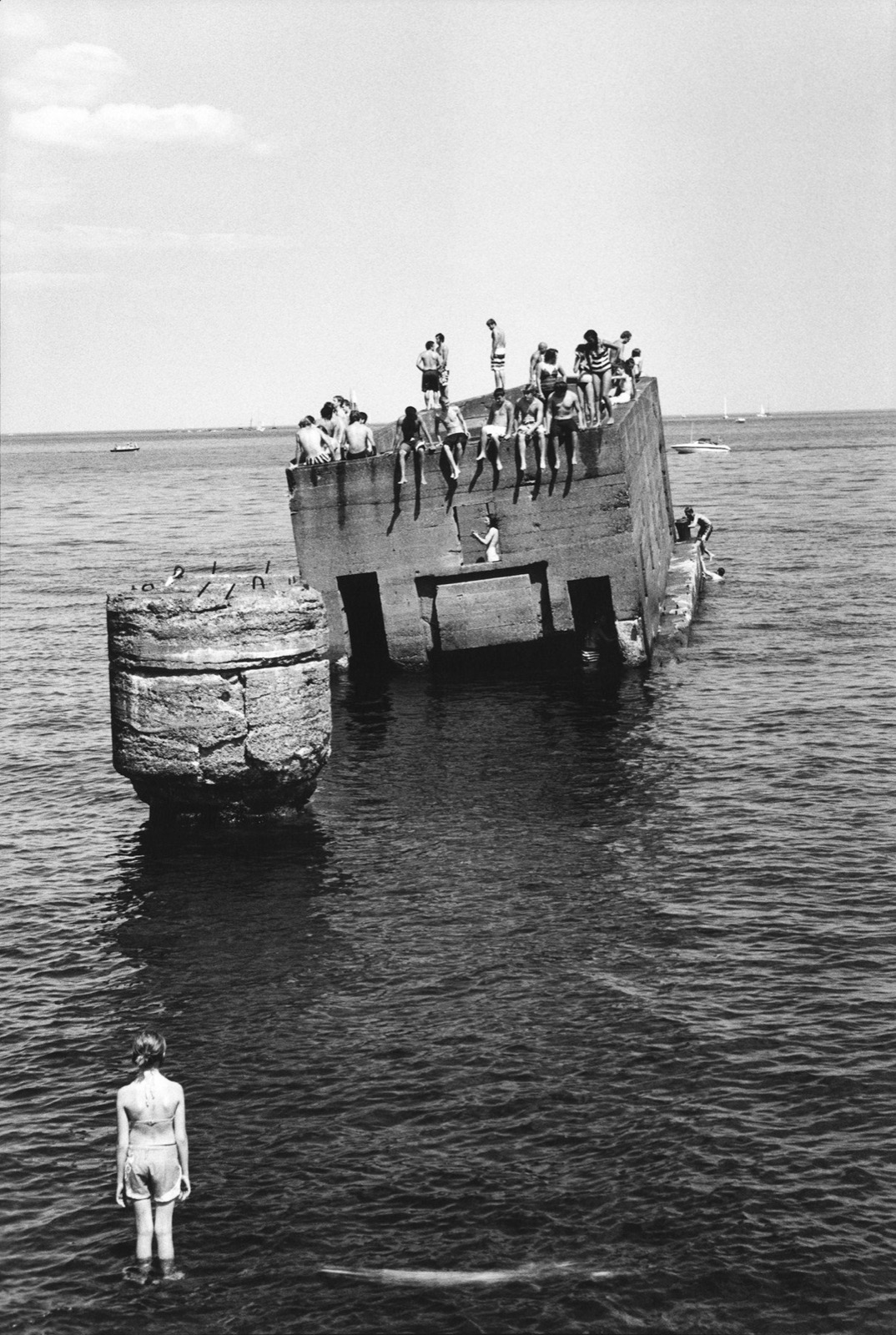

Set this beside the bathers of Eakins or the lakeside boys of the old physique annuals and you feel the same heat coming off it, the same frank pleasure in young flesh stacked against summer light. A concrete pier wades out into the lake, and a crowd of swimmers has colonized its top edge — boys mostly, lean and sun-darkened, perched along the lip with legs dangling, shoulders touching, some standing to dive, one caught mid-leap with arms thrown wide. They make a frieze of bodies, casual as breathing, the way the young arrange themselves before they know they're being watched.
What pulls against all that easy company is the girl in the foreground. She stands waist-deep at the far bottom of the frame, her back to us, a small figure in a two-piece, hair cropped, arms loose at her sides. She isn't swimming toward the pier or away from it. She simply watches the older kids the way you watch a party you haven't been invited to, the gap of dark water between her and them measured in every kind of distance — age, nerve, desire. Lange gives her the whole lower third of the picture and lets the loneliness of it sit there, unhurried.
The grain holds everything in the same silvered hush: the chalky stone of a second, ruined piling to the left, the small white boats stitched along the horizon, the wide flat glare of the water. It's an unmistakably American summer, the kind that smells of warm cement and lake weed, but the longing in it is older than any place. The eye keeps sliding from the heap of bodies back down to that solitary girl, and the picture refuses to close the distance for you.