Nothing here is going anywhere — the motorcycle is a Triumph, built for speed, but its kickstand is down and its rider half-dismounted, leaning against the saddle, one boot in the East Hampton dirt; the road the machine promises is what the picture withholds. No engine sound reaches us, no wind, no destination. What we get instead is a pause — a shirtless man with a beard and long fair hair resting a hand on a dog that has stretched itself luxuriously across the fuel tank, ears up, mouth open, entirely at home on a vehicle it will never drive.
One could say the photograph is less about the man than about a certain American fantasy he is lent to: the open road, the loyal dog, the outlaw ease, all of it borrowed from movies and advertising and then quieted into a still frame. Weber knows the vocabulary. He lets the torn denim, the bare torso and the Triumph script do their familiar work, then undercuts the swagger by handing the composition over to the dog, who upstages everyone. The trees behind dissolve into soft grey; the man meets the lens, unhurried.
This is the register Weber has worked in since the Calvin Klein campaigns of the 1980s — athletes, animals and Americana, masculinity photographed with unembarrassed tenderness. As a gelatin silver print the image gives that idyll its skin: continuous greys in the woodland, velvet blacks in the engine and tyres, a bright even light laid across chest and fur alike. The ride stays withheld, and the print is better for keeping the man, the dog and the Triumph forever parked.
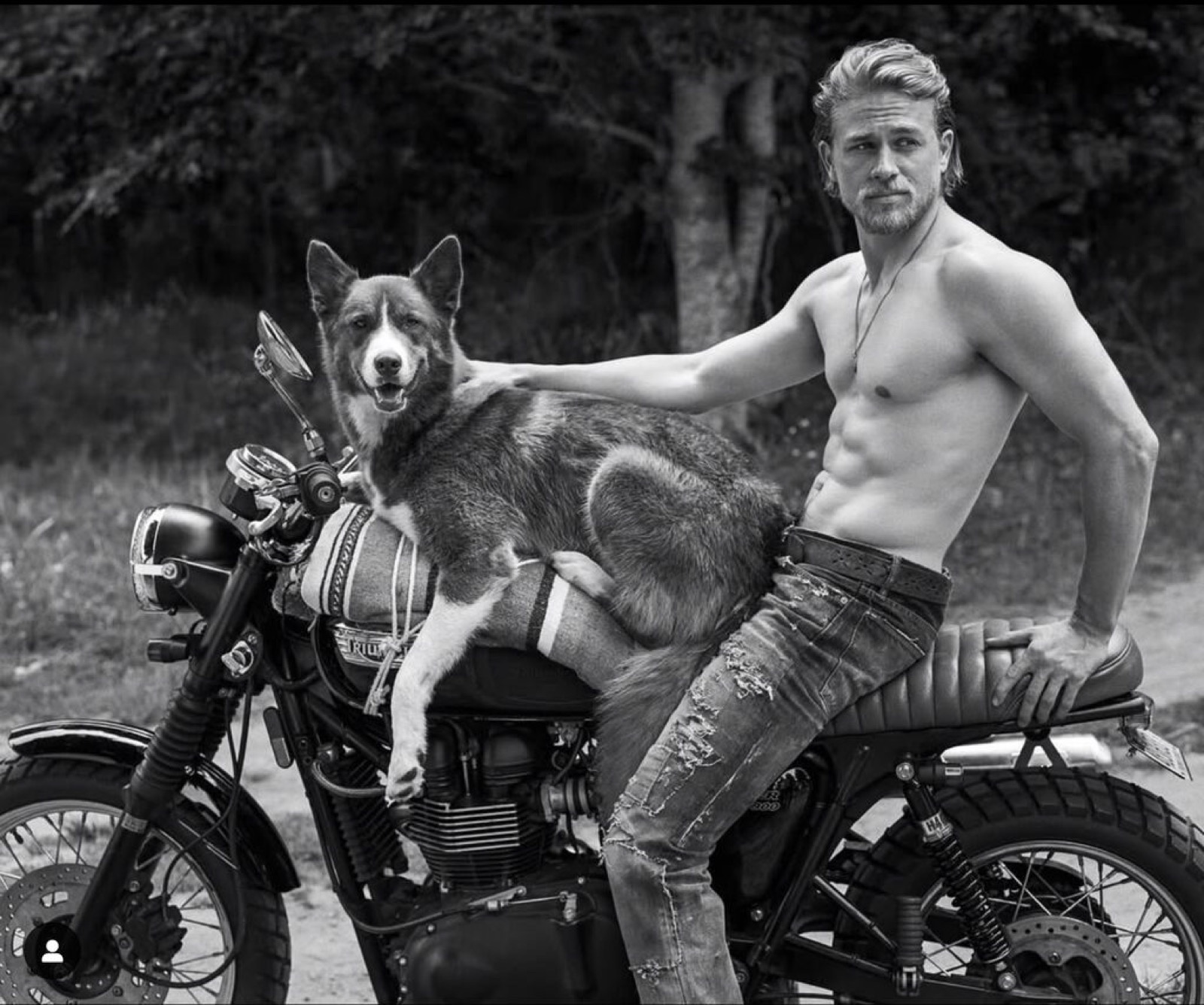

Nothing here is going anywhere — the motorcycle is a Triumph, built for speed, but its kickstand is down and its rider half-dismounted, leaning against the saddle, one boot in the East Hampton dirt; the road the machine promises is what the picture withholds. No engine sound reaches us, no wind, no destination. What we get instead is a pause — a shirtless man with a beard and long fair hair resting a hand on a dog that has stretched itself luxuriously across the fuel tank, ears up, mouth open, entirely at home on a vehicle it will never drive.
One could say the photograph is less about the man than about a certain American fantasy he is lent to: the open road, the loyal dog, the outlaw ease, all of it borrowed from movies and advertising and then quieted into a still frame. Weber knows the vocabulary. He lets the torn denim, the bare torso and the Triumph script do their familiar work, then undercuts the swagger by handing the composition over to the dog, who upstages everyone. The trees behind dissolve into soft grey; the man meets the lens, unhurried.
This is the register Weber has worked in since the Calvin Klein campaigns of the 1980s — athletes, animals and Americana, masculinity photographed with unembarrassed tenderness. As a gelatin silver print the image gives that idyll its skin: continuous greys in the woodland, velvet blacks in the engine and tyres, a bright even light laid across chest and fur alike. The ride stays withheld, and the print is better for keeping the man, the dog and the Triumph forever parked.