Set this beside Brassaï's couples in the Paris dance halls a generation earlier and the lineage is plain: the same trust in available light, the same belief that a 35mm camera held close can describe intimacy without arranging it. Where Brassaï leaned on flash, Horvat lets the thin club light do everything; the kinship is one of intent, not method. What he keeps from that tradition, and from his early reportage, is the conviction that a dance is told not by its steps but by the geometry of an embrace and the angle of a glance.
The frame organizes itself around one face: the young woman turned toward the camera over her partner's shoulder, her cheek lit while his head stays in shadow, her eyes wide and unguarded as though she has just registered something we cannot see. Her bare forearm crosses his back; his rolled sleeve and the dark frame of his glasses anchor the right edge. The grain is heavy, the light thin, and the dancers behind them collapse into a single soft mass, so that two bodies surface out of the dark like the only fact in the room.
By 1959 Horvat was moving between the reportage that formed him and the fashion work he would soon remake for Jardin des Modes and Harper's Bazaar. London's Soho clubs gave him exactly the register he prized: the candid scene caught with existing light, no flash to flatten it, the photographer close enough to feel the music yet declining to direct it.
This is a gelatin silver print made in 2000, the image roughly 31 by 26 centimeters on a 40 by 30 sheet, from a negative that belongs to the documentary spine of Horvat's career rather than to his glossier fame. The pleasure of it is wholly photographic: how one lit face, pulled from a grainy darkness, carries the whole weight of a London night.

Set this beside Brassaï's couples in the Paris dance halls a generation earlier and the lineage is plain: the same trust in available light, the same belief that a 35mm camera held close can describe intimacy without arranging it. Where Brassaï leaned on flash, Horvat lets the thin club light do everything; the kinship is one of intent, not method. What he keeps from that tradition, and from his early reportage, is the conviction that a dance is told not by its steps but by the geometry of an embrace and the angle of a glance.
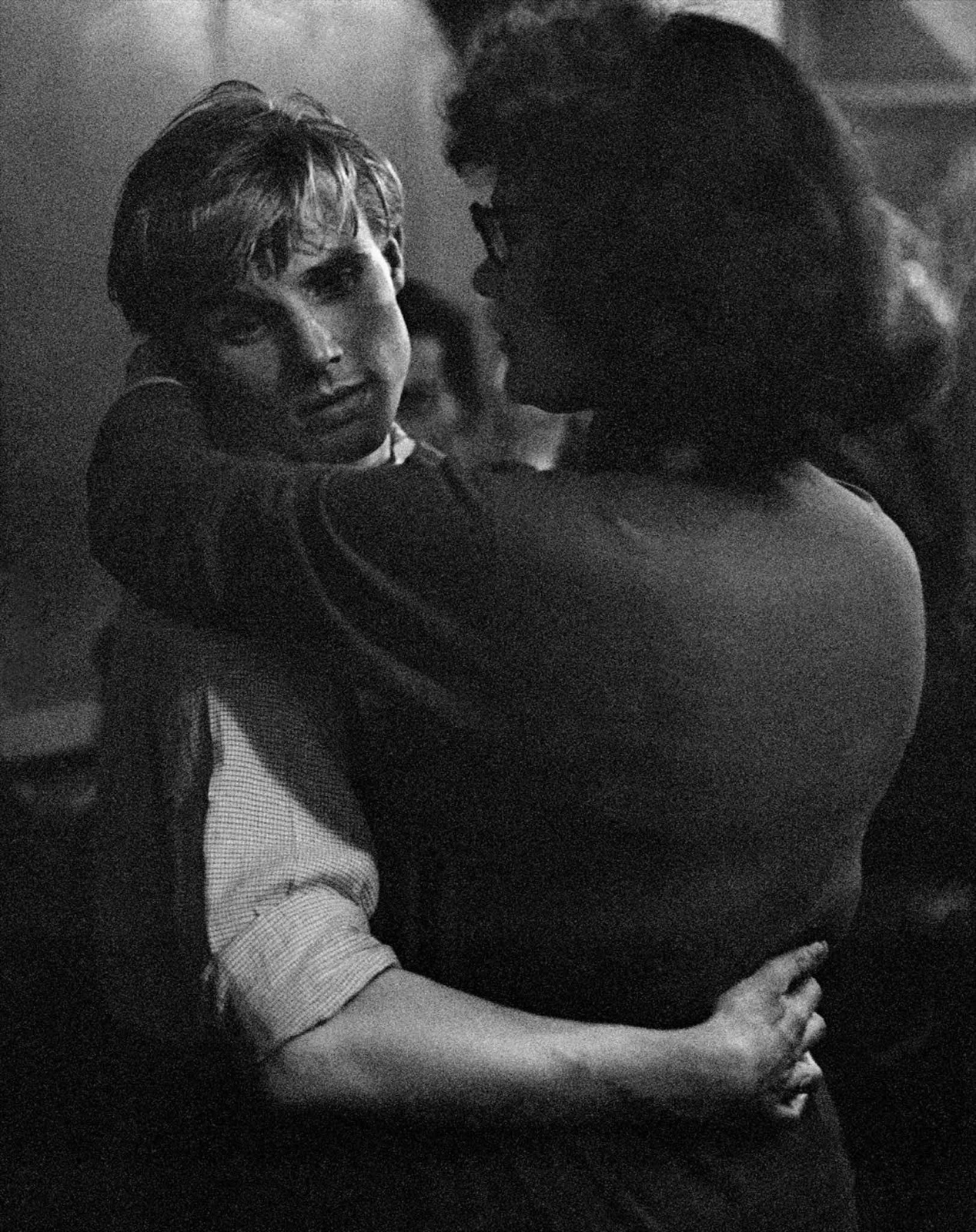
The frame organizes itself around one face: the young woman turned toward the camera over her partner's shoulder, her cheek lit while his head stays in shadow, her eyes wide and unguarded as though she has just registered something we cannot see. Her bare forearm crosses his back; his rolled sleeve and the dark frame of his glasses anchor the right edge. The grain is heavy, the light thin, and the dancers behind them collapse into a single soft mass, so that two bodies surface out of the dark like the only fact in the room.
By 1959 Horvat was moving between the reportage that formed him and the fashion work he would soon remake for Jardin des Modes and Harper's Bazaar. London's Soho clubs gave him exactly the register he prized: the candid scene caught with existing light, no flash to flatten it, the photographer close enough to feel the music yet declining to direct it.
This is a gelatin silver print made in 2000, the image roughly 31 by 26 centimeters on a 40 by 30 sheet, from a negative that belongs to the documentary spine of Horvat's career rather than to his glossier fame. The pleasure of it is wholly photographic: how one lit face, pulled from a grainy darkness, carries the whole weight of a London night.