Steven Meisel
American, b. 1954Naomi Campbell, Paris, 1991
Archival Pigment Print.
Small / Image: 50.8 x 39.4 cm / 20 x 15 1/2 in / Sheet: 61 x 50.8 cm / 24 x 20 in
Medium / Image: 101.6 x 76.2 cm / 40 x 30 in / Sheet: 106.7 x 81.3 cm / 42 x 32 in
Large / Image : 152.4 x 114.3 cm / 60 x 45 in / Sheet : 157.5 x 119.4 cm / 62 x 47 in
XL / Image: 196.3 x 147.3 cm / 77 1/4 x 58 in / Sheet: 201.4 x 152.4 cm / 79 1/4 x 60 in
Hand-signed by artist, titled, numbered and print date in ink label affixed to mount verso
Edition of 7 — Image: 50.8 x 39.4 cm / 20 x 15 1/2 in / Sheet: 61 x 50.8 cm / 24 x 20 in
Edition of 6 — Image: 101.6 x 76.2 cm / 40 x 30 in / Sheet: 106.7 x 81.3 cm / 42 x 32 in
Edition of 3 — Image : 152.4 x 114.3 cm / 60 x 45 in / Sheet : 157.5 x 119.4 cm / 62 x 47 in
Edition of 1 — Image: 196.3 x 147.3 cm / 77 1/4 x 58 in / Sheet: 201.4 x 152.4 cm / 79 1/4 x 60 in
© The Artist
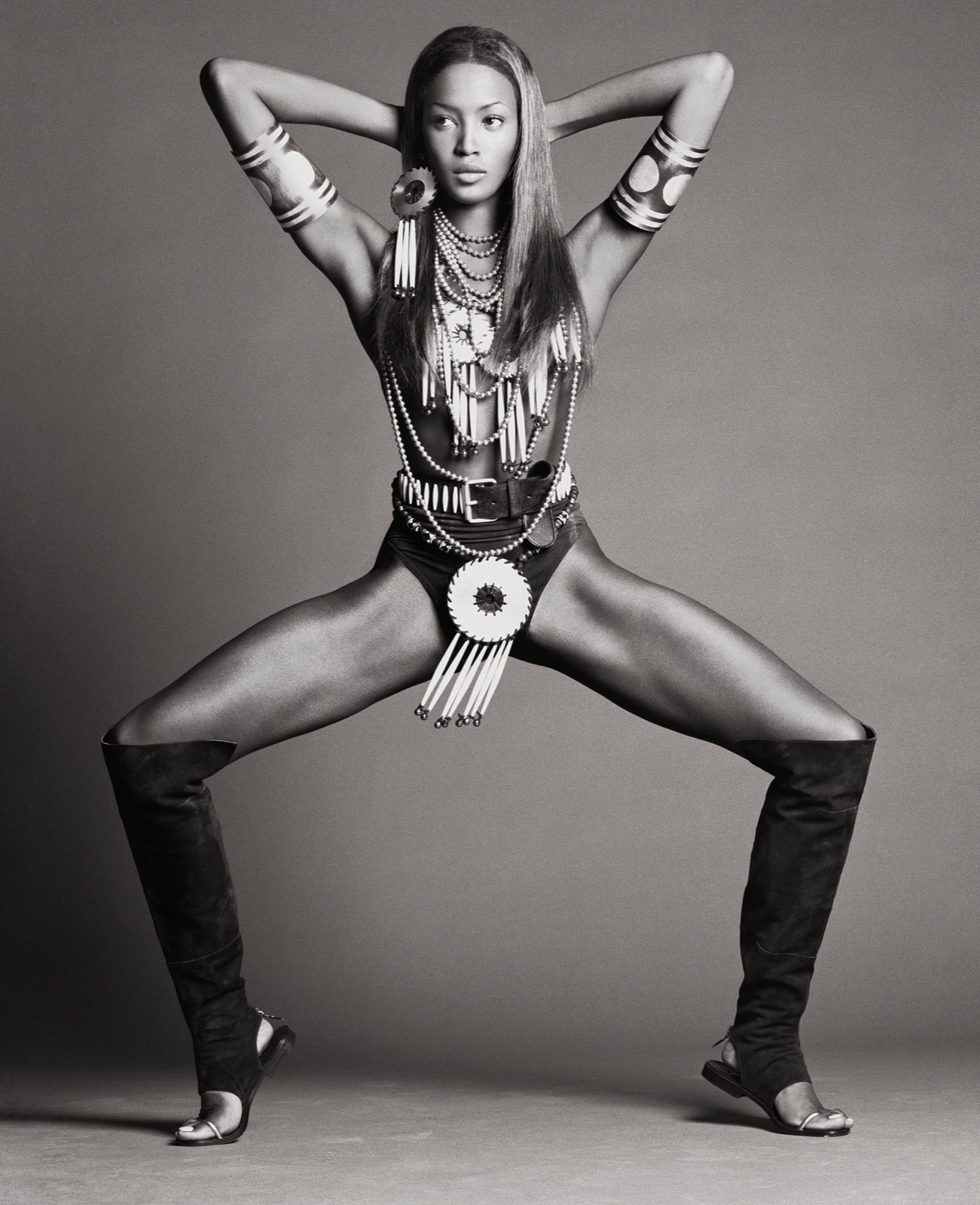
Begin with the symmetry. Campbell stands frontal, legs driven apart into a wide inverted V, both arms folded behind her head so the elbows answer each other like the points of a compass. Two concentric beaded discs sit at each upper arm; a third, larger disc hangs at the hip, its white fringe falling between her thighs. The figure is built to be read as a near-perfect mirror image, and Steven Meisel lets the studio give him nothing to distract from it: a plain seamless ground, even light, the long fall of straightened hair breaking the otherwise rigorous axis.
What interests me is how still this is, and how much movement it implies. The pose is athletic, almost a held frame from a sequence we don't have — a dancer or fighter caught at the instant of maximum tension. Photography does this better than any medium: it arrests the body at the one position the eye could never sustain, then asks us to treat that impossibility as a fact. The thigh-high suede boots and the wide stance read as motion frozen; the symmetry reads as design. The picture lives in the gap between those two claims.
Meisel made his name in exactly this register through the early 1990s — the studio portrait as collaboration, the model not described but constructed, often for Italian Vogue. Here the ornament does conceptual work: discs, chains and fringe organise the body into pure graphic incident, so that Campbell becomes both performer and emblem. The frame holds her at the height of her authority and converts that authority into structure. Offered across editioned sizes up to near life-scale, it is a measured, deliberate object — an image that knows precisely what kind of image it is.