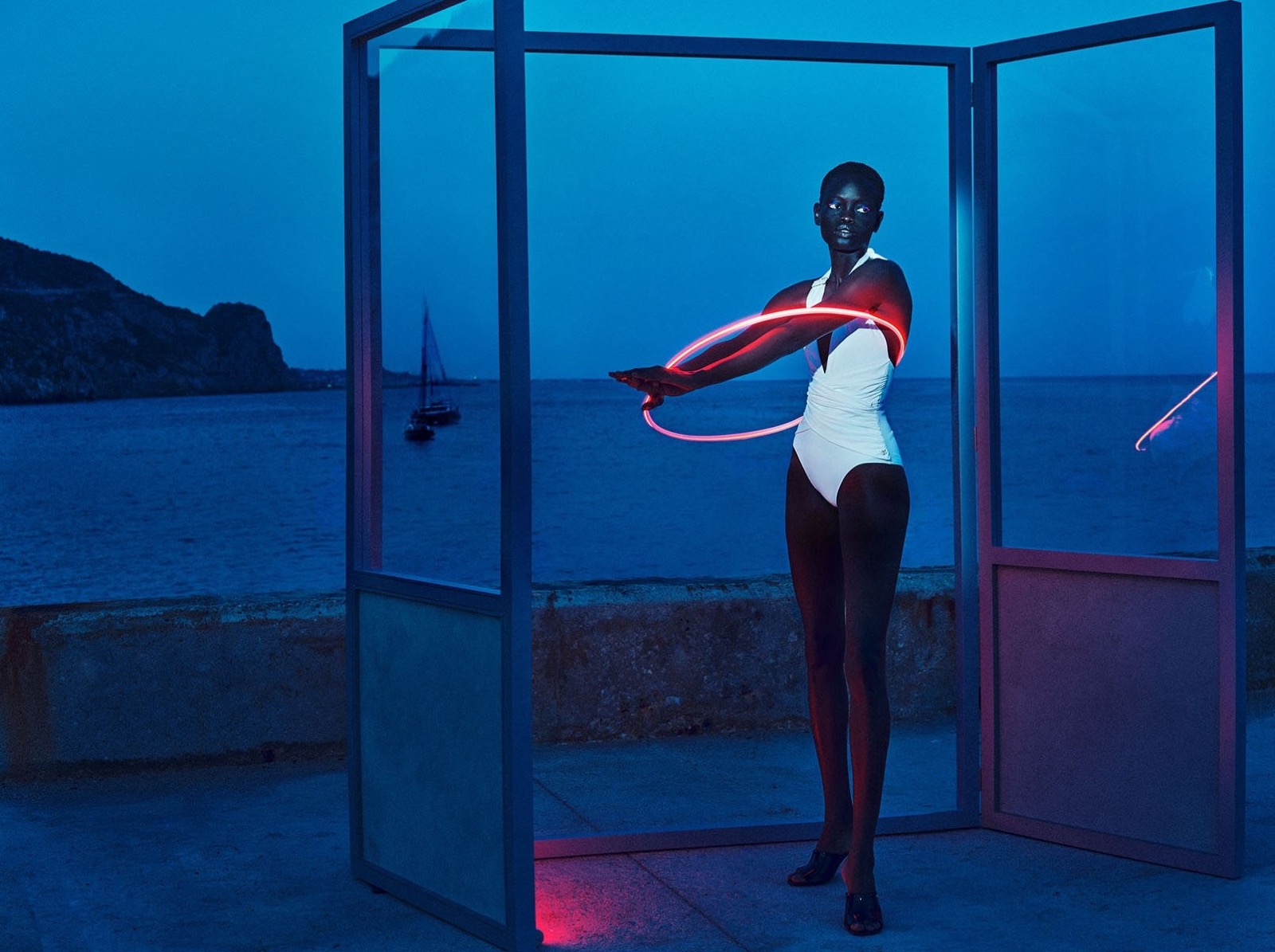
Why carry a folding glass screen to the edge of the sea? Its panels frame nothing the coast was not already offering: dusk-blue water, a sailboat at anchor, a headland going black. Yet the screen is what makes this a picture rather than a view. Between its hinged panes a model in a white swimsuit extends both arms, level as a sleepwalker, through a hoop of red neon that circles her like the orbit of a small electric planet.
Everything declares its construction, and the image is stronger for it. The blue is the given: that saturating last light photographers wait out whole days for. The red is the intervention, a ring of pure current that repeats in the glass as faint streaks and pools in rose on the concrete at the frame’s lower left. Her gaze is steady, her lids catch a pale gleam, and the choreography is exact: not a woman playing with a hoop, but a figure holding a pose the light completes. This is the directorial mode of fashion at full confidence: the photograph as a staged proposition about glamour, offered without apology and without alibi.
Txema Yeste, born in Barcelona, has built such propositions for Numéro, Harper’s Bazaar and Vogue, and an elemental undertow runs through his editorial work: water, sand, wind, flame. Here the element is electricity, brought to the shoreline and bent into a circle. As an archival pigment print, the picture holds that improbable chord, blue hour against neon, with all the depth and saturation it demands.
Why carry a folding glass screen to the edge of the sea? Its panels frame nothing the coast was not already offering: dusk-blue water, a sailboat at anchor, a headland going black. Yet the screen is what makes this a picture rather than a view. Between its hinged panes a model in a white swimsuit extends both arms, level as a sleepwalker, through a hoop of red neon that circles her like the orbit of a small electric planet.
Everything declares its construction, and the image is stronger for it. The blue is the given: that saturating last light photographers wait out whole days for. The red is the intervention, a ring of pure current that repeats in the glass as faint streaks and pools in rose on the concrete at the frame’s lower left. Her gaze is steady, her lids catch a pale gleam, and the choreography is exact: not a woman playing with a hoop, but a figure holding a pose the light completes. This is the directorial mode of fashion at full confidence: the photograph as a staged proposition about glamour, offered without apology and without alibi.
Txema Yeste, born in Barcelona, has built such propositions for Numéro, Harper’s Bazaar and Vogue, and an elemental undertow runs through his editorial work: water, sand, wind, flame. Here the element is electricity, brought to the shoreline and bent into a circle. As an archival pigment print, the picture holds that improbable chord, blue hour against neon, with all the depth and saturation it demands.