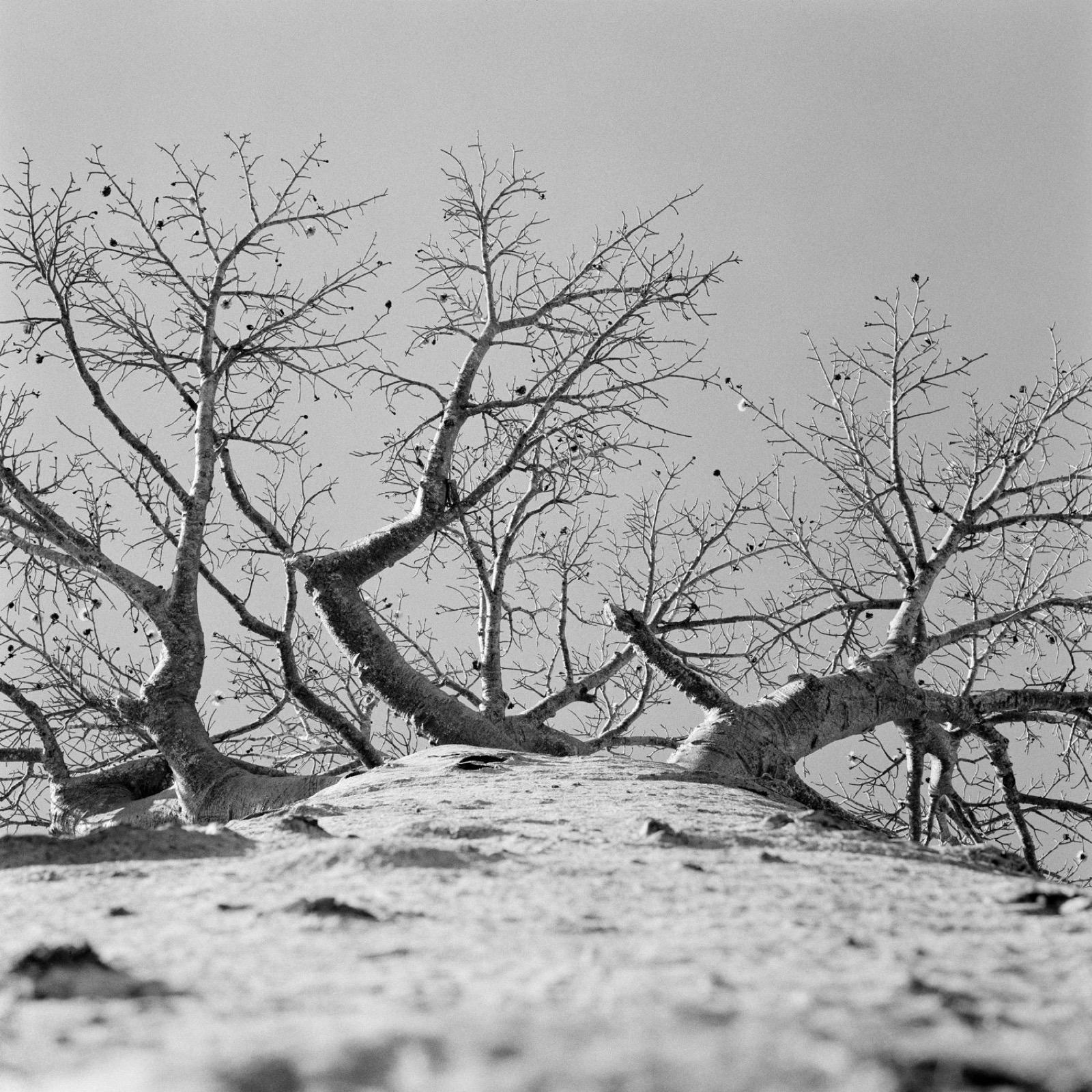
They reach sideways rather than up, these pale baobab trunks flinging themselves low and horizontal across a mound of cracked earth as if caught mid-crawl toward the camera. A photograph cannot show growth, only arrest it, and that is the drama here: branches that took decades to elbow their way outward are stopped in a hundredth of a second, their spidery twigs frozen in the act of clawing at a bleached grey sky. The stillness is a kind of held breath.
The vantage does most of the thinking. Lying almost on the ground, the camera lets the foreground of dry, fissured soil swell into a soft out-of-focus tide that rises to meet the sharp architecture of the trunks, so the picture is built from two textures pressed together, the near blur and the far filigree. Photography has always loved this trick of collapsing distance, the way a low lens turns a rise of parched earth into a horizon and a stunted tree into something monumental. Nothing grand is being described, yet everything looks consequential.
Rendered as a gelatin silver print toned in selenium and made the year after the negative, the image gives its full tonal argument: warm-black bark, chalk-bright highlights along each branch, and the long gradient of the sky that keeps the whole thing airy rather than austere. The photographer, who founded the gallery presenting the work, uses an old, patient medium to make a dry landscape feel like an event, proof that a print’s craft can lend gravity to the plainest patch of ground.
They reach sideways rather than up, these pale baobab trunks flinging themselves low and horizontal across a mound of cracked earth as if caught mid-crawl toward the camera. A photograph cannot show growth, only arrest it, and that is the drama here: branches that took decades to elbow their way outward are stopped in a hundredth of a second, their spidery twigs frozen in the act of clawing at a bleached grey sky. The stillness is a kind of held breath.
The vantage does most of the thinking. Lying almost on the ground, the camera lets the foreground of dry, fissured soil swell into a soft out-of-focus tide that rises to meet the sharp architecture of the trunks, so the picture is built from two textures pressed together, the near blur and the far filigree. Photography has always loved this trick of collapsing distance, the way a low lens turns a rise of parched earth into a horizon and a stunted tree into something monumental. Nothing grand is being described, yet everything looks consequential.
Rendered as a gelatin silver print toned in selenium and made the year after the negative, the image gives its full tonal argument: warm-black bark, chalk-bright highlights along each branch, and the long gradient of the sky that keeps the whole thing airy rather than austere. The photographer, who founded the gallery presenting the work, uses an old, patient medium to make a dry landscape feel like an event, proof that a print’s craft can lend gravity to the plainest patch of ground.