A road photographed from a moving car is an image of not-arriving. We see where we are going and are never allowed to get there; the destination stays dissolved in mist at the vanishing point, marked only by the two small lamps of an oncoming car, the single sign that anyone else is abroad in this weather.
Rain beads on the glass at the right edge, and Hido leaves it there, refusing to pretend the camera is anywhere but inside, sheltered, passing through. The wet asphalt takes a dull shine; a utility pole leans as though pushed by the wind; the poles behind it dwindle in a grey procession. Everything is soft, provisional, seen at speed. Melancholy, one begins to suspect, is less a feeling than a way of framing, a decision about how much to keep out of focus.
Such pictures propose that the American road, that old emblem of freedom, is also a corridor of solitude, a place one passes through rather than inhabits. The archival pigment print, mounted on aluminium, gives the greys a wet weight they would lose on paper, and lets the far headlights keep their faint, hopeful glow. Nothing happens, and this is precisely the subject: the long, blurred, unremarkable in-between that makes up most of a life and that we almost never think to photograph.
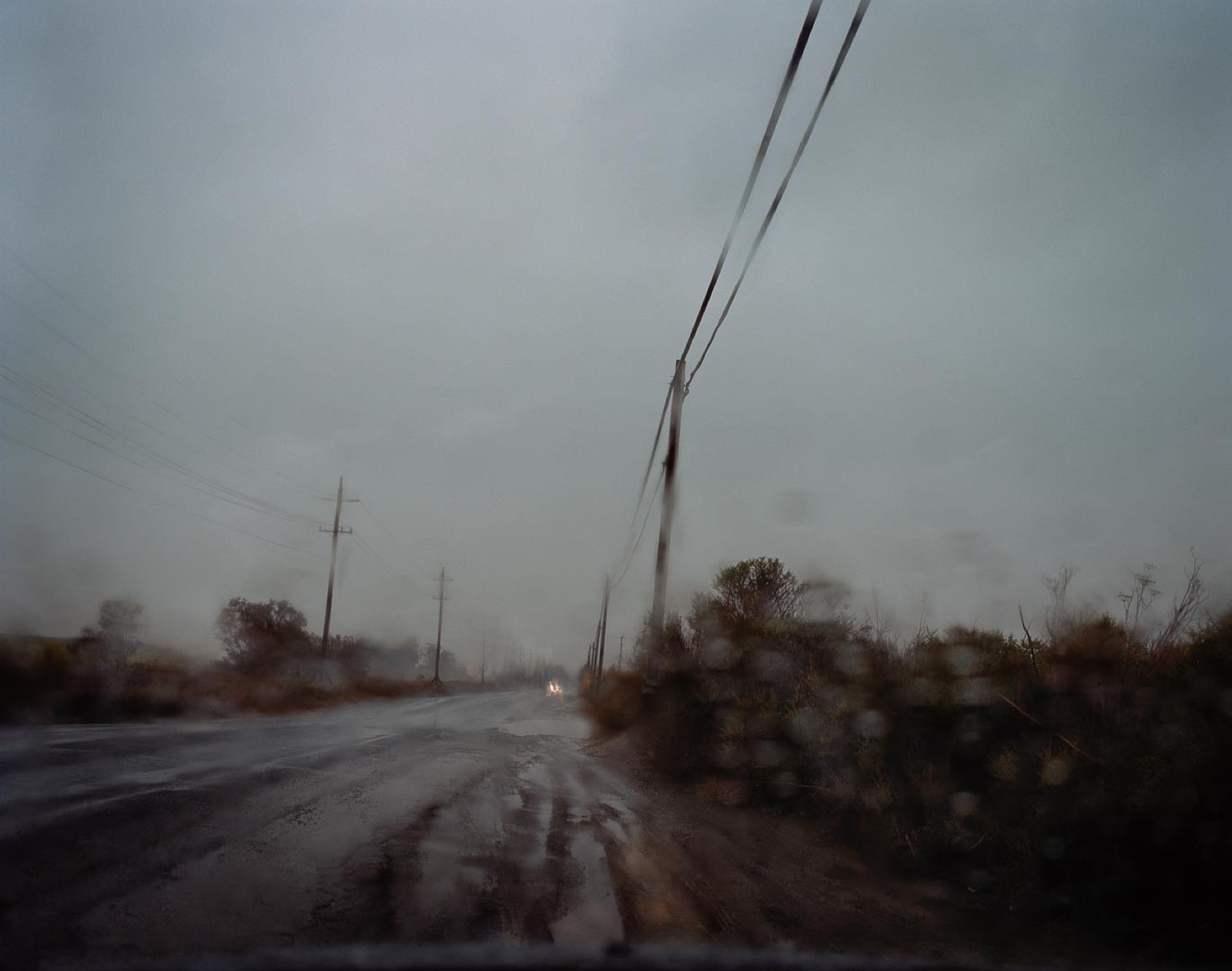

A road photographed from a moving car is an image of not-arriving. We see where we are going and are never allowed to get there; the destination stays dissolved in mist at the vanishing point, marked only by the two small lamps of an oncoming car, the single sign that anyone else is abroad in this weather.
Rain beads on the glass at the right edge, and Hido leaves it there, refusing to pretend the camera is anywhere but inside, sheltered, passing through. The wet asphalt takes a dull shine; a utility pole leans as though pushed by the wind; the poles behind it dwindle in a grey procession. Everything is soft, provisional, seen at speed. Melancholy, one begins to suspect, is less a feeling than a way of framing, a decision about how much to keep out of focus.
Such pictures propose that the American road, that old emblem of freedom, is also a corridor of solitude, a place one passes through rather than inhabits. The archival pigment print, mounted on aluminium, gives the greys a wet weight they would lose on paper, and lets the far headlights keep their faint, hopeful glow. Nothing happens, and this is precisely the subject: the long, blurred, unremarkable in-between that makes up most of a life and that we almost never think to photograph.