Nyakong stands almost frontally against a peach ground graded from warm at the top to pale at the edges. She is bare from the waist up, and across her chest — laid horizontally, not tied, not fastened to anything I can see — is a single long red feather. Below it a satin skirt the colour of dried blood catches the light in broad folds. Her hair is cropped close. She looks directly out.
I find myself thinking about the physics before the meaning. That feather is balanced. Its shaft rests where her ribs are, the vane fans upward, and the whole arrangement can only have survived for as long as she stood absolutely still. So the picture is a record of a collaboration: someone placed it, she held her breath, and the shutter had to be quick enough. The most fragile element in the frame is the one carrying the entire composition.
The feather is doing older work as well. A single red plume across a dark torso reaches back into a long visual history of how African bodies have been costumed for European cameras, and Yeste — a Spanish photographer who has worked extensively across the Sahel and the Maghreb as well as in the studio — cannot be unaware of it. What alters the transaction, for me, is the look. She is not turned into ornament, not turned into landscape, not turned away. She meets the lens with an expression that has decided something in advance, and the feather starts to seem less like a costume than like a thing she has agreed to hold still for.
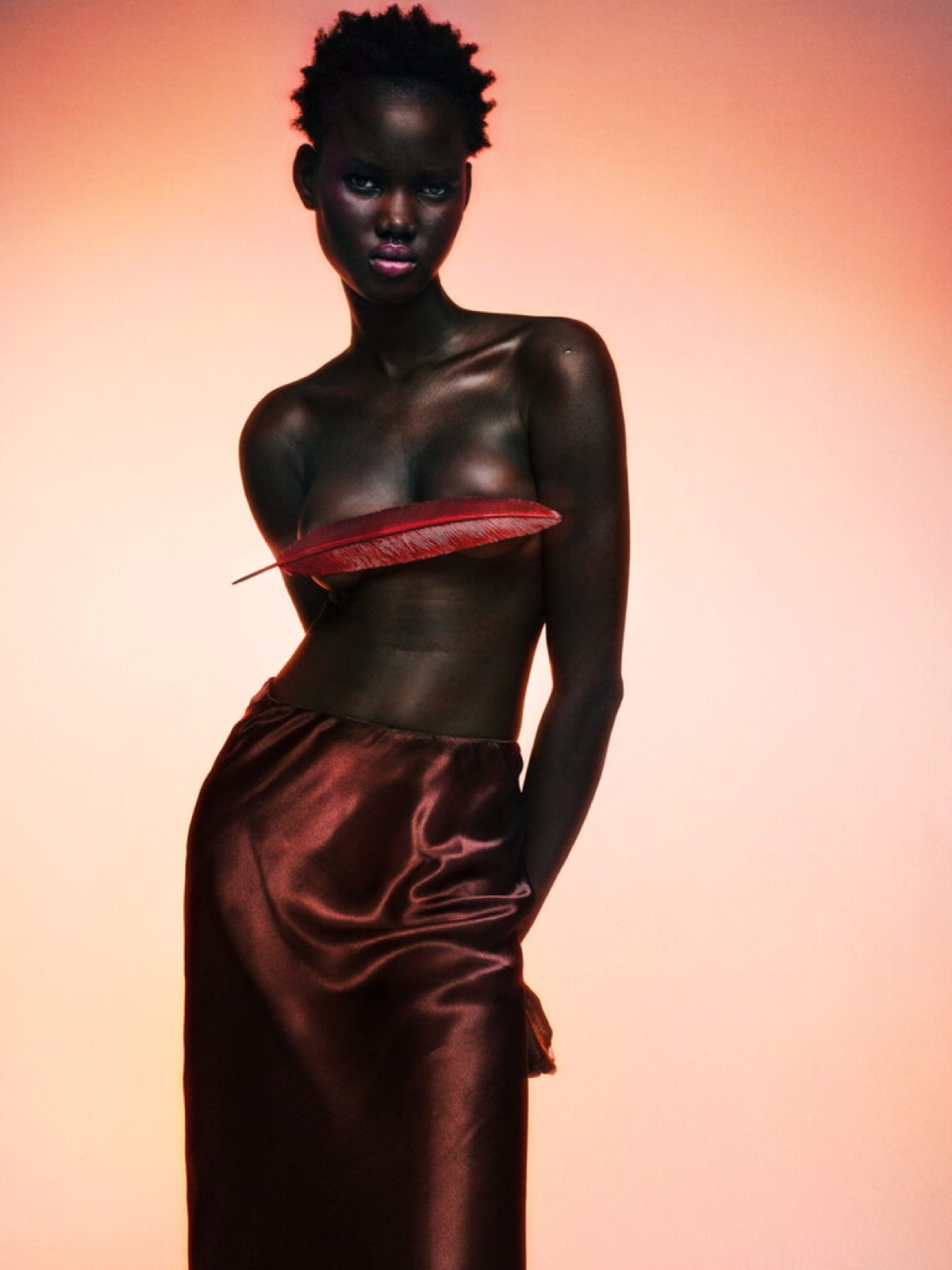

Nyakong stands almost frontally against a peach ground graded from warm at the top to pale at the edges. She is bare from the waist up, and across her chest — laid horizontally, not tied, not fastened to anything I can see — is a single long red feather. Below it a satin skirt the colour of dried blood catches the light in broad folds. Her hair is cropped close. She looks directly out.
I find myself thinking about the physics before the meaning. That feather is balanced. Its shaft rests where her ribs are, the vane fans upward, and the whole arrangement can only have survived for as long as she stood absolutely still. So the picture is a record of a collaboration: someone placed it, she held her breath, and the shutter had to be quick enough. The most fragile element in the frame is the one carrying the entire composition.
The feather is doing older work as well. A single red plume across a dark torso reaches back into a long visual history of how African bodies have been costumed for European cameras, and Yeste — a Spanish photographer who has worked extensively across the Sahel and the Maghreb as well as in the studio — cannot be unaware of it. What alters the transaction, for me, is the look. She is not turned into ornament, not turned into landscape, not turned away. She meets the lens with an expression that has decided something in advance, and the feather starts to seem less like a costume than like a thing she has agreed to hold still for.