Two women share a single frame, but only one of them knows a picture is being made. Reflected in a corner shop window, Vivian Maier stands with her Rolleiflex held at her waist, steady and unsmiling, while a stylish stranger in a striped dress strides past against a backdrop of palms, wet pavement, and finned American cars. She made this self-portrait in the mid-1950s, and it is among the most quietly brilliant of the hundreds she left behind.
For four decades Maier photographed the American street for no one but herself, a nanny whose vast archive of more than 150,000 negatives surfaced only after her death in 2009. The self-portrait was her constant thread, made not from vanity but from a need to test her own presence in a world that barely registered her. Here the mirror does the work, folding watcher and watched into one composition. Because the twin-lens Rolleiflex is held at the waist and looked down into, she can gaze straight out at us while appearing to look modestly away, a sly double game of seeing and being seen that no other camera would allow. The wet pavement, the imported palms, and the chrome of the passing cars place her squarely in the sunlit ease of 1950s Florida, a world she studies coolly from behind the glass but never quite enters.
Her discovery, when the young collector John Maloof bought a box of her negatives at a Chicago auction in 2007, became one of the great stories in the history of the medium. Once entirely invisible, Maier now hangs in major institutions around the world and commands a devoted following. This reflection is the artist at her most self-aware, stepping into her own picture, on her own quiet terms, and claiming the place the world had denied her.
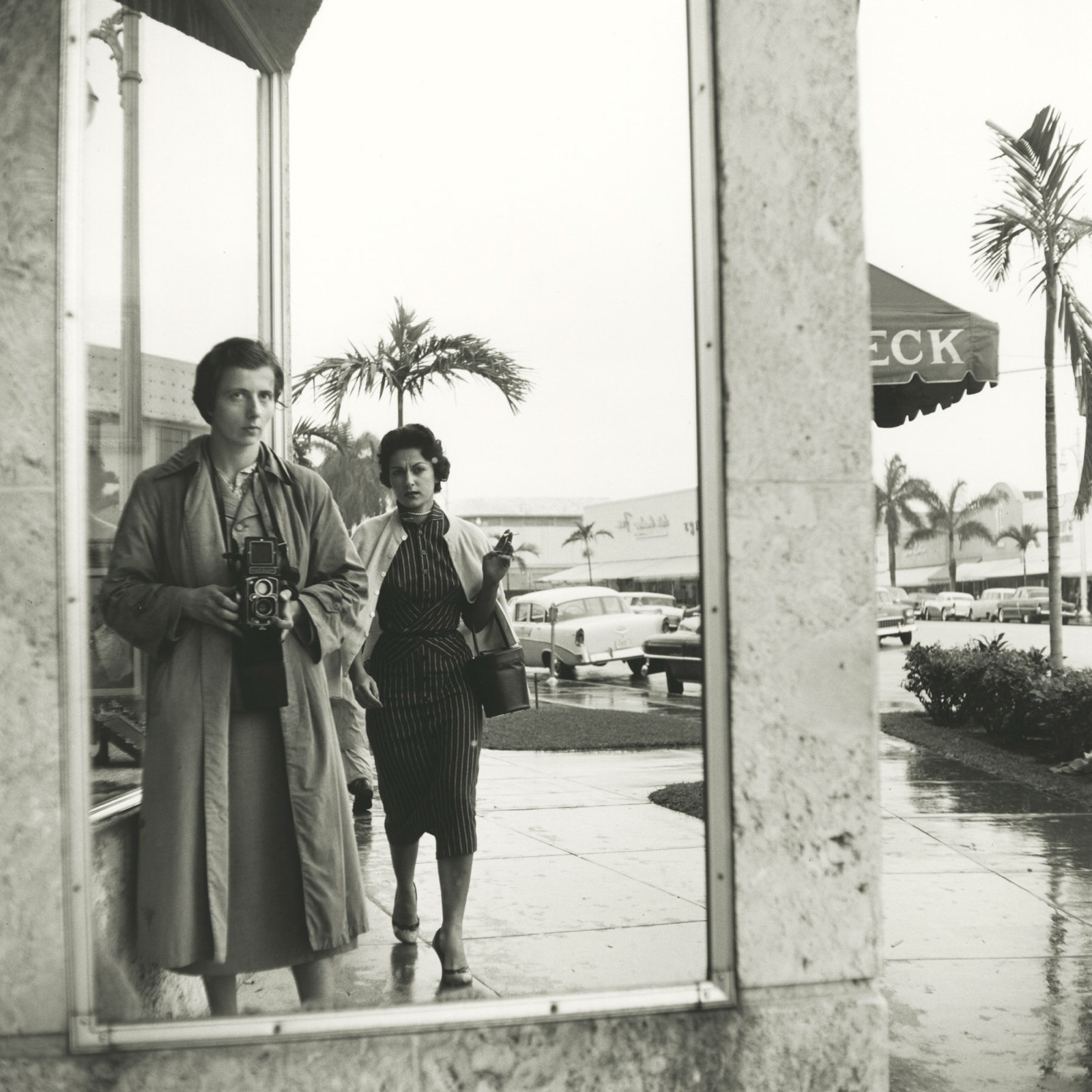
Two women share a single frame, but only one of them knows a picture is being made. Reflected in a corner shop window, Vivian Maier stands with her Rolleiflex held at her waist, steady and unsmiling, while a stylish stranger in a striped dress strides past against a backdrop of palms, wet pavement, and finned American cars. She made this self-portrait in the mid-1950s, and it is among the most quietly brilliant of the hundreds she left behind.
For four decades Maier photographed the American street for no one but herself, a nanny whose vast archive of more than 150,000 negatives surfaced only after her death in 2009. The self-portrait was her constant thread, made not from vanity but from a need to test her own presence in a world that barely registered her. Here the mirror does the work, folding watcher and watched into one composition. Because the twin-lens Rolleiflex is held at the waist and looked down into, she can gaze straight out at us while appearing to look modestly away, a sly double game of seeing and being seen that no other camera would allow. The wet pavement, the imported palms, and the chrome of the passing cars place her squarely in the sunlit ease of 1950s Florida, a world she studies coolly from behind the glass but never quite enters.
Her discovery, when the young collector John Maloof bought a box of her negatives at a Chicago auction in 2007, became one of the great stories in the history of the medium. Once entirely invisible, Maier now hangs in major institutions around the world and commands a devoted following. This reflection is the artist at her most self-aware, stepping into her own picture, on her own quiet terms, and claiming the place the world had denied her.