Archival pigment print mounted on aluminium Dibond.
One Size Only / 71.1 x 50.8 cm / 28 x 20 in
Hand-signed by the artist, with title, date, and edition number inscribed in ink on an archival label affixed to the reverse side of the mounted photograph
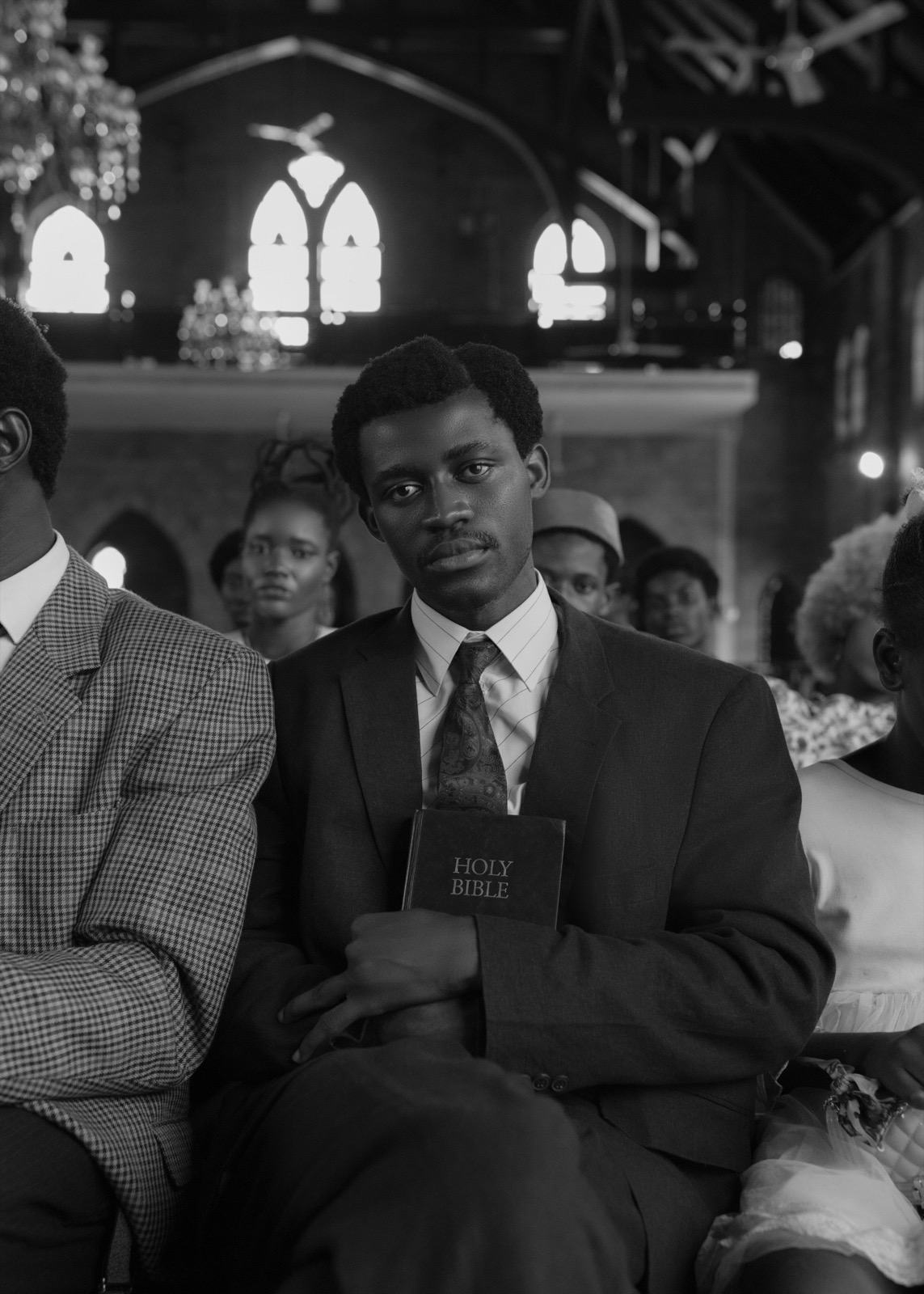
What he keeps from us is the book itself. The Bible is turned outward so the gilt words HOLY BIBLE face the lens, but his two hands are clamped flat across its cover, fingers interlaced, pressing it shut against the breastbone. We are shown the title and denied the text; the gesture offers and withholds at once. Whatever this young man is reading, or refusing to read, stays inside the closed boards he will not open for us.
This is staging in the fullest contemporary sense — the tableau built rather than caught. Idun-Tawiah constructs his scenes the way a director blocks a set, and here the architecture does half the work: the Gothic lancet windows blown to pure light behind the pews, the chandeliers softened into haloes, the rows of congregants compressed into shallow focus so that only the sitter resolves with full weight. He sits dead-centre in a grey suit and a paisley tie knotted slightly askew, the Sunday formality of a particular Accra modernity. The monochrome is a decision, not a default; it lifts the picture out of the present and into the register of remembered ceremony.
The face complicates the withholding. He looks straight back, level and unhurried, neither devout nor performing devotion — a guarded composure that keeps its own counsel while the closed Bible does the speaking. That tension between the offered title and the sealed pages, between the direct gaze and the protected object, is exactly where the work positions itself: portraiture as constructed image, the diasporic studio tradition restaged for the gallery wall. From the Ghanaian series that brought Idun-Tawiah to wide notice, this print belongs to a young practice already read as one of the most assured restagings of Black congregational life now being made.
What he keeps from us is the book itself. The Bible is turned outward so the gilt words HOLY BIBLE face the lens, but his two hands are clamped flat across its cover, fingers interlaced, pressing it shut against the breastbone. We are shown the title and denied the text; the gesture offers and withholds at once. Whatever this young man is reading, or refusing to read, stays inside the closed boards he will not open for us.
This is staging in the fullest contemporary sense — the tableau built rather than caught. Idun-Tawiah constructs his scenes the way a director blocks a set, and here the architecture does half the work: the Gothic lancet windows blown to pure light behind the pews, the chandeliers softened into haloes, the rows of congregants compressed into shallow focus so that only the sitter resolves with full weight. He sits dead-centre in a grey suit and a paisley tie knotted slightly askew, the Sunday formality of a particular Accra modernity. The monochrome is a decision, not a default; it lifts the picture out of the present and into the register of remembered ceremony.
The face complicates the withholding. He looks straight back, level and unhurried, neither devout nor performing devotion — a guarded composure that keeps its own counsel while the closed Bible does the speaking. That tension between the offered title and the sealed pages, between the direct gaze and the protected object, is exactly where the work positions itself: portraiture as constructed image, the diasporic studio tradition restaged for the gallery wall. From the Ghanaian series that brought Idun-Tawiah to wide notice, this print belongs to a young practice already read as one of the most assured restagings of Black congregational life now being made.