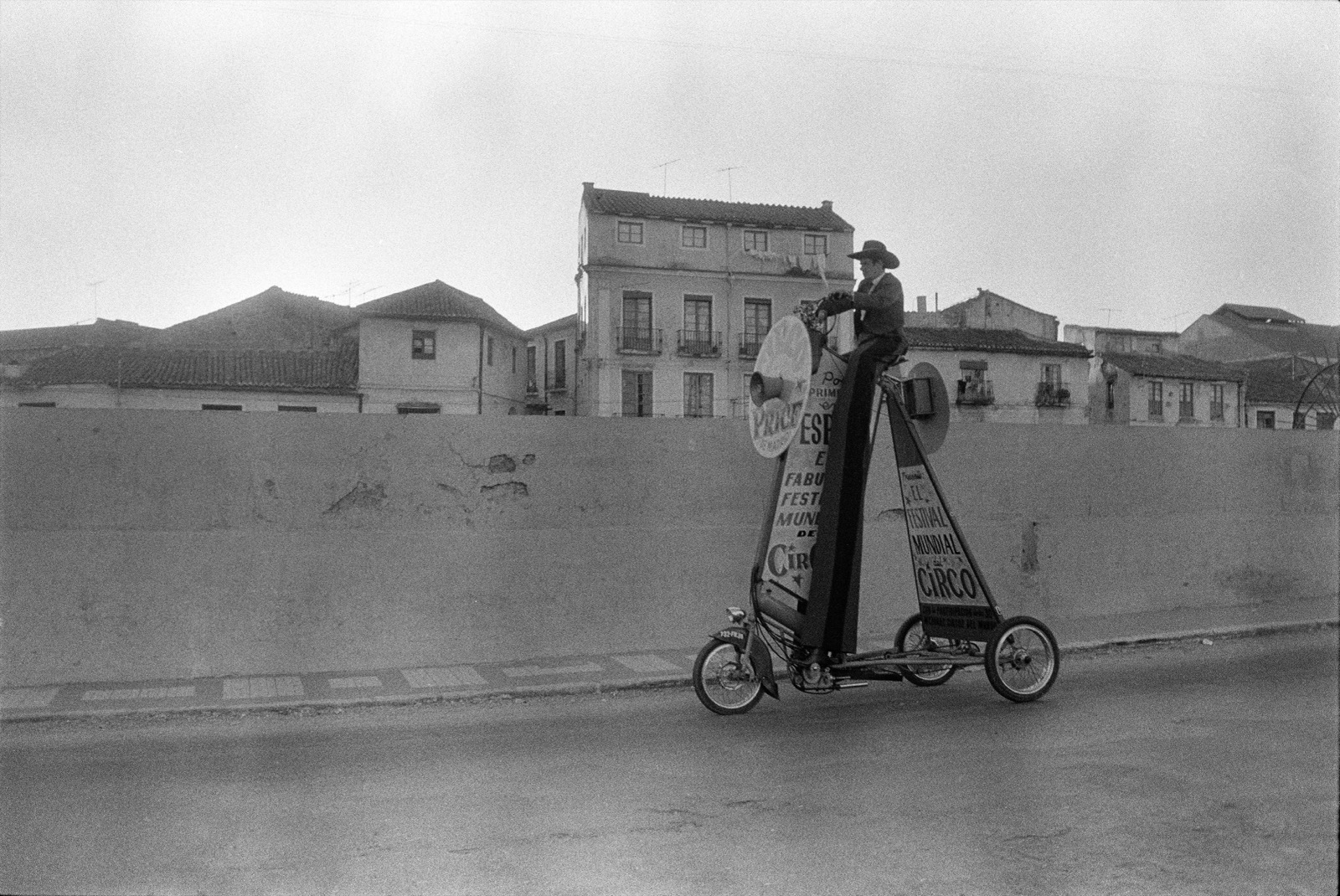
The contraption is the whole event: a tall, spindly three-wheeler stacked into a kind of rolling tower, its placards crying El Festival Mundial del Circo while a man in a flat-brimmed hat sits absurdly high at the top, steering a circus down an ordinary street. Meyerowitz has done the sensible thing and the funny thing at once. He waits until the rider crosses the open road in clean profile, so the rig reads flat against the sky like a billboard that has learned to walk, and he sets the lens low enough that the whole improbable stack clears the wall behind it. The picture works because the camera describes the machine plainly and lets the strangeness arrive on its own.
What holds it together is the wall. A long band of pale concrete runs the width of the frame, capped by the tile roofs of Malaga's houses, and against that patient horizontal the vertical circus tower becomes a small comedy of proportion—too tall, too narrow, going nowhere fast. The road in the foreground is empty; the diagonal of the curb pushes the rider gently to the left, where there is room for him to keep traveling out of the picture. Nothing is staged. The man simply happened to be advertising a circus, and Meyerowitz happened to be looking with the right economy.
This is early work, made in black and white during the European travels of the mid-sixties, before the color pictures that would remake his reputation. Already the eye is sure: the willingness to let an odd fact in the street carry the frame, the formal calm under the joke. It is a photograph about how a flat gray morning can hold one preposterous, upright thing and make you believe it.
The contraption is the whole event: a tall, spindly three-wheeler stacked into a kind of rolling tower, its placards crying El Festival Mundial del Circo while a man in a flat-brimmed hat sits absurdly high at the top, steering a circus down an ordinary street. Meyerowitz has done the sensible thing and the funny thing at once. He waits until the rider crosses the open road in clean profile, so the rig reads flat against the sky like a billboard that has learned to walk, and he sets the lens low enough that the whole improbable stack clears the wall behind it. The picture works because the camera describes the machine plainly and lets the strangeness arrive on its own.
What holds it together is the wall. A long band of pale concrete runs the width of the frame, capped by the tile roofs of Malaga's houses, and against that patient horizontal the vertical circus tower becomes a small comedy of proportion—too tall, too narrow, going nowhere fast. The road in the foreground is empty; the diagonal of the curb pushes the rider gently to the left, where there is room for him to keep traveling out of the picture. Nothing is staged. The man simply happened to be advertising a circus, and Meyerowitz happened to be looking with the right economy.
This is early work, made in black and white during the European travels of the mid-sixties, before the color pictures that would remake his reputation. Already the eye is sure: the willingness to let an odd fact in the street carry the frame, the formal calm under the joke. It is a photograph about how a flat gray morning can hold one preposterous, upright thing and make you believe it.