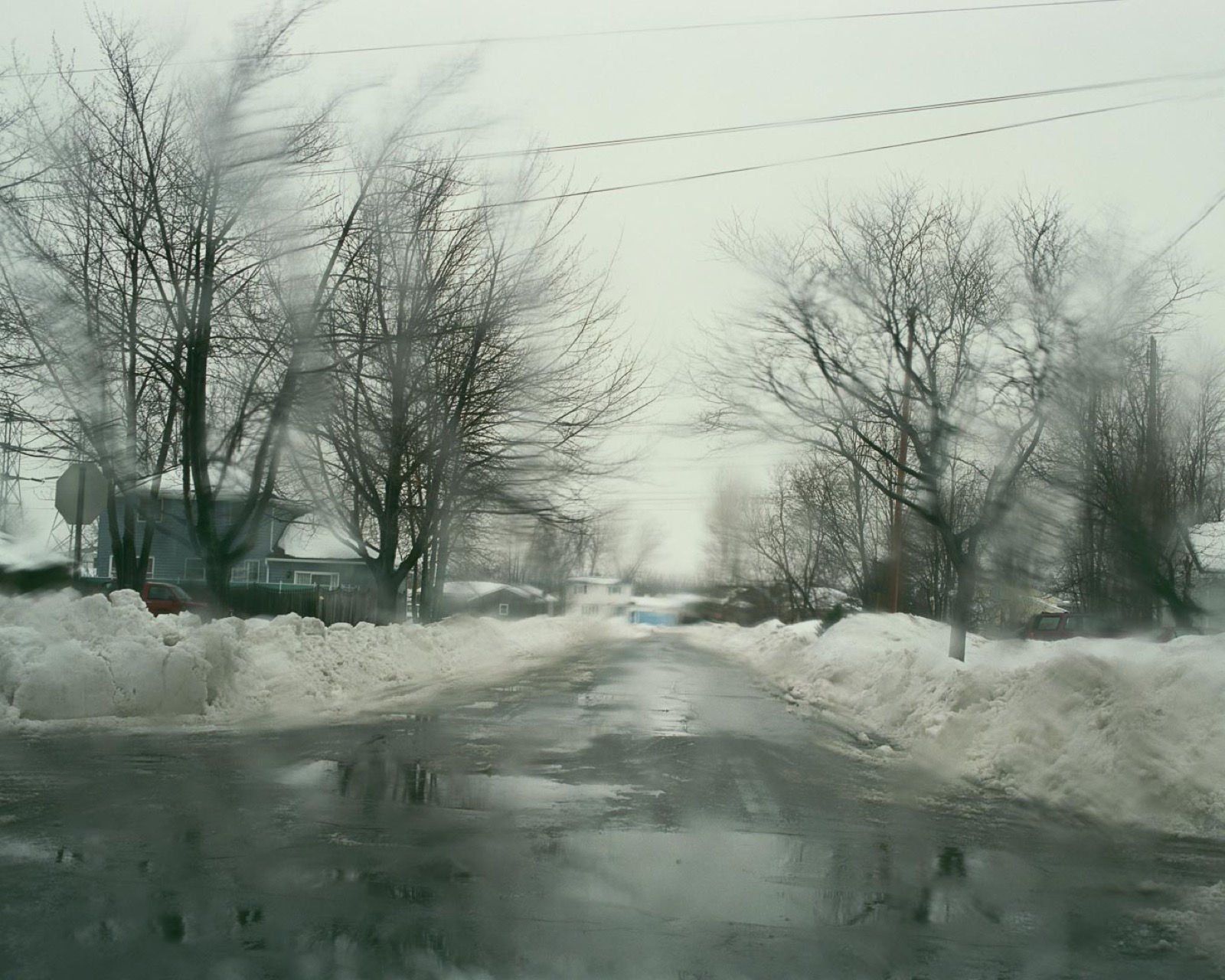
In the last winters of the twentieth century, when American photography had largely traded the road trip for the studio, Todd Hido was still driving, and this is what driving looked like: a plowed street somewhere in the snow belt, banks of dirty snow shouldering both curbs, a blue house and a red pickup holding the left edge, and a stop sign turning its blank back to us.
He photographed through the windshield, and the glass, streaked with melt, does what pictorialist lenses once did: the bare trees smear sideways as if drawn in wet ink, the power lines stay improbably sharp, and the whole scene settles into a narrow register of grey-green that a printer would recognize as the hardest range to hold. A century earlier Stieglitz stood in the slush of Fifth Avenue waiting for a blizzard to organize the street; here the storm has already passed, the plows have been through, and what is left is aftermath, the least heroic weather there is. The picture’s warmth is in its refusals: no figure, no incident, only the street’s long recession toward houses that keep their own counsel.
Hido’s road landscapes have entered SFMOMA, the Getty and the Whitney, and this archival pigment print shows why the medium suits them: pigment holds those close grey intervals steady without letting them go dead on the wall. He numbers his pictures rather than naming them, an archivist’s habit; the effect is that each one, like this street, must speak entirely for itself, and this one does.

In the last winters of the twentieth century, when American photography had largely traded the road trip for the studio, Todd Hido was still driving, and this is what driving looked like: a plowed street somewhere in the snow belt, banks of dirty snow shouldering both curbs, a blue house and a red pickup holding the left edge, and a stop sign turning its blank back to us.
He photographed through the windshield, and the glass, streaked with melt, does what pictorialist lenses once did: the bare trees smear sideways as if drawn in wet ink, the power lines stay improbably sharp, and the whole scene settles into a narrow register of grey-green that a printer would recognize as the hardest range to hold. A century earlier Stieglitz stood in the slush of Fifth Avenue waiting for a blizzard to organize the street; here the storm has already passed, the plows have been through, and what is left is aftermath, the least heroic weather there is. The picture’s warmth is in its refusals: no figure, no incident, only the street’s long recession toward houses that keep their own counsel.
Hido’s road landscapes have entered SFMOMA, the Getty and the Whitney, and this archival pigment print shows why the medium suits them: pigment holds those close grey intervals steady without letting them go dead on the wall. He numbers his pictures rather than naming them, an archivist’s habit; the effect is that each one, like this street, must speak entirely for itself, and this one does.