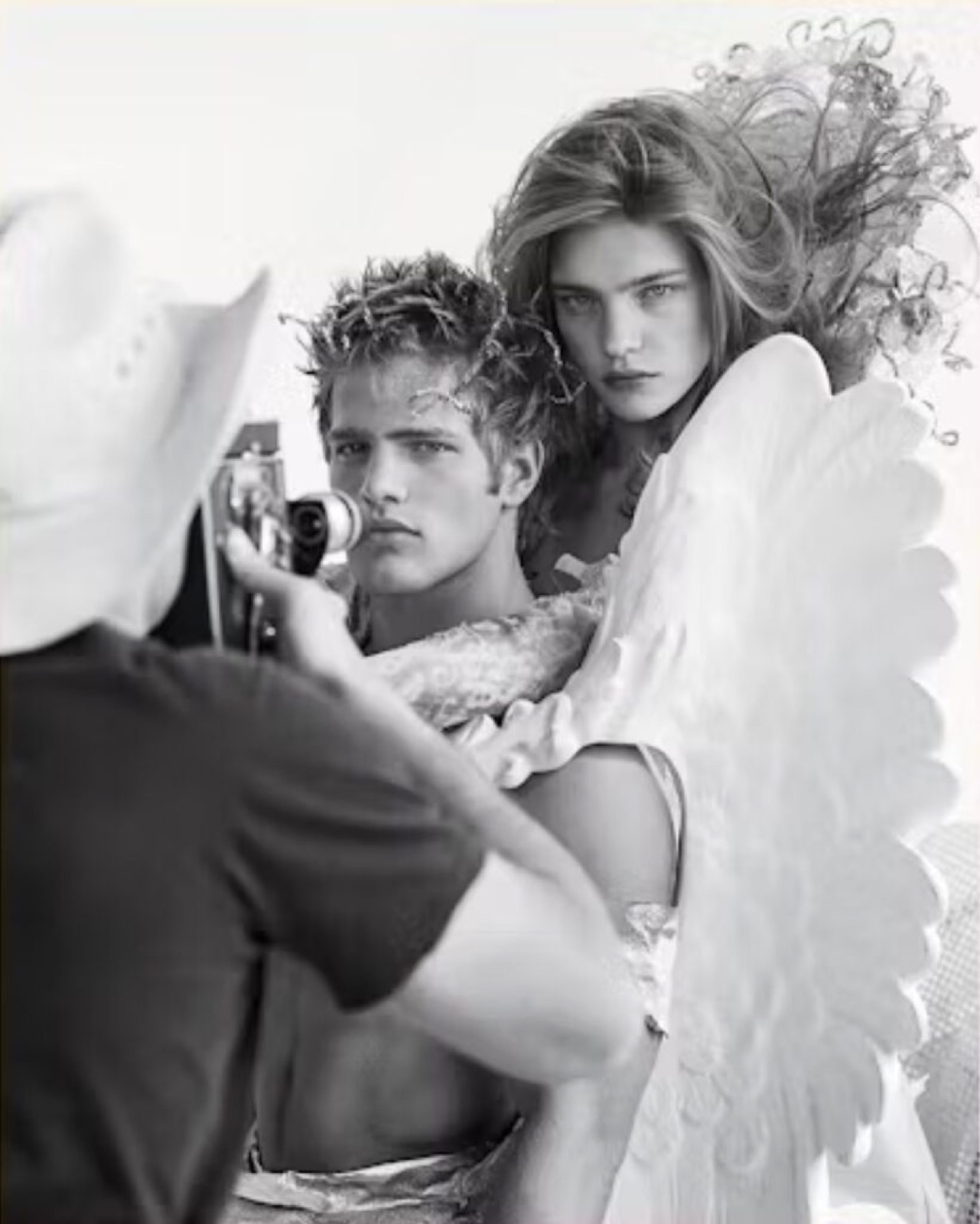
A single strand of Vodianova’s hair has escaped the wind and drawn a dark loop against the white ground, and once you notice it the whole photograph reorganizes around such filaments: the boy’s damp forelock, the frayed rim of a feather, the fine cable at the movie camera. Bruce Weber has photographed a filming. In the near foreground, his back to us, a man in a dark shirt and soft white hat lifts a compact motion-picture camera toward Joseph Sayers and Natalia Vodianova, who lean close, cheek near shoulder, and stare past that lens toward the still camera that holds them.
The tonal range is the argument. Weber lets the background burn to almost nothing, so the two faces surface out of light with their edges half-dissolved; the great white wing strapped to Vodianova’s back reads less as costume than as a mass of graded grays, each scalloped feather a separate value. Little is sharp except the eyes and the small lens between them. This is a picture about being watched from two directions at once, composed and candid in a single breath.
Weber, who gave the American fashion photography of his era its sun-warmed, athletic idiom, was rarely more himself than when the shoot itself became the subject. This gelatin silver print keeps that doubling in its grain: continuous tone, deep blacks earned in the darkroom, whites held open rather than bleached. It records a commercial afternoon, a music video, a New York studio, and recovers it as portraiture, two young faces and a wing fixed in metal salts while a movie quietly ran.

A single strand of Vodianova’s hair has escaped the wind and drawn a dark loop against the white ground, and once you notice it the whole photograph reorganizes around such filaments: the boy’s damp forelock, the frayed rim of a feather, the fine cable at the movie camera. Bruce Weber has photographed a filming. In the near foreground, his back to us, a man in a dark shirt and soft white hat lifts a compact motion-picture camera toward Joseph Sayers and Natalia Vodianova, who lean close, cheek near shoulder, and stare past that lens toward the still camera that holds them.
The tonal range is the argument. Weber lets the background burn to almost nothing, so the two faces surface out of light with their edges half-dissolved; the great white wing strapped to Vodianova’s back reads less as costume than as a mass of graded grays, each scalloped feather a separate value. Little is sharp except the eyes and the small lens between them. This is a picture about being watched from two directions at once, composed and candid in a single breath.
Weber, who gave the American fashion photography of his era its sun-warmed, athletic idiom, was rarely more himself than when the shoot itself became the subject. This gelatin silver print keeps that doubling in its grain: continuous tone, deep blacks earned in the darkroom, whites held open rather than bleached. It records a commercial afternoon, a music video, a New York studio, and recovers it as portraiture, two young faces and a wing fixed in metal salts while a movie quietly ran.