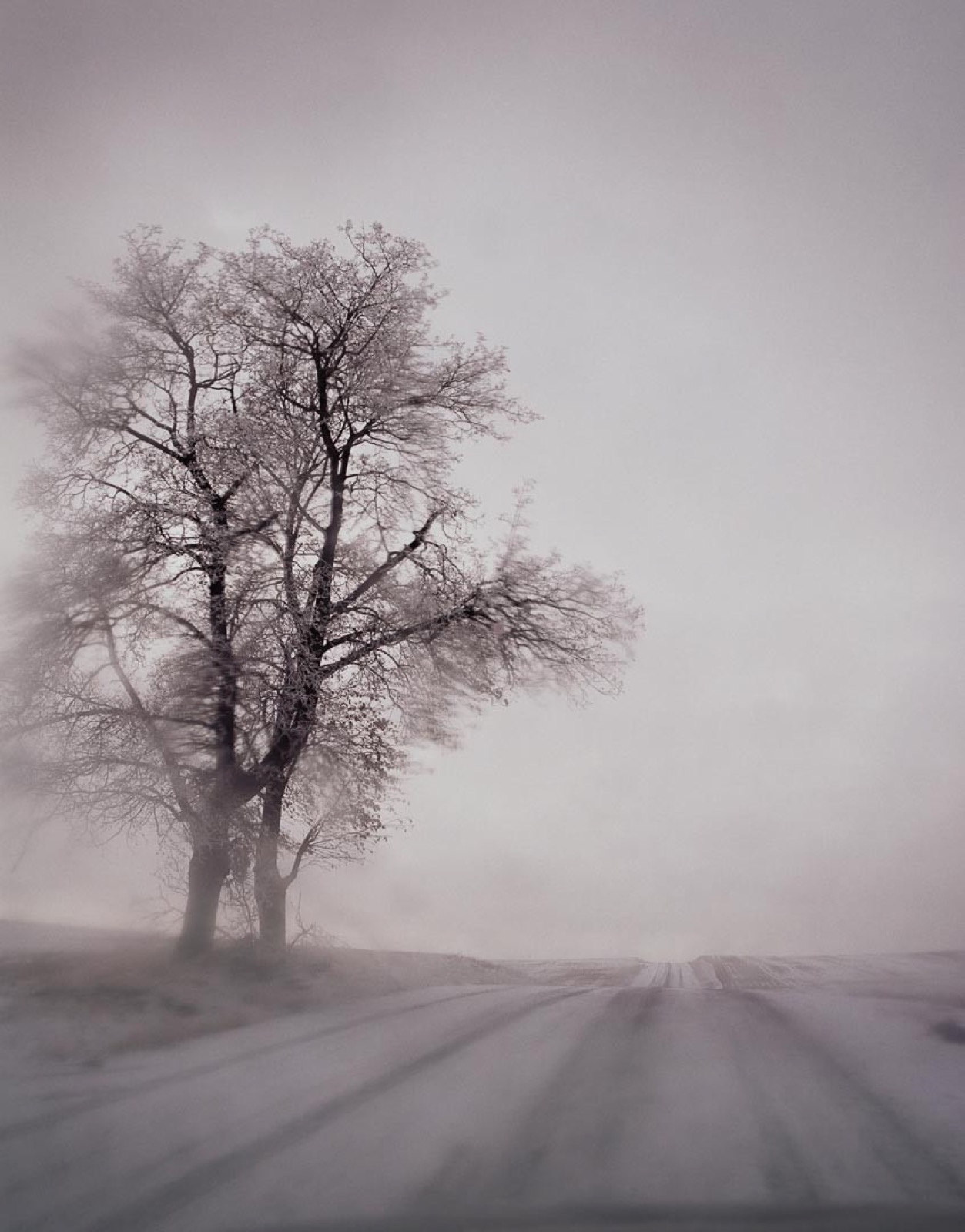
How much can a photograph surrender to weather and still hold together? Here almost everything dissolves. A single bare tree, really two trunks grown together, leans at the left against a white void; a road climbs past it into blowing snow and simply vanishes. The tonality is barely more than mauve-grey laid over grey, a monochrome pushed to the threshold of legibility, the storm quietly eating the edges of the visible world.
The picture descends from an old pictorial impulse — the soft, atmospheric print that treats the photograph as a made, handled thing rather than a merely transparent record — and Hido revives it without a trace of irony. Snow has always been a gift to photographers because it turns the visible world into blank paper, and this frame is largely paper: the tree a smudge of graphite, the tire tracks in the road a faint grey pressure, the horizon a rumor.
Held as an archival pigment print on Dibond, the object has a quiet physicality; the near-white expanse asks to be read as surface at least as much as scene. Part of Excerpts from Silver Meadows, it belongs to Hido's mythology of an American back-country winter, half-remembered and half-invented, closer to a mood than to a fact. The photograph keeps only what the eye keeps in a whiteout: one dark shape, and the road going on past it.

How much can a photograph surrender to weather and still hold together? Here almost everything dissolves. A single bare tree, really two trunks grown together, leans at the left against a white void; a road climbs past it into blowing snow and simply vanishes. The tonality is barely more than mauve-grey laid over grey, a monochrome pushed to the threshold of legibility, the storm quietly eating the edges of the visible world.
The picture descends from an old pictorial impulse — the soft, atmospheric print that treats the photograph as a made, handled thing rather than a merely transparent record — and Hido revives it without a trace of irony. Snow has always been a gift to photographers because it turns the visible world into blank paper, and this frame is largely paper: the tree a smudge of graphite, the tire tracks in the road a faint grey pressure, the horizon a rumor.
Held as an archival pigment print on Dibond, the object has a quiet physicality; the near-white expanse asks to be read as surface at least as much as scene. Part of Excerpts from Silver Meadows, it belongs to Hido's mythology of an American back-country winter, half-remembered and half-invented, closer to a mood than to a fact. The photograph keeps only what the eye keeps in a whiteout: one dark shape, and the road going on past it.