We live now in the aftermath of the color photograph, when saturation itself has become a subject, and this fuchsia room is a monument to that fact. A woman stands inside a cube painted entirely pink, floor and walls a single unbroken rose, holding aloft a sheet of sheer chiffon that catches the light like a sail. She wears a transparent pink slip over black, pointed satin heels below. I take in the spectacle whole, and then my eye is caught elsewhere.
On the floor, low in the right corner, sits a small television, switched on, its screen glowing a cold electric blue, the one thing in the frame not obeying the pink. That blue rectangle changes everything. It introduces time into a scene that had seemed suspended, a broadcast humming to itself while the model performs her stillness above. Suddenly the pink reads as a set, the woman as an image being made, and the little screen as a rival image, indifferent, already elsewhere. The coiled black cable opposite answers it like a stray thought.
Yeste, long a leading figure in Spanish fashion photography and a presence in Numéro, Harper’s Bazaar and Vogue, understands that pure color can be as elemental as fire or water, and here he floods a whole architecture with it. The archival pigment print is what makes the gamble hold, sustaining that impossible pink across walls and cloth and shoe without a single flat patch, while letting the television keep its cool blue secret. One leaves the picture certain the set is still humming, the screen still lit.
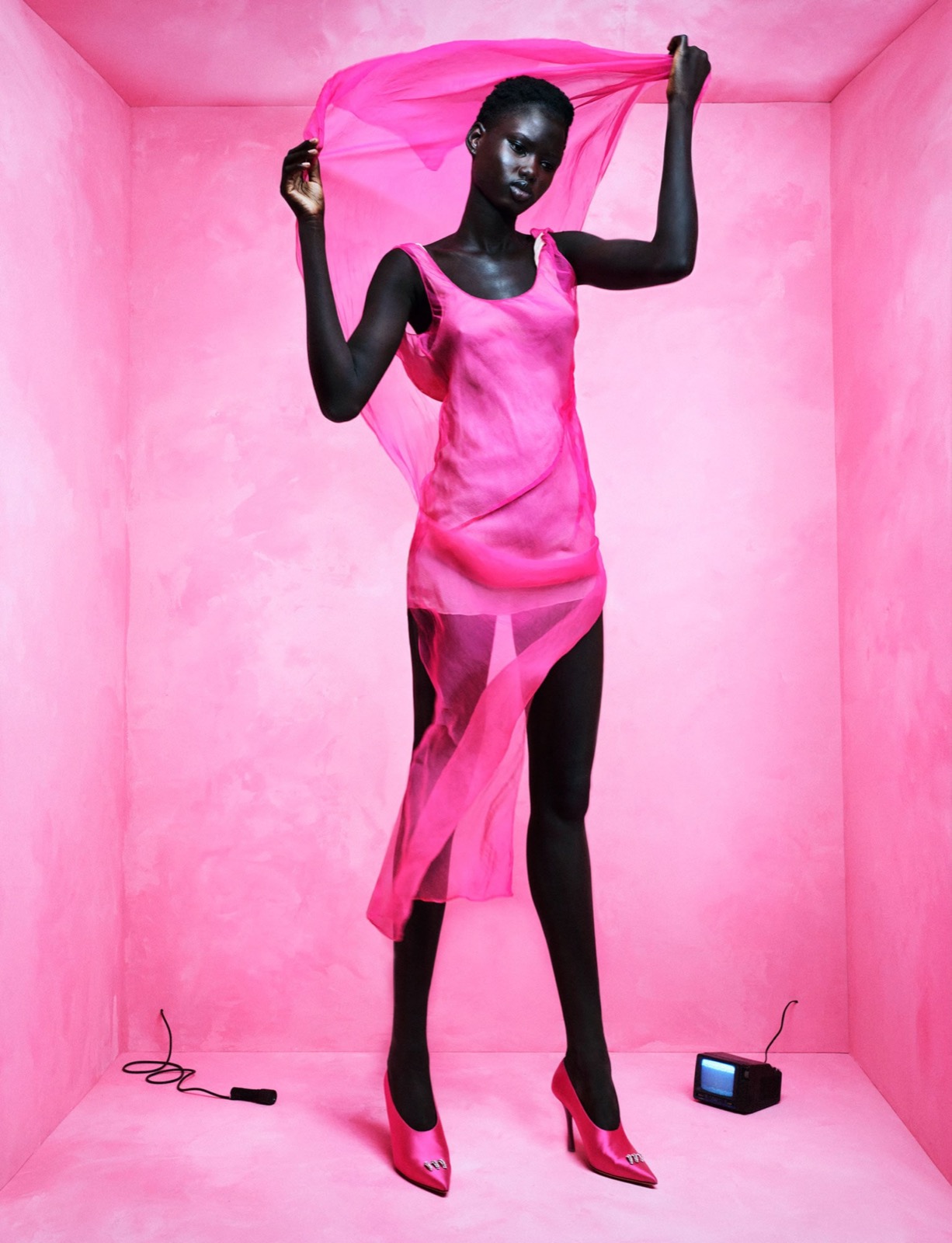

We live now in the aftermath of the color photograph, when saturation itself has become a subject, and this fuchsia room is a monument to that fact. A woman stands inside a cube painted entirely pink, floor and walls a single unbroken rose, holding aloft a sheet of sheer chiffon that catches the light like a sail. She wears a transparent pink slip over black, pointed satin heels below. I take in the spectacle whole, and then my eye is caught elsewhere.
On the floor, low in the right corner, sits a small television, switched on, its screen glowing a cold electric blue, the one thing in the frame not obeying the pink. That blue rectangle changes everything. It introduces time into a scene that had seemed suspended, a broadcast humming to itself while the model performs her stillness above. Suddenly the pink reads as a set, the woman as an image being made, and the little screen as a rival image, indifferent, already elsewhere. The coiled black cable opposite answers it like a stray thought.
Yeste, long a leading figure in Spanish fashion photography and a presence in Numéro, Harper’s Bazaar and Vogue, understands that pure color can be as elemental as fire or water, and here he floods a whole architecture with it. The archival pigment print is what makes the gamble hold, sustaining that impossible pink across walls and cloth and shoe without a single flat patch, while letting the television keep its cool blue secret. One leaves the picture certain the set is still humming, the screen still lit.